
Solid-State Switching
With CoolSiC™ JFETs, lnfineon introduces a new kind of switching device for power distribution systems that cannot afford delays
When an electrical circuit is overloaded, you expect a circuit breaker to respond immediately and reliably. However, in today’s fast-moving, electrified systems, such as electric trucks, Al data centres and modern industrial manufacturing plants, ‘immediately’ is no longer fast enough. Every microsecond counts, and standard protective devices such as fuses, relays, and moulded case circuit breakers simply cannot keep up in the rapidly growing world of AC and DC power systems. They were designed for a different era when millisecond response times were fast enough. But now they lack the speed, precision, and intelligence that today’s systems demand, and this can have serious consequences.

This assumes a larger relevance for countries like India where large investments in areas like renewable energies, servers, data centres and electromobility will work as growth drivers in the long term. As these power supply systems are becoming faster, more compact and increasingly software-defined, mechanical protection methods are struggling to keep up. This is a disaster for today’s highly electrified world, where every microsecond counts and reliability, speed, and safety are more important than ever. Latest safety systems like Solid State Circuit Breakers (SSCB), e- Fuses and Solid-state battery disconnect switches help to solve these problems to a large extent by offering quick response time compared to their mechanical variants.
lnfineon’s newly launched family of high voltage CoolSiC” JFETs helps engineers to design such highly reliable safety systems to meet modern system demands and respond to faults instantly and reliably.
Take a modern electric truck, for example: if a fault occurs during high-speed charging or rapid acceleration and the device isn’t disconnected quickly, critical components can overheat, potentially damaging power electronics or even causing a fire. Similarly. in an Al data centre, if a short circuit occurs on a power bus and isn’t quickly isolated, an entire rack can be crippled, resulting in data loss, downtime and expensive hardware damage.
These examples illustrate how vulnerable modern systems have become to electrical faults, especially now that vehicles, factories, and data infrastructures are becoming increasingly electrified, compact, and complex. This shift places new demands on power distribution systems: higher voltages, faster protection, and significantly tighter safety margins.
Alternatives with flaws
Solid-state protection devices based on MOSFETs are already available on the market and have addressed many shortcomings of mechanical switches, such as contact wear, slow reaction times, and imprecise thresholds. But they also have their limits, especially in high-voltage or high-current applications.
Even silicon carbide (SiC) MOSFETs can’t fully close the gap when it comes to robustness under fault conditions or sustained operation in linear mode, although they offer overall better switching performance, higher efficiency, and improved thermal characteristics compared to silicon MOSFETs. Their relatively high on-resistance (RDS‹ONo›)ften requires larger devices, driving up both cost and complexity.

To manage the resulting thermal load or enable higher current levels, designers must resort to parallelizing multiple devices, which requires deep product and system expertise.
Furthermore, limitations in avalanche robustness and linear mode stability constrain the
SiC MOSFETs’fault-handling capabilities under extreme conditions like pre-charging or un-clamped inductive switching. These constraints force engineers to compromise rather than deploying an optimal solution — trading speed for safety, or efficiency for design simplicity. But in modern systems where fault isolation must happen as fast and reliably as possible, these trade-offs aren’t just inconvenient, they’re potential points of failure.
For the next generation of applications like solid-state circuit breakers (SSCBs), battery disconnect switches, and hot-swap E-fuses in Al data centres, system designers need something more: a technology that combines ultra-low RDS(OtNh)e,rmal stability in linear mode, and robust avalanche behaviour to ensure fast, safe and reliable performance under harsh conditions.
Built to Protect
To overcome the limitations of mechanical protection devices and to extend the capabilities of solid-state switches, lnfineon has developed a new type of discrete switching device: the CoolSiC™ JFET technology ( see figure 1 ). The device is based on a purely vertical trench structure that minimises conduction losses and keeps electrical performance stable, even under changing load conditions. MOSFET-based solutions often require larger cooling elements or derating to stay within safe limits. In contrast, the CoolSiC™ JFETs maintains its efficiency across a wide load range, including continuous line operation as found in electric vehicle battery disconnects or server power distribution.
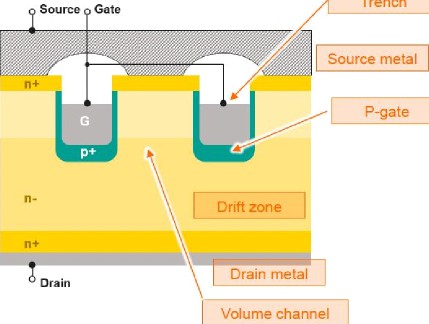
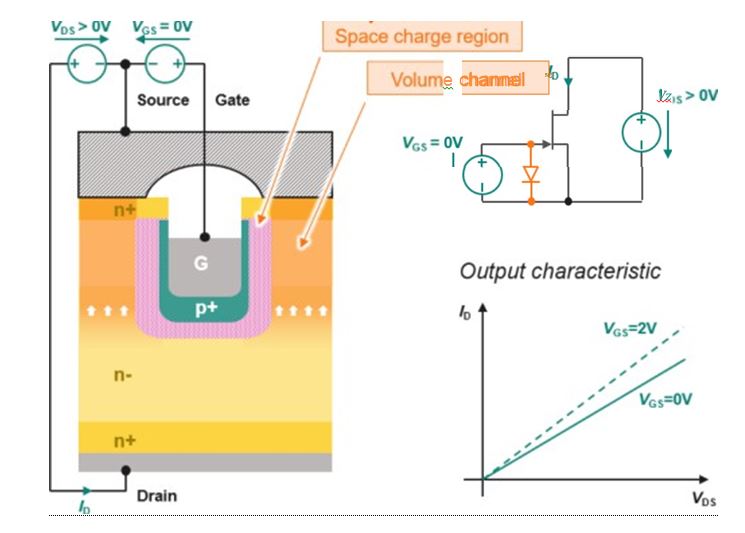
One reason for this efficiency is how the JFET device conducts current. Unlike SiC MOSFETs, which rely on a thin surface-level n-channel, the JFET allows current to flow through the entire volume of the semiconductor. Because of this bulk conduction, JFETs are normally on, resulting in reduced channel resistance (see figure 3). While the drift region — which blocks voltage — limits both device types similarly, JFETs benefit from lower resistance in the channel itself. As a result, they achieve lower overall RDS(ON) r the same chip size, which keeps systems cooler and translates to better efficiency in high-voltage designs.
Another important characteristic is the device’s avalanche ruggedness. In fault scenarios such as short circuits or overloads, the JFET responds quickly and consistently, handling sudden voltage spikes and current surges. This fast reaction helps prevent equipment failure and mitigates risk to the system. Because the JFET can absorb high energy internally, it eliminates the need for elaborate external clamping circuits, which simplifies the overall protection scheme. The result: a more compact, cost-effective, and robust design.
Though naturally a normally ON device, the JFET can be combined with a low-voltage silicon MOSFET in a cascode configuration to behave like a normally off switch (see figure 4). This setup provides the benefits of JFET conduction and ruggedness, as well as the control characteristics of MOSFETs. This offers not only reliable and predictable switching behaviour but also essential features for applications like solid-state breakers or industrial protection switches. It also gives designers the flexibility to implement the device into existing control architectures with minimal changes.
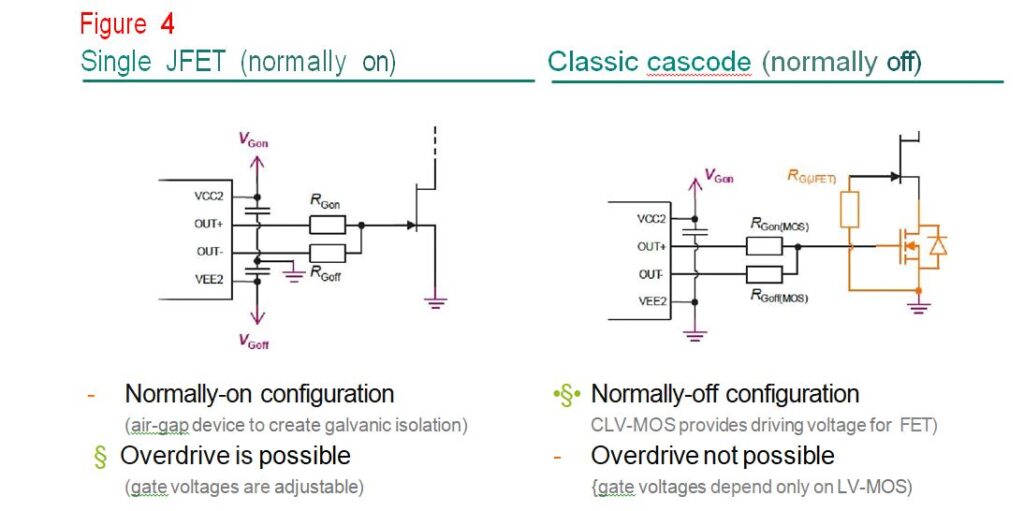
behaves like a normally off device
However, other combinations are also possible, for example for systems that require bidirectional current flow, such as battery disconnect switches or AC protection devices. In this case, bidirectionality can be achieved by connecting two JFETs in a source-to-source configuration. This also increases design flexibility and facilitates the integration of the device into complex architectures.
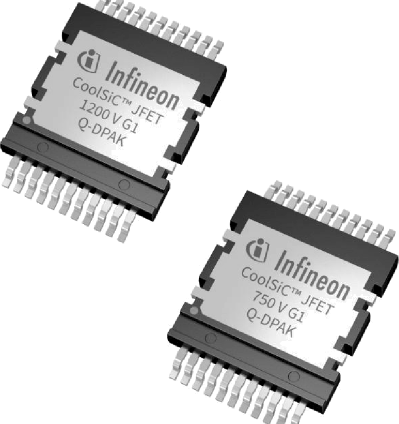
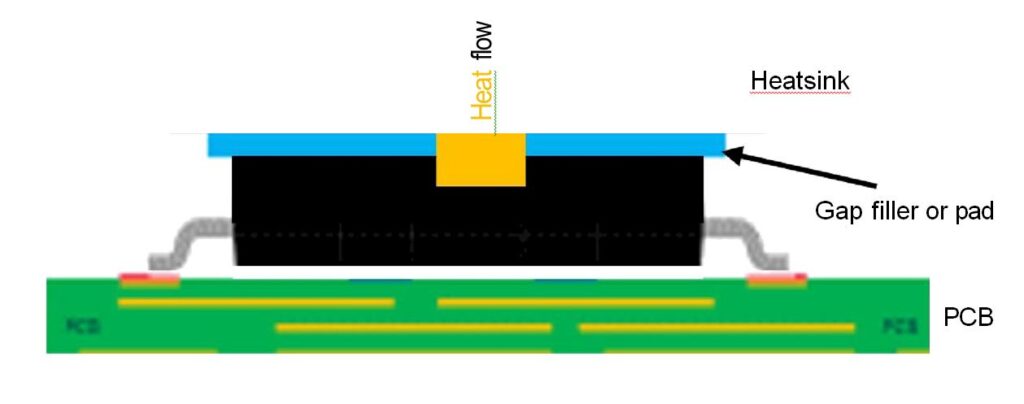
Equally important is the device’s packaging. The use of a g-DPAK surface-mount package with top- side cooling allows for efficient heat extraction away from the die (see figure 5). This simplifies heat management and helps achieve higher power density, particularly in applications where space and cooling capabilities are limited. lnfineon’s XT interconnect technology further supports transient thermal performance to handle demanding load cycling, ensuring long-term reliability even in harsh environments.
In short, CoolSiC™ JFETs offer a powerful combination of system simplicity, efficiency, and reliability, especially in designs where space is at a premium and response times are critical. What’s more, lnfineon plans to expand the portfolio with additional package and module options to cover a broader range of applications and current ratings. For engineers developing the next generation of electrified systems, these devices represent an opportunity to rethink protection methods at the speed which modern systems demand, and to make power distribution ready for what’s next.
To know more, scan below: