


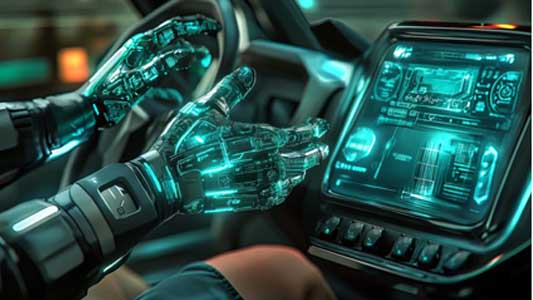
The automotive industry stands at a defining moment. How vehicles process information and make decisions is undergoing a transformation that will separate tomorrow’s leaders from those left behind. Edge AI in vehicles, where artificial intelligence runs directly on in-vehicle hardware rather than remote cloud servers, isn’t just another technology trend. It’s the competitive battleground that will determine which companies control the intelligence layer and capture recurring revenue in the software-defined era.
Modern vehicles generate up to 25 gigabytes of data per hour from cameras, radar, lidar, and sensors. Yet the critical question isn’t how much data you collect, it’s where you process it, how fast you act on it, and who owns the intelligence. Processing this data efficiently while maintaining millisecond-level response times for safety-critical functions requires comprehensive vehicle software platforms like Sonatus that enable edge AI lifecycle management at scale. This article explores what edge AI truly means for competitive positioning, why forward-thinking OEMs are racing to deploy it, and the strategic imperatives for scaling deployment before the window for advantage closes.
What Is Edge AI in Vehicles?
Edge AI refers to deploying artificial intelligence models and data processing directly on local hardware—in-vehicle electronic control units (ECUs), domain controllers, or gateways—rather than relying exclusively on centralized cloud infrastructure.
In automotive applications, vehicles perform real-time inference and decision-making without constantly communicating with remote servers. A driver monitoring system detecting drowsiness in under 50 milliseconds and triggering alerts instantly, impossible with cloud processing that introduces 100-200ms of latency, exemplifies why architecture matters more than raw computing power.
Edge AI vs. Cloud AI
Cloud-based AI involves transmitting vehicle data to remote data centers for processing, then returning results to the vehicle. While cloud computing remains essential for intensive model training and fleet-wide analytics, it introduces critical limitations: latency delays that prevent real-time response, connectivity dependency that creates service gaps, and privacy concerns that increase regulatory exposure.
Edge AI addresses these by enabling vehicles to operate as distributed computing platforms, capable of sensing, analyzing, deciding, and acting independently. This architectural shift is foundational to the software-defined vehicle (SDV) vision and will determine which companies can deliver experiences that command premium pricing.
Why the Automotive Industry Is Embracing Edge AI
Several converging forces are creating a widening gap between early movers and those still debating architecture:
- Real-Time Decision Making: Advanced driver assistance systems (ADAS), autonomous driving, and collision avoidance require response times in milliseconds. Predictive maintenance algorithms can detect bearing wear and adjust vehicle behavior before component failure. Cloud-dependent systems simply cannot compete where latency equals liability.
- Data Growth and Bandwidth Constraints: Autonomous vehicle prototypes can generate up to 4 terabytes of data daily. Transmitting everything to the cloud is economically untenable. Edge AI reduces data transmission costs by up to 80% by performing local filtering and inference. This cost advantage compounds across millions of vehicles over 10-15 year lifecycles.
- Privacy Regulations: While automotive software architecture standards like AUTOSAR have been in place since before AI, the industry standards now must include cybersecurity. When AI processes cabin camera footage or biometric data locally, exposure to data breaches decreases significantly. Edge AI implements “data minimization” principles—processing sensitive information in-vehicle and transmitting only anonymized insights. This isn’t just compliance; it’s a competitive advantage as regulations tighten globally.
- Software-Defined Vehicle Imperative: The industry’s future depends on software-defined vehicles, where value creation shifts to continuous updates and capability enhancements. Edge AI enables vehicles to evolve post-production through distributed computing and rapid feature deployment. Without it, the software-defined promise remains theoretical while competitors deliver tangible value.
Core Benefits of In-Vehicle Edge AI
Real-Time Intelligence: Vehicles adapt instantly to changing conditions. Driver monitoring continuously analyzes gaze direction and eyelid closure to detect distraction without delay. Predictive diagnostics identify developing faults days before traditional codes appear. This responsiveness creates measurable differentiation that customers experience every drive.
Enhanced Privacy: By processing data locally, vehicles minimize raw sensor feed transmission, reducing breach exposure and simplifying regulatory compliance. For OEMs, this means decreased liability risk, a strategic advantage as consumer trust becomes a purchase criterion.
Scalability and Feature Velocity: Edge AI architectures enable rapid over-the-air deployment of new features and models, essential for competing in the SDV era. Automakers continuously improve capabilities rather than waiting for model year updates, maintaining relevance in a market where software determines value.
Cost Efficiency: Reducing reliance on continuous connectivity lowers operational costs. Local inference eliminates per-vehicle data transmission fees and reduces cloud computing expenses, savings that compound significantly across fleets.
Competitive Differentiation: Responsive edge AI delivers superior experiences through advanced personalization and autonomous features, enabling new revenue streams through subscription services and premium feature tiers that cloud-dependent architectures cannot match.
Real-World Edge AI Applications
Edge AI is already powering production vehicle features that demonstrate the strategic gap opening between leaders and followers:
Driver Monitoring Systems: Computer vision models detect distraction or drowsiness and trigger graduated alerts, from gentle chimes to active lane-keeping intervention, all processed locally with zero latency.
Predictive Maintenance: Machine learning analyzes sensor data to predict component failures. One major OEM reported a 40% reduction in unexpected breakdowns using edge-based diagnostics, translating directly to customer satisfaction and warranty cost reduction.
Intelligent Energy Management: Electric vehicles optimize battery usage based on driving patterns and terrain prediction, extending range by 10-15% compared to static strategies. This performance advantage becomes a tangible differentiator in purchase decisions.
Personalization Engines: Vehicles recognize drivers through biometric authentication, automatically adjusting settings within seconds, all processed locally without cloud dependency or privacy concerns.

Implementation Challenges and Solutions
Hardware Constraints: Vehicle ECUs operate under strict power and cost constraints. Solution: Model compression techniques like pruning and quantization reduce AI model size by 80-90% with minimal accuracy loss. Purpose-built automotive AI processors from NVIDIA, Qualcomm, and others enable efficient deployment within existing budgets.
Model Lifecycle Management: Managing AI across distributed fleets introduces complexity that can paralyze organizations lacking proper infrastructure. Solution: Comprehensive MLOps platforms designed for automotive provide centralized management, automated deployment pipelines, A/B testing, and fail-safe rollback mechanisms.
Legacy Architecture Integration: Most manufacturers face heterogeneous architectures with legacy ECUs. Solution: Abstraction layers and middleware platforms enable edge AI deployment across diverse hardware without complete architecture overhauls, accelerating time-to-market.
Safety and Security: Edge AI potentially expands attack surfaces. Solution: Safety-certified AI frameworks, secure boot mechanisms, and hardware-based security modules ensure deployments meet ISO 26262 and ISO/SAE 21434 requirements without compromising innovation velocity.
Deploying Edge AI at Scale: Platform Requirements
Operationalizing edge AI requires comprehensive platform capabilities spanning the AI lifecycle. Essential requirements include model development infrastructure supporting diverse model types, OTA deployment with versioning control, real-time performance monitoring, and continuous improvement loops with automated retraining. Another factor is incorporating U.S. vehicle safety and autonomous AI guide rails such as those established by NHTSA.
Several providers offer automotive-tailored platforms: NVIDIA DRIVE provides high-performance computing for autonomous driving, Qualcomm Snapdragon Ride delivers scalable solutions with integrated AI acceleration, and other specialized platforms enable comprehensive edge AI lifecycle management for software-defined vehicles with integrated OTA orchestration.
Successful implementations use platform approaches that abstract complexity, support heterogeneous hardware, and provide comprehensive lifecycle management, allowing OEMs to focus on differentiation rather than infrastructure.
The Future of Edge AI in Automotive
Edge AI represents a fundamental architectural shift defining the next decade of automotive innovation. Expanding capabilities will include advanced personalization where vehicles learn individual preferences, cooperative vehicle-to-vehicle intelligence sharing processed insights, and edge-deployable generative AI powering natural language assistants.
New business models emerge naturally: intelligence-as-a-service through subscription-based AI features, usage-based services supporting fleet optimization and insurance, and continuous value delivery creating ongoing customer relationships throughout vehicle lifetime.
The edge AI ecosystem requires collaboration across silicon vendors, Tier-1 suppliers, software platform providers, cloud infrastructure companies, and OEMs orchestrating the entire system.
Conclusion
The evolution to edge AI in vehicles is reshaping automotive competition in ways that create compounding advantages for early movers. For manufacturers and mobility companies, the window for competitive positioning is narrowing rapidly. Companies establishing edge AI capabilities now will deploy features faster, build trusted customer relationships through privacy-respecting architectures, capture new revenue streams, and reduce operational costs—while late movers find themselves locked out of the most valuable layer of the automotive stack.
The technical foundation exists today through specialized platforms, proven optimization techniques, and mature OTA infrastructure. The constraint isn’t technical capability, its organizational urgency. The question is no longer whether to implement edge AI, but how quickly your organization can scale deployment before the competitive gap becomes insurmountable.
By investing in edge AI infrastructure today, automotive companies lay the groundwork for leadership in the next generation of intelligent, connected, and continuously evolving mobility. Automotive edge AI platforms provide OEMs with the tools needed to accelerate this transformation while managing complexity at scale.