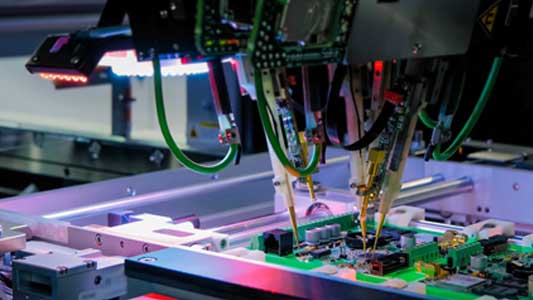

In the world of electronic test equiment, every test, every calibration, and every measurement depends on one principle — precision. Automated Test Equipment (ATE) stands at the heart of this precision ecosystem, ensuring that semiconductors, sensors, and circuit boards perform exactly as designed. As testing demands evolve, the stability, accuracy and durability of the individual components required to achieve the highest level of performance becomes a defining factor. At the foundation of that requirement is one of the smallest yet most critical components: the humble resistor.
Resistors – The Backbone of ATE Accuracy
Automated Test Equipment is often required to operate across vast electrical ranges, analyzing voltages, currents, and resistances to confirm the performance of Semiconductors during the manufacturing process. This must be performed at high speed with the maximum levels of accuracy and repeatability. Within these high-speed systems, resistors are used many locations including current-sense modules, voltage dividers, gain control circuits, and calibration bridges. They act as the silent guarantors of accuracy. If a resistor drifts — even by a fraction of a percent — the ripple effect can compromise the performance and calibration of entire test systems, leading to inconsistent results and costly re-qualification cycles.

For engineers working on advanced semiconductor testing and validation or automotive electronics, a few microvolts of measurement error can determine whether a design passes or fails compliance testing. The biggest challenge, however, lies not only in achieving accuracy in the short term, but in maintaining that accuracy over time.
Choosing the best part for the job
Resistor technologies such as wirewound, thick film, or thin film resistors often show good initial accuracy, but their stability can be affected by short term changes in ambient temperature, power, and over time. These effects cause resistors to drift — which can lead to a degradation in system performance. For test environments where consistent high precision is required, these variations are at best inconvenient, and at worst unacceptable.
This is where VPG Foil Resistors’ Bulk Metal® Foil technology has set the global benchmark. Developed through a proprietary process, the foil resistor element is bonded, not deposited, creating a robust bond between the resistive foil and its substrate. The result is a resistor with an ultra-low Temperature Coefficient of Resistance (TCR) — down to ±0.2 ppm/°C typical — and tight tolerances as low as ±0.005%. VPG’s unique foil resistor technology ensures that the resistor’s value remains virtually unchanged with variations in ambient temperature, power and over the long term.
Performance Proven by Stability
Long Term stability is not an abstract promise; it is measurable. Bulk Metal® Foil resistors from VPG Foil Resistors exhibit outstanding load-life stability, better than ±0.005% after 2,000 hours at rated power, and show negligible hysteresis when cycled between −55°C and +125°C. This means test engineers can rely on consistent results month after month, year after year, thereby reducing maintenance costs and minimizing downtime. In addition, VPG Foil Resistors ensure that measurement noise remains exceptionally low, due to their inherent low noise characteristics.
Precision That Drives Innovation
The demands placed on ATE suppliers continue to grow as industries embrace emerging technologies such as automotive ADAS, aerospace IoT, and renewable-energy power modules. Each of these fields requires faster test cycles and tighter tolerances. Electronics Engineers are constantly asked to measure smaller signals with greater confidence — often in harsher thermal and electrical environments.
VPG Foil Resistors support these ambitions by maintaining performance where other resistor technologies reach their limits. The ability to combine ultra-low TCR, low noise, and long-term stability empowers ATE designers to push the boundaries of accuracy and innovation. This capability doesn’t just optimize testing — it safeguards the credibility of every data point.
Conclusion: The Unseen Element of Trust Automated Test Equipment is often seen as a system of software, sensors, and measurement algorithms. Yet, behind every calibrated result lies a chain of components that determine whether that data can be trusted. Resistors designed with Bulk Metal® Foil technology ensure that this trust is never compromised. They make possible the precise, repeatable measurements upon which modern electronics depend — from the chip in a smartphone to the control system of an aircraft