


Electronics Era

  • About Us
  • Advertise with Us
  • Contact Us
  • e-Mag
  • Webinars
Header logo on website
Advertisement
Advertisement
Menu
  • Home
  • News
    • Industry News
    • Product News
  • TECH ROOM
    • Sensor
    • VR / AR
    • Embedded
    • Medical Electronics
    • Industry 4.0
    • Robotic
    • Automation
    • Smart Machine
    • Component
    • MCU
    • Manufacturing
    • Aerospace & Defence
    • Security
    • Policy
    • RENEWABLES
      • Sustainability
  • Semiconductor
    • AUTOMOTIVE ELECTRONICS
      • EVs
      • HEVs
      • ADAS
      • Connected Cars
    • IoT-Internet of Things
      • Development Kit
      • IoT Design
    • Power Electronics
      • AC-DC/DC-DC Converters
      • Mosfets
      • IGBTs
      • LEDs
  • T & M
    • 5G testing
    • Oscilloscopes
    • SDN & NFV
    • RF & Wireless
  • AI/ML
  • Telecom
    • 5G/6G
  • Future Tech
    • Data Center
    • Cloud Computing
    • Big Data Analytics
  • Webinars
  • Editor’s Pick
    • Tech Article
    • Tech Blog
    • White Papers
    • EE-Tech Talk
    • Market Research
    • Videos
  • EE Awards
    • EE Awards 2025
    • EE Awards 2024
  • MORE
    • E-Mag
    • Events
    • MAGAZINE Subscription
    • Contact Us
Home AI/ML

Small Changes Make Some AI Systems More Brain-Like than Others

For visual AI systems, selecting the right blueprint may accelerate learning

Nimish by Nimish
December 1, 2025
in AI/ML
Reading Time: 3 mins read
Johns Hopkins

AI Systems More Brain-Like than Others

Share on FacebookShare on TwitterShare on LinkedIn

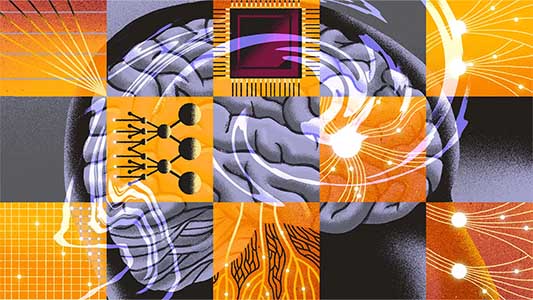
Artificial intelligence systems that are designed with a biologically inspired architecture can simulate human brain activity before ever being trained on any data, according to new research from Johns Hopkins University.

The findings, published in Nature Machine Intelligence, challenge conventional approaches to building AI by prioritizing architectural design over the type of deep learning and training that takes months, costs billions of dollars and requires thousands of megawatts of energy. 

“The way that the AI field is moving right now is to throw a bunch of data at the models and build compute resources the size of small cities. That requires spending hundreds of billions of dollars. Meanwhile, humans learn to see using very little data,” said lead author Mick Bonner, assistant professor of cognitive science at Johns Hopkins University. “Evolution may have converged on this design for a good reason. Our work suggests that architectural designs that are more brain-like put the AI systems in a very advantageous starting point.”

Bonner and a team of scientists focused on three classes of network designs that AI developers commonly use as blueprints for building their AI systems: transformers, fully connected networks, and convolutional networks.

The scientists repeatedly modified the three blueprints, or the AI architectures, to build dozens of unique artificial neural networks. Then, they exposed these new and untrained AI networks to images of objects, people, and animals and compared the models’ responses to the brain activity of humans and primates exposed to the same images.

When transformers and fully connected networks were modified by giving them many more artificial neurons, they showed little change. Tweaking the architectures of convolutional neural networks in a similar way, however, allowed the researchers to generateactivity patterns in the AI that better simulated patterns in the human brain. 

The untrained convolutional neural networks rivaled conventional AI systems, which generally are exposed to millions or billions of images during training, the researchers said, suggesting that the architecture plays a more important role than researchers previously realized. 

“If training on massive data is really the crucial factor, then there should be no way of getting to brain-like AI systems through architectural modifications alone,” Bonner said. “This means that by starting with the right blueprint, and perhaps incorporating other insights from biology, we may be able to dramatically accelerate learning in AI systems.”

Next, the researchers are working on developing simple learning algorithms modeled after biology that could inform a new deep learning framework.

Authors include Atlas Kazemian and Eric Elmoznino from Johns Hopkins University.

CONTACT: 

Hannah Robbins

667-232-9047

Tags: AIJohns Hopkins
Nimish

Nimish

[adrotate banner="216"]

Join Our Newsletter

* indicates required
Electronics Era

Electronics Era, India's no.1 growing B2B news forum on Electronics and Cutting Edge Technology is exploring the editorial opportunity for organizations working in the Electronics Manufacturing Services(EMS) Industry.

Follow Us

Browse by Category

  • 5G testing
  • 5G/6G
  • AC-DC/DC-DC Converters
  • ADAS
  • Aerospace & Defence
  • AI/ML
  • Automation
  • AUTOMOTIVE ELECTRONICS
  • Big Data Analytics
  • Blockchain
  • Cloud Computing
  • Component
  • Connected Cars
  • Data Center
  • Editor's Desk
  • EE-Tech Talk
  • Electronics Components
  • Embedded
  • EVs
  • Future Tech
  • HEVs
  • Industry 4.0
  • Industry News
  • IoT Design
  • IoT-Internet of Things
  • LED & Lighting
  • LEDs
  • Manufacturing
  • Market Research
  • MCU
  • Medical Electronics
  • Mosfets
  • News
  • Oscilloscopes
  • Policy
  • Power Electronics
  • Product News
  • RENEWABLES
  • RF & Wireless
  • Robotic
  • SDN & NFV
  • Security
  • Semiconductor
  • Sensor
  • Smart Machine
  • SMT/PCB/EMS
  • Sustainability
  • T & M
  • Tech Article
  • Tech Blog
  • TECH ROOM
  • Telecom
  • Uncategorized
  • VR / AR
  • White Papers

Recent News

Nagarro

Nagarro Partners with BrowserStack to ​​Supercharge AI-Powered Testing Workflows for Enterprises

June 5, 2026
Delta Electronics India

Precision, Power, and Connectivity: The New Imperatives Shaping Indian Manufacturing at INTEC 2026

June 5, 2026
  • About Us
  • Advertise with Us
  • Contact Us

© 2022-23 TechZone Print Media | All Rights Reserved

No Result
View All Result
  • Home
  • News
    • Industry News
    • Product News
  • TECH ROOM
    • Sensor
    • VR / AR
    • Embedded
    • Medical Electronics
    • Industry 4.0
    • Robotic
    • Automation
    • Smart Machine
    • Component
    • MCU
    • Manufacturing
    • Aerospace & Defence
    • Security
    • Policy
    • RENEWABLES
      • Sustainability
  • Semiconductor
    • AUTOMOTIVE ELECTRONICS
      • EVs
      • HEVs
      • ADAS
      • Connected Cars
    • IoT-Internet of Things
      • Development Kit
      • IoT Design
    • Power Electronics
      • AC-DC/DC-DC Converters
      • Mosfets
      • IGBTs
      • LEDs
  • T & M
    • 5G testing
    • Oscilloscopes
    • SDN & NFV
    • RF & Wireless
  • AI/ML
  • Telecom
    • 5G/6G
  • Future Tech
    • Data Center
    • Cloud Computing
    • Big Data Analytics
  • Webinars
  • Editor’s Pick
    • Tech Article
    • Tech Blog
    • White Papers
    • EE-Tech Talk
    • Market Research
    • Videos
  • EE Awards
    • EE Awards 2025
    • EE Awards 2024
  • MORE
    • E-Mag
    • Events
    • MAGAZINE Subscription
    • Contact Us

© 2022-23 TechZone Print Media | All Rights Reserved

Advertisement
Advertisement