


Introduction
The rapid proliferation of unmanned aerial systems (UAS), commonly known as drones, has fundamentally altered the threat landscape across civilian, commercial, and military domains. From low-cost quadcopters to coordinated autonomous swarms, drones are now capable of executing surveillance, electronic warfare, and kinetic missions with increasing sophistication. This evolution has driven an urgent need for advanced counter-drone (C-UAS) and counter-swarm defence systems, underpinned by cutting-edge electronics in sensing, radio frequency (RF) systems, and electronic warfare (EW).
Unlike traditional air defence systems, counter-drone strategies must deal with small size, low radar cross-section (RCS), erratic flight patterns, and swarm intelligence, requiring a multi-layered and highly adaptive approach. This article explores the electronic architecture and strategies behind modern counter-drone systems, focusing on sensor technologies, EW capabilities, and RF-domain solutions.
The Evolving Threat Landscape
Modern drone threats can be categorized into:
- Single UAV threats: Used for surveillance, payload delivery, or disruption.
- Swarm attacks: Coordinated groups leveraging AI and distributed intelligence.
- Autonomous navigation drones: GPS-denied operation using onboard sensors.
- Low-RCS (Radar Cross Section) drones: Difficult to detect with conventional radar.
Drone swarms, in particular, represent a paradigm shift. Inspired by biological systems, swarm drones can dynamically adapt, distribute tasks, and reconfigure mid-mission. Traditional defense systems designed for single targets struggle against such distributed threats.
Understanding Drone and Swarm Threats
Modern drone threats can be categorized into:
- Single UAV threats: Used for surveillance, payload delivery, or disruption.
- Swarm attacks: Coordinated groups leveraging AI and distributed intelligence.
- Autonomous navigation drones: GPS-denied operation using onboard sensors.
- Low-RCS (Radar Cross Section) drones: Difficult to detect with conventional radar.
Drone swarms, in particular, represent a paradigm shift. Inspired by biological systems, swarm drones can dynamically adapt, distribute tasks, and reconfigure mid-mission. Traditional defense systems designed for single targets struggle against such distributed threats.
Drones have evolved from hobbyist devices into sophisticated platforms capable of carrying out various tasks, from surveillance to delivery services. In particular, drone swarms—groups of coordinated drones—pose substantial threats due to their potential for mass disruption. These systems can overwhelm traditional defenses, making it imperative for the electronics industry to innovate countermeasures that can detect, assess, and neutralize such threats effectively.
System Architecture for Counter-Drone Defense
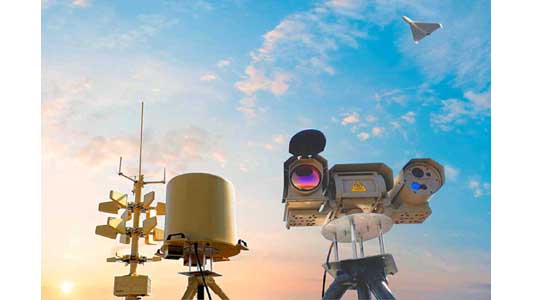
A counter-drone defense system architecture integrates multi-layered sensing, identification, decision-making, and neutralization capabilities. It typically combines radar, RF scanners, electro-optical/infrared sensors, and acoustic arrays for detection and tracking. Data fusion engines and AI-based analytics enable accurate classification of drones and swarms. Command-and-control (C2) systems coordinate responses in real time. Countermeasures include electronic warfare (jamming, spoofing), kinetic interceptors, and directed-energy systems. Secure communication networks ensure resilience against cyber threats. Modular and scalable design allows deployment across military bases, critical infrastructure, and urban environments, ensuring rapid response, adaptability, and layered protection against evolving unmanned aerial threats.
Sensor Technologies for Drone Detection
Sensor technologies for drone detection integrate radar, RF scanners, electro-optical/infrared imaging, and acoustic arrays to identify low-signature UAVs. Advanced sensor fusion and AI-driven analytics enhance detection accuracy, classification, and tracking. These multi-modal systems provide real-time situational awareness, enabling reliable and scalable counter-drone operations across defense, critical infrastructure, and urban environments.
a) Radar Systems
Radar remains a primary detection tool, especially for long-range surveillance. However, detecting small drones presents challenges due to:
- Low RCS
- Slow speeds
- Low-altitude flight
Advanced radar techniques include:
- FMCW (Frequency Modulated Continuous Wave) radar
- Pulse-Doppler radar with clutter rejection
- MIMO radar arrays for improved angular resolution
- AI-enhanced radar signal processing
Millimeter-wave radar (24 GHz, 60 GHz, 77 GHz bands) is increasingly used for short-range detection with high precision.
b) RF Detection Systems
RF sensors passively monitor the electromagnetic spectrum to detect drone communication signals between UAVs and ground control stations.
Key capabilities:
- Protocol identification (Wi-Fi, proprietary links)
- Direction finding (DF)
- Signal fingerprinting
Detection of multiple drones simultaneously
RF detection is particularly effective against commercial drones but less useful against autonomous drones operating without active communication.
c) Electro-Optical (EO) and Infrared (IR) Sensors
- EO/IR systems provide visual confirmation and classification:
- Daylight cameras for visual tracking
- Thermal imaging for night operations
- AI-based image recognition for drone identification
d) Acoustic Sensors
Acoustic arrays detect drones based on their unique sound signatures. Though limited in range, they are useful in urban environments where RF or radar signals may be cluttered.
Limitations include weather sensitivity and line-of-sight constraints.
Electronic Warfare (EW) Strategies
Electronic Warfare (EW) strategies for counter-drone defense focus on RF jamming, GNSS spoofing, and protocol manipulation to disrupt command-and-control links. Advanced EW systems employ adaptive, spectrum-aware techniques and cognitive algorithms to counter agile threats, ensuring effective neutralization while minimizing collateral interference in dense electromagnetic and civilian operational environments.
RF Jamming: RF jamming disrupts UAV communication links by transmitting controlled interference across operational frequency bands, degrading signal integrity and forcing loss of command, control, and data connectivity.

Command & Control (C2) link jamming: Command & Control (C2) link jamming selectively disrupts UAV uplink and downlink channels using targeted RF interference, inducing link loss and triggering autonomous failsafe behaviors.
Video/data link disruption: Video/data link disruption degrades UAV payload and telemetry transmission by injecting targeted RF interference into high-bandwidth downlink channels, increasing packet loss, latency, and signal degradation to impair real-time data delivery.
Broadband and narrowband jamming: Broadband jamming emits wide-spectrum interference to suppress multiple channels simultaneously, whereas narrowband jamming targets specific frequencies with focused energy for efficient, selective disruption of known communication links.
Directional jamming using phased-array antennas minimizes collateral interference.
RF Technologies in Counter-Drone Systems
RF technologies in counter-drone systems enable detection, identification, and neutralization by monitoring and exploiting UAV communication spectra. Advanced RF sensors perform signal interception, protocol analysis, and geolocation of drones and operators. Integrated RF countermeasures, including jamming and spoofing, provide selective disruption while ensuring spectrum efficiency and minimal collateral interference.
a) Spectrum Monitoring
Spectrum monitoring continuously analyzes RF environments to detect, classify, and track UAV communication signals, enabling real-time threat identification and informed countermeasure deployment.
- Software-defined radios (SDRs) enable flexible monitoring
- AI/ML algorithms classify signals in real-time
b) Direction Finding and Geolocation
Direction finding and geolocation techniques use multi-antenna arrays and time/phase difference measurements to accurately determine the position of UAVs and their controllers in real time.
Technologies include:
- Time Difference of Arrival (TDOA)
- Angle of Arrival (AOA)
- Frequency Difference of Arrival (FDOA)
c) High-Power Microwave (HPM) Systems
High-Power Microwave (HPM) systems generate intense electromagnetic pulses to disrupt or damage UAV electronic subsystems, enabling non-kinetic neutralization of drone threats over short to medium ranges.
d) Phased Array Antennas
Phased array antennas employ electronically controlled beam steering and beamforming to rapidly direct RF energy for precise detection, tracking, and targeted countermeasures against UAV threats.
Electronically steerable arrays enable:
- Rapid beamforming
- Multi-target engagement
- Adaptive interference suppression
These are crucial for both radar and jamming applications.
Counter-Swarm Strategies
Counter-swarm strategies focus on detecting, tracking, and neutralizing multiple coordinated UAVs through layered and scalable defense architectures. They integrate multi-sensor fusion, AI-driven analytics, and distributed command-and-control for real-time situational awareness. Electronic warfare, directed energy, and autonomous interceptors enable effective disruption and engagement of dense, adaptive drone swarms.
a) Distributed Detection Networks
Distributed detection networks integrate geographically dispersed, multi-modal sensors with edge processing and networked data fusion to provide resilient, real-time tracking and localization of UAV threats across wide operational areas.
Multiple sensor nodes form a networked detection grid:
- Edge processing reduces latency
- Collaborative tracking improves coverage
- Resilient against node failures
b) AI and Machine Learning
AI and machine learning in counter-swarm strategies enable real-time swarm detection, behavior prediction, and adaptive response optimization by analyzing multi-sensor data and dynamically coordinating countermeasures against evolving UAV threats.
AI plays a crucial role in:
- Swarm behavior prediction
- Target prioritization
- Autonomous threat response
Neural networks can identify swarm patterns and anticipate attack vectors.
c) Layered Defense Architecture
Layered defense architecture integrates multiple defensive tiers—sensing, identification, electronic warfare, and kinetic engagement—to provide depth, redundancy, and adaptive response against diverse UAV threats.
Effective systems deploy multiple layers:
- Outer Layer: Long-range radar and RF detection
- Mid Layer: EW disruption (jamming/spoofing)
- Inner Layer: Kinetic or directed energy systems
d) Network-Centric Warfare Integration
Network-centric warfare integration links distributed sensors, command nodes, and effectors over secure, low-latency networks to enable shared situational awareness and coordinated, real-time engagement of UAV threats. It includes:-
- Real-time data sharing
- Command and control integration
- Interoperability across platforms
Counter UAV Systems for India
Counter-UAV systems in India integrate radar, RF, EO/IR sensors, and AI-driven analytics for reliable detection and tracking. Indigenous solutions developed by Defence Research and Development Organisation employ electronic warfare, GNSS spoofing, and directed energy for neutralization, ensuring scalable, spectrum-efficient protection of borders, critical infrastructure, and urban environments.
The Indian Army’s efforts for C-UAV seem to be progressing on two parallel tracks. The Army Air Defence College at Gopalpur, Odisha, has integrated vintage 40mm Bofors L 70 and 23mm Russian Zu-23 guns with a counter-drone technology designed by Hyderabad-based Zen Technologies—which is also supplying the same to IAF. This has led to the development of an integrated soft-hard kill system which may prove effective against drone swarms. This is due to the comparatively high rate of fire of these guns, and the use of proximity-fuse ammunition, which detonates in the space surrounding the air threat, exploding in more than 1,000 pieces of tungsten shards and thereby hitting more than one target in a swarm.
The Defence Research and Development Organisation (DRDO) has handed over a fixed quantity of D-4 (Drone Detect, Deter and Destroy) systems to the Army. The same was first deployed during the 2021 Republic Day parade. The system, which uses a combination of hard-and soft-kill options, can detect micro drones and uses a laser-based kill mechanism to terminate targets. It also employs RF/Global Navigation Satellite System (GNSS) to detect the communication frequency used by the drone controller, which is then jammed.
Challenges and Limitations
Despite advances Counter-drone and swarm defense electronics face challenges in detecting low-RCS, slow, and autonomous UAVs in cluttered environments, leading to false positives and tracking complexity.
Spectrum congestion and frequency-agile drones limit the effectiveness of RF-based detection and jamming techniques.
Scalability against dense swarms strains sensing, processing, and engagement resources.
Additionally, minimizing collateral interference, ensuring cybersecurity resilience, and maintaining real-time response in contested environments remain critical limitations.
Emerging Technologies
Emerging technologies in counter-drone and swarm defense electronics include AI-driven sensor fusion, enabling real-time detection, classification, and predictive tracking of coordinated UAV threats.
Cognitive electronic warfare systems dynamically adapt jamming and spoofing strategies based on spectrum intelligence.
Directed energy solutions such as high-energy lasers and high-power microwaves provide rapid, scalable neutralization.
Additionally, autonomous interceptor drones, edge computing, and quantum-enhanced sensing are advancing resilience, precision, and response speed in next-generation counter-swarm architectures.
Conclusion
In an age where drones and swarm technologies are increasingly accessible, the importance of effective counter-drone strategies cannot be overstated. By leveraging advancements in sensor technologies, electronic warfare tactics, and radio frequency systems, the electronics industry can develop robust solutions that safeguard public safety and national security. As threats evolve, so too must our defenses, necessitating continuous research and development within this critical field. Moving forward, the successful implementation of counter-drone technologies will rely on collaboration, innovation, and a proactive stance towards emerging aerial threats.