



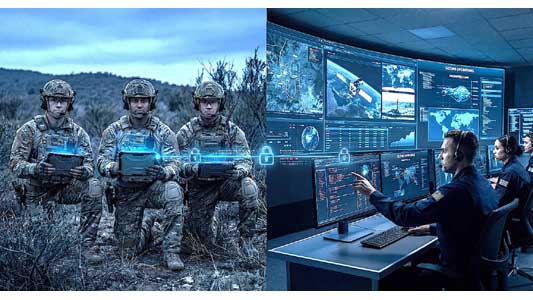
Securing Military Communications in the Post-Quantum Era
Throughout various decades, cryptography technology has been used in defense communication as the main concept that enables the establishment of effective military operations. Such include battlefield communications, satellite communications, intelligence, and command & control communications, where the use of cryptography serves as the primary defensive measure utilized by an opponent when trying to intercept any form of information.
A new technology wave is on the verge of coming into action, and this time it will not spare even the defense industry. The quantum computer that has been only a mere theory until today is about to become reality in an unprecedented manner. While there is no disputing the great amount of potential that comes with the quantum computer in terms of scientific research, materials science, and optimization, one must not underestimate the threat posed to present-day cryptographic systems.
RSA, DHI and ECC are examples of some of the public key cryptography algorithms that work under the assumption that the mathematical formulas used by them cannot easily be computed using traditional computing methods. With the advent of quantum computing, which is able to execute Shor’s algorithm, such computations may become much easier.
This raises many fears, particularly among defence agencies, which are often concerned about maintaining their classified material secure for several more years. The military intelligence intercepted at any given point in time could be held until quantum technology becomes sufficiently advanced enough to enable the decryption of this intelligence—a strategy referred to as Harvest Now Decrypt Later (HNDL).
The Quantum Threat to Conventional Cryptography
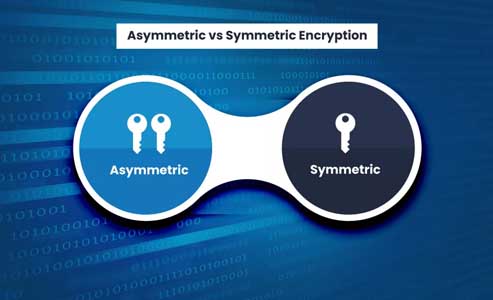
There exist two major groups of cryptographic mechanisms being used today:
Symmetric Cryptography
Symmetric cryptography employs a shared key for both the encryption and decryption process, resulting in highly efficient and secure encryption/decryption of information.Examples include:
- AES (Advanced Encryption Standard)
- ChaCha20
These algorithms use the same key for encryption and decryption.
Asymmetric Cryptography
Asymmetric cryptography utilizes a combination of keys for purposes of encryption, decryption, and verification, thus allowing the transmission of information, signature, and key exchange across networks.

Some examples are:
- RSA
- ECC
- Diffie-Hellman Key Exchange
These use public/private keys for secure communication and identification.
While symmetric ciphers can withstand attacks from quantum computers, although with more difficult key lengths, the problem becomes more complicated in case of public keys.
Quantum computers executing Shor’s Algorithm could efficiently:
- Factor large integers
- Solve discrete logarithm problems
- Break RSA encryption
- Compromise ECC-based security
Since public-key cryptography forms the backbone of:
- Secure military communications
- Digital signatures
- Authentication systems
- PKI infrastructures
- Satellite communications
The defence sector must transition toward quantum-resistant alternatives well before large-scale quantum computers become operational.
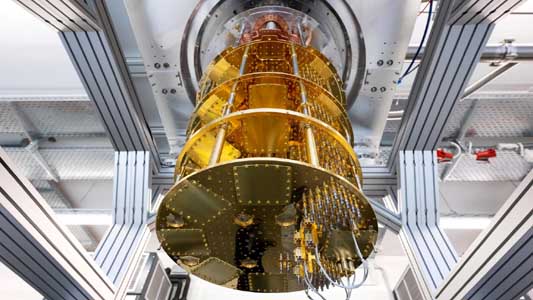
Understanding Quantum-Resistant Cryptography
Post-Quantum Cryptography (PQC) or Quantum-Resistant Cryptography covers cryptographic techniques that would be able to resist attack by both traditional computers and quantum computers.
While QKD takes advantage of quantum mechanical principles to ensure protection of cryptographic data, post-quantum cryptography technologies are capable of being utilized through traditional computing devices and traditional transmission channels.
The fundamental idea is to develop a new cryptographic method based on problems that cannot be solved via quantum computing.
Several methods have been put forward thus far.
Lattice-Based Cryptography
Lattice cryptography is among the best-known post-quantum cryptography algorithms that make use of complex lattice theory calculations, rather than depending on any integer factorization or logarithmic computations. Lattice cryptography algorithms are quite resilient against attacks by quantum computers, and they ensure encryption, signing, and key exchanges.
Their security is based on hard mathematical problems related to lattices of very high dimensions.
Some of the advantages of lattice cryptography algorithms include:
- Good security assumptions
- Good efficiency of implementation
- Good scalability
- Readiness for embedded devices
Some examples include:
- CRYSTALS-Kyber
- CRYSTALS-Dilithium
Hash-Based Cryptography
Hash-based Cryptography utilizes cryptographic hash functions for constructing digital signatures in post-quantum cryptography. It depends on the security provided by hash functions as opposed to mathematical operations susceptible to quantum computer hacking. Hash-based cryptography stands out due to its high level of security assurance and straightforward implementation.
Advantages are:
- Basis on secure principles
- Life-long viability
Applications are:
- Firmware Authentication
- Software Updates
- Military Equipment Authentication
Code-Based Cryptography
Error-correcting coding systems utilize error-correcting codes.
Strengths are:
- Long standing assurance of security
- Security against all known quantum algorithms
This type of encryption has special significance within defense systems requiring high levels of security.
Multivariate and Isogenies
Although these techniques are still under development, they present another way of creating encryption which is secure against quantum computers.
Defence Communication Systems: Why the Transition Cannot Wait
Lifespan of military systems is usually around 20 to 40 years.
These systems may include the following:
- Fighter jets
- Naval vessels
- Satellite systemsMissile defense systems
- Tactical radios
All of the above-listed systems use cryptography that can be broken within its lifespan.
It is not only applicable to the future message intercepting.
In other words, currently intercepted messages are likely to be saved and decrypted once quantum computers become available.
Critical defence information at risk includes:
- Intelligence reports
- Strategic planning data
- Weapons system specifications
- Battlefield communications
- Diplomatic communications
- Space asset telemetry
The long-term confidentiality requirements of defence data make quantum readiness an immediate strategic necessity rather than a future concern.
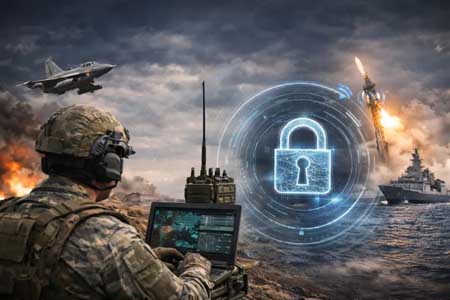
Secure Defence Communications in the Post-Quantum Era
Security in military communications will depend on the implementation of a multiple-level security framework comprising quantum-proof cryptographic algorithms, modern networking solutions, and hardware security techniques.
Post-Quantum Public Key Infrastructure (PKI)
Contemporary military networks depend on the Public Key Infrastructure.
Future military networks based on post-quantum cryptography will need:
- Quantum proof certificates
- PQC-based authentication
- Secure identity management
- Post-quantum signatures
Such frameworks will be essential for secure communication and identification.
Hybrid Cryptographic Approaches
Many organizations are adopting hybrid cryptographic models.
In this approach:
- Classical cryptography operates alongside PQC algorithms.
- Both encryption methods must be broken to compromise communications.
This provides enhanced security during the transition period and ensures interoperability with existing systems.
Secure Tactical Communications
Modern warfare increasingly depends on network-centric operations.
Military radios, battlefield networks, and command systems require:
- Ultra-secure authentication
- Rapid key exchange
- Resilience against electronic warfare
Quantum-resistant algorithms can protect these communications while maintaining operational efficiency.
Quantum Key Distribution for Strategic Defence Networks
As the PQC prevents any quantum attacks mathematically, the quantum physics approach is used by Quantum Key Distribution to ensure secure transmissions.
This technology allows two users to share encryption keys via photons’ quantum states.
Any kind of interception of those keys leaves detectable traces and exposes the intruder at once.
The uses of QKD cover the following spheres:
- Strategic communications
- Nuclear communications
- Governmental communications
- Defence communications
Even if the implementation of QKD is limited due to infrastructural needs, its security guarantees are unmatched.
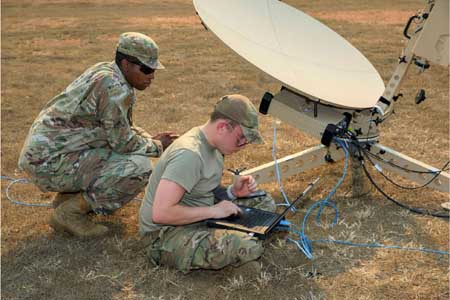
Securing Defence Satellites and Space Communications
Modern military operations increasingly depend on space-based assets.
Defence satellites support:
- Navigation
- Intelligence gathering
- Communications
- Missile warning systems
- Surveillance operations
Quantum-resistant cryptography is becoming essential for protecting:
- Satellite command links
- Telemetry data
- Inter-satellite communications
- Ground station connectivity
Future satellite constellations may also integrate QKD-enabled communication channels to enhance strategic security.
Given the increasing militarization of space, secure quantum-resilient communications will play a critical role in safeguarding orbital assets.
Hardware Security: The Foundation of Trust
Cryptography alone cannot secure defence systems. Hardware-level protection is equally important.
Key technologies include:
Hardware Security Modules (HSMs)
HSMs securely generate, store, and manage cryptographic keys. Future defence-grade HSMs will support post-quantum algorithms and secure key lifecycle management.
Trusted Platform Modules (TPMs)
TPMs provide:
- Secure boot capabilities
- Device authentication
- Cryptographic key protection
These functions are critical for military computers and embedded systems.
Secure Microelectronics
Quantum-resistant security must extend into silicon.
Advanced secure processors integrate:
- Anti-tamper protection
- Side-channel attack resistance
- Cryptographic accelerators
- Secure execution environments
Defence semiconductor strategies increasingly emphasize trusted domestic manufacturing and supply-chain assurance.
AI and Machine Learning in Secure Defence Communications
The application of Artificial Intelligence (AI) and Machine Learning (ML) is changing secure defence communications through the ability of these technologies to detect threats and identify anomalies in real time. Some of the ways in which AI and ML improve the security of communications include increased network resiliency, optimized spectrum management, and automated decision making.
Machine learning algorithms can:
- Detect anomalous network activity
- Identify intrusion attempts
- Predict cyberattacks
- Automate threat response
When integrated with quantum-resistant architectures, AI enhances the resilience of defence communication networks.
Applications include:
- Dynamic key management
- Network anomaly detection
- Adaptive cyber defence
- Electronic warfare countermeasures
The combination of AI and PQC creates intelligent security ecosystems capable of responding to evolving threats in real time.
Challenges in Implementing Quantum-Resistant Security
There are several issues that are associated with the implementation of quantum resistant security systems. For instance, post-quantum encryption algorithms tend to use more memory than traditional encryption methods and require more powerful hardware. Additionally, there are issues related to the compatibility of legacy systems, as well as the migration process itself. It is essential to keep in mind that post-quantum technologies are continually being developed, which means that they have to be constantly updated. There is also the problem of testing and certification on a large scale.
India’s Opportunity in Quantum-Secure Defence Technologies
India seems to be doing well in the following sectors of its National Quantum Mission and native capabilities in quantum technology, cyber security, and secure communications.
A combination of:
- The native semiconductor development
- The development of defense electronics
- The strategic communication system
- The quantum technology
has great innovation potential.
Indians, through the defense field, R&D establishments, and electronics manufacturing industry, have great potential to come up with:
- The quantum encryption hardware
- The secure communications software
- The QS network hardware
- The cryptographic processors
Conclusion
The problem of cybersecurity in modern times includes such aspect as development of quantum computing. For the armed forces, when confidentiality, integrity, and availability of information is vital to national security, quantum-proof cryptology is inevitable.
All of the above aspects mentioned above – quantum cryptology, quantum key distribution, microelectronics quantum-proof, artificial intelligence used for military purposes, as well as communications system – form the elements of military communications of the future.
As soon as the humanity enters the era of post-quantum age, the states that are able to create their own quantum-proof infrastructures will definitely gain some advantages in protection of their vital national interests. This will be true both because of the state-of-the-art weapons and process automation in the armed forces as well as quantum-proof basis that will lay under all of these things.
Hence, the quantum communication systems may prove to be at least as valuable for the countries as the radar, satellites and command communications within their defensive systems.