



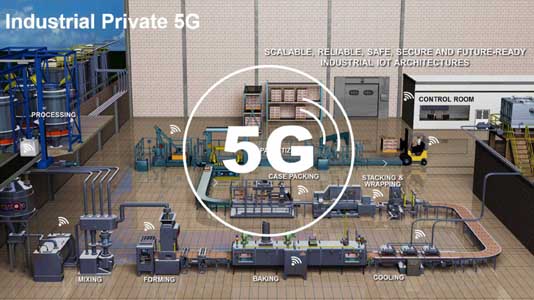
The Convergence Powering Industry 4.0
Industrial Revolution 4.0 has radically changed how manufacturing, logistics, energy, mining, and processes industries operate due to advancements in digital technology. The key to this revolution involves a highly advanced combination of private 5G, Industrial Internet of Things (IIoT), and Machine Learning (ML). It is from this combination that a new breed of applications involving ultra-low latency has been made possible through a combination of wired and wireless communications that was not feasible before.
The demands from industries for enhanced productivity, reduced downtime, energy efficiency, increased safety, and more flexibility have grown significantly. Existing systems cannot cater to the requirement of having a highly connected network, with low latency and deterministic communication that is essential in the present-day advanced smart factories. However, with the arrival of 5G and cellular private networking, all these demands will be easily fulfilled.
Private 5G networks, together with IIoT sensors and artificial intelligence algorithms, form the backbone of intelligent industrial ecosystems that make decisions autonomously and perform maintenance activities in advance.
This leads to a very connected industrial world where all kinds of devices including sensors, robots, and even humans work together towards increasing efficiency.
Why Ultra-Low Latency Matters in Industrial Environments
Latency is essentially the time it takes for information to travel from one system to another. In the industrial environment, even milliseconds can mean the difference between effective functionality and disastrous failure.
Traditional industrial Ethernet connections provide very low latencies, but lack flexibility and scalability. Traditional Wi-Fi networks, on the other hand, while offering mobility, fail to offer guaranteed deterministic performance under industrial conditions.
Modern industrial applications increasingly require:
- Real-time machine control
- Autonomous robotics
- Precision manufacturing
- Remote operations
- Safety-critical automation
- Instant fault detection
Many of these applications need end-to-end latencies of less than 10 milliseconds, whereas some mission-critical applications need latencies as low as 1 millisecond.
The technology of 5G was actually developed to cope with this issue using Ultra-Reliable Low-Latency Communications (URLLC), which is one of the fundamental components of 5G architecture. This feature turns industrial communications into an intelligent real-time operations system.
Private 5G: The Industrial Network of Choice
Although the public 5G network offers wide geographical coverage, industries now favor setting up Private 5G networks.
The Private 5G network refers to a unique cellular network that is installed in an industrial setup like:
- Manufacturing plants
- Warehouses
- Airports
- Ports
- Oil and gas facilities
- Mining operations
- Utility installations
Unlike any public networks, private 5G provides full control of network performance, security policies, spectrum utilization, and QoS/QoE.
The following points highlight their key benefits:
Predictable Performance
A private network does not suffer from congestion as a result of consumer traffic.
Enhanced Security
Industrial data remains within enterprise-controlled environments, reducing exposure to external threats.
Network Slicing
Different industrial applications can be assigned dedicated network resources, ensuring critical processes receive priority access.
Massive Device Connectivity
Millions of devices can be accommodated within each square kilometer through private 5G, thus providing a solution suited for densely packed IIoT installations.
Mobility
Uninterrupted communication can be guaranteed by autonomous mobile robots, automatic guided vehicles, and industrial drones while moving around the installation.
Such capabilities make Private 5G one of the key technologies in Industry 4.0 solutions
Industrial IoT: Creating the Connected Factory
The Industrial Internet of Things (IIoT) is changing the nature of traditional manufacturing facilities through the incorporation of various devices and systems. With the implementation of sensors, machines, cloud computing, and analysis tools, IIoT makes possible real-time observation, predictive maintenance, and informed decision making.
IIoT devices continuously collect operational information from:
- Production equipment
- Robotic systems
- Conveyors
- Environmental sensors
- Energy systems
- Safety devices
- Quality inspection systems
Modern industrial facilities can deploy tens of thousands of sensors generating continuous streams of data.
Examples include:
- Temperature measurements
- Vibration signatures
- Pressure readings
- Machine health indicators
- Acoustic signals
- Visual inspection images
- Power consumption metrics
However, historically, such information was usually confined to each system separately.
The implementation of Private 5G technology ensures the integration of all these components into one intelligent network. This is the basis for implementing machine-learning solutions.
Machine Learning: Transforming Data into Operational Intelligence
Collecting industrial data alone does not create value.
The true transformation occurs when machine learning algorithms analyze massive data streams and convert them into actionable insights.
Machine learning enables systems to:
- Detect anomalies
- Predict equipment failures
- Optimize production parameters
- Improve product quality
- Enhance energy efficiency
- Automate decision-making
Unlike the conventional rule-based system, ML systems keep on learning as they receive more operational data.
This means that an ML system observing the vibrations of industrial motors will be able to predict problems with motor bearings weeks before a disaster strikes.
Likewise, analytics applied to production lines will be able to spot changes in the production process much before defects arise. The integration of IIoT data and ML-based analytics will create a self-improving system of industrial intelligence.
Edge Computing: Bringing Intelligence Closer to the Factory Floor
Real-time ultra-low latency industrial use cases cannot depend exclusively on remote cloud infrastructure servers.
The transmission of data to central cloud infrastructures causes a delay that could be unacceptable.
This problem is solved by the introduction of edge computing, which processes information nearer its source.
Edge computing can be implemented in the manufacturing site itself when a 5G private network is utilized.
Benefits include:
- Reduced latency
- Faster decision-making
- Lower bandwidth consumption
- Enhanced security
- Improved operational continuity
Inferencing machines using machine learning at the edge can process sensor information and take actions within milliseconds.
This becomes important when it comes to industrial automation technologies.
A robot arm that needs to perform precision assembling cannot afford to wait for hundreds of milliseconds for a cloud reply.
Integration between edge computing and private 5G technology is thus becoming a critical tool for industrial intelligence.
Ultra-Low Latency Industrial Use Cases
Autonomous Mobile Robots (AMRs)
Modern factories increasingly deploy autonomous mobile robots to transport materials and products.
These robots rely on:
- Real-time navigation
- Obstacle detection
- Dynamic route optimization
- Fleet coordination
Private 5G enables continuous communication between robots, edge servers, and production systems.
Machine learning algorithms analyze traffic patterns and optimize movement paths in real time, reducing congestion and increasing operational efficiency.
Collaborative Robotics (Cobots)
Robotic collaboration entails the robot working together with a human worker directly on the same platform.
Cobots need to be very fast and have instant awareness of their surroundings for safety purposes.
This is made possible by connecting them to 5G and using artificial intelligence for image recognition capabilities.
Predictive Maintenance
Predictive maintenance is among the most commercially valuable Industry 4.0 applications.
IIoT sensors continuously monitor:
- Bearings
- Pumps
- Motors
- Compressors
- Turbines
- Gearboxes
Machine learning models identify failure patterns before breakdowns occur.
Private 5G ensures continuous high-speed transmission of sensor data, enabling real-time equipment health monitoring and minimizing costly downtime.
Smart Quality Inspection
Conventional quality control processes depend on manual work or offline quality assurance.
A modern inspection system is based on:
- High-definition cameras
- Computer vision technology
- Machine learning analysis
Private 5G networks enable the fast transmission of large image files. Artificial intelligence allows for the real-time analysis of products, discovering flaws and making adjustments to production processes. This makes the process much more efficient.
Industrial Digital Twins
The digital twin refers to a digital representation of physical assets, production line, or even the whole facility.
This is an ongoing process that constantly keeps pace with actual operating data.
With private 5G, real-time information is collected from thousands of IIoT sensors.
Enhancements are made by using machine learning technology through the use of:
- Predictive analysis
- Simulation of changes in processes
- Production optimization
This way, businesses can test their operational enhancements in virtual space before doing them physically.
Remote Operations and Telepresence
Mining, oil and gas production, utilities, and similar industries usually work in dangerous conditions.
Private 5G enables remote control of:
- Excavators
- Drilling machines
- Cranes
- Inspecting robots
The ultra-low latency guarantees that the operator receives feedback in real-time.
In addition, machine learning can provide additional benefits by adding autonomy and predictions.
It increases safety and effectiveness of the work.
Smart Warehousing and Logistics
Warehouses are increasingly being turned into highly automated spaces.
Some connected devices used include:
- Automated storage systems
- Devices to track inventory
- Mobile robots
- Automated forklifts
Private 5G guarantees reliable network connections across massive warehouses, while machine learning drives efficiencies in inventory management, logistics optimization, and demand forecasting.
This leads to increased efficiency and decreased expenses.
5G Network Slicing for Industrial Applications
The feature that stands out with 5G technology is network slicing.
The same physical network can be used for different virtual networks dedicated to certain applications.
For instance:
- Safety applications can get priority with extremely low latency.
- Videography applications can get higher bandwidth slices.
- Environmental sensing can be done using low-power slices.
With the help of this approach, it is easier for companies to provide services for different workloads without compromising on performance.
Challenges and Considerations
However, the implementation of Private 5G, IIoT, and ML infrastructures comes with some difficulties.
Investment in Infrastructure
The deployment of Private 5G networks involves:
- Radio Access Network (RAN) components
- Core network setup
- Edge computing solutions
- Device integration
Deployment costs may be high at first.
System Integration Challenges
Most industries still use outdated equipment not built to support new connectivity requirements.

System integration may be necessary for successful implementation.
Cybersecurity Concerns
As industrial systems become more connected, cyberattack surfaces will increase.
Cybersecurity practices and zero-trust architectures must be implemented.
Skills Gap
Organizations need expertise spanning:
- Telecommunications
- Industrial automation
- AI and machine learning
- Cybersecurity
- Edge computing
Bridging this multidisciplinary skills gap remains a major challenge.
Conclusion
Private 5G, IIoT, and ML have transcended being standalone domains of technology. Rather, the combination of these technologies has created an ecosystem that is poised to revolutionize how industrial processes operate by ensuring ultra-low latency communication, ubiquitous connectivity, and smart analysis for industrial applications like autonomous robotics, predictive maintenance, digital twins, and remote operations.
With the continued evolution of manufacturers and industrial organizations on the path of Industry 4.0, the effective adoption of Private 5G, IIoT, and ML technologies would be key to gaining a competitive advantage, resulting in improved productivity, increased safety, enhanced resiliency, and sustainability.
In other words, the future factory won’t just be connected; it will be smart and autonomous.