Introduction:
The Urgency for Next-Generation AI Hardware Artificial Intelligence (AI) is entering an era defined by exponential growth in model complexity, data volumes, and real-time decision-making requirements. From large language models (LLMs) to autonomous systems, the computational demands are rapidly outpacing the capabilities of traditional semiconductor architectures. Conventional von Neumann systems—characterized by separate memory and processing units—are increasingly constrained by latency, energy consumption, and memory bandwidth bottlenecks.
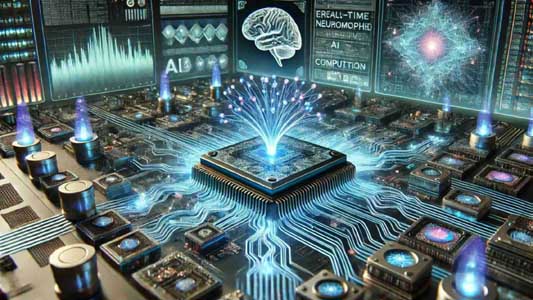
This growing disparity between AI workloads and hardware efficiency has catalyzed the exploration of alternative computing paradigms. Among the most promising are neuromorphic computing and photonic computing, both of which aim to fundamentally rethink how computation is performed. When combined, these paradigms offer a transformative pathway toward ultra-efficient, high-speed AI acceleration.

Limitations of Conventional Computing Architectures
Modern AI acceleration heavily relies on GPUs, TPUs, and specialized ASICs. While these platforms have delivered remarkable performance gains, they remain constrained by:
• Memory bottlenecks (von Neumann bottleneck)
• High energy consumption per operation
• Thermal dissipation challenges
• Limited scalability for edge deployment
For example, traditional digital systems typically consume on the order of 100 picojoules per multiply–accumulate (MAC) operation, whereas the human brain operates at dramatically lower energy scales.
As Moore’s Law approaches its physical limits, simply scaling transistor density is no longer sufficient. A paradigm shift in computing architecture is essential.
Neuromorphic Computing: Brain-Inspired Intelligence
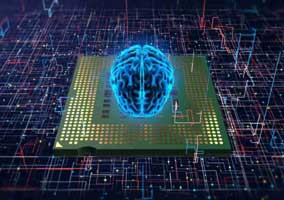
Neuromorphic computing is inspired by the structure and functionality of the human brain. Instead of processing data sequentially, neuromorphic systems utilize networks of artificial neurons and synapses that operate in a highly parallel, event-driven manner.
Key Characteristics
Spiking Neural Networks (SNNs)
Spiking Neural Networks (SNNs) are biologically inspired models that mimic how real neurons communicate using discrete spikes over time. Unlike traditional neural networks, SNNs process temporal information efficiently, enabling low-power, event-driven computation. They are particularly suited for neuromorphic hardware and applications requiring real-time sensory processing and energy-efficient AI.
Co-located Memory and Compute
Co-located memory and compute refers to architectures where data storage and processing units are placed physically close or integrated together, reducing data movement. This minimizes latency and energy consumption compared to traditional von Neumann systems, enabling faster, more efficient computing—especially for data-intensive workloads like AI, edge processing, and real-time analytics.
Event-Driven Operation
Event-driven operation in neuromorphic computing processes information only when significant input changes (events) occur, such as spikes in neural activity. Instead of continuous clock-driven execution, computation is triggered asynchronously, reducing unnecessary processing. This approach enables ultra-low power consumption, low latency, and efficient real-time response, closely mimicking biological neural systems.
Massive Parallelism
Massive parallelism in neuromorphic computing refers to simultaneous processing by thousands to millions of artificial neurons and synapses operating concurrently. Unlike sequential architectures, computations occur in distributed, asynchronous fashion, enabling real-time performance and high efficiency. This parallel structure mirrors the brain, supporting complex tasks like perception, learning, and adaptive decision-making.
Neuromorphic computing has demonstrated significant potential in improving energy efficiency and AI performance, particularly for edge applications and real-time inference.
Advantages for AI Acceleration
- Ultra-low power consumption
- Real-time processing capabilities
- Improved latency for edge devices
- Enhanced adaptability and learning efficiency
These attributes make neuromorphic systems particularly suited for applications such as robotics, IoT, autonomous vehicles, and smart sensors.
Photonic Computing: Harnessing the Power of Light
Photonic computing leverages photons instead of electrons to perform computations. By utilizing light for data transmission and processing, photonic systems can achieve unprecedented speed and bandwidth.
Core Principles
Optical Signal Processing
Optical signal processing uses light (photons) instead of electrical signals to perform operations such as filtering, modulation, switching, and computation. It offers ultra-high bandwidth, low latency, and reduced electromagnetic interference. Widely used in fiber-optic communications and emerging photonic computing, it enables faster data processing and energy-efficient handling of large-scale information.
Parallelism through Wavelength Division
Parallelism through wavelength division uses multiple light wavelengths (channels) to transmit and process data simultaneously within a single optical medium. Each wavelength carries independent information, enabling high-throughput parallel operations. Widely applied in wavelength division multiplexing (WDM), it boosts bandwidth efficiency, scalability, and performance in optical communications and photonic computing systems.
Minimal Heat Generation
Minimal heat generation in neuromorphic computing arises from event-driven operation, sparse activity, and low-voltage analog signaling. By processing data only when needed and reducing memory-compute data movement, these systems significantly lower power dissipation. This enables energy-efficient, scalable hardware suitable for edge AI, while mitigating thermal constraints common in conventional computing architectures.
Key Benefits
- Sub-nanosecond latency
- High bandwidth and throughput
- Low energy dissipation
- Scalability for large-scale AI models
Photonic integrated circuits (PICs) have enabled the development of ultrafast artificial neural networks, capable of handling complex AI workloads efficiently.
Convergence: Neuromorphic Photonic Computing
The integration of neuromorphic principles with photonic hardware represents a groundbreaking advancement in AI acceleration. This hybrid approach combines:
The energy efficiency and adaptability of neuromorphic systems
The speed and parallelism of photonic computing
Why This Convergence Matters
Photonic neuromorphic systems can perform matrix operations—the backbone of AI models—natively and at extremely high speeds, while maintaining low energy consumption.
Key Features
- In-memory optical computing: In-memory optical computing performs data processing directly within optical memory using light, eliminating data transfer bottlenecks between memory and processors. It enables ultra-fast, energy-efficient computation with high parallelism, making it ideal for AI and data-intensive applications.
- Analog signal processing: Analog signal processing manipulates continuous-time signals such as voltage or current to extract, filter, or amplify information in real time. It offers low latency and high energy efficiency, making it essential for communication systems, audio electronics, and sensor interfaces.
- High-density integration of neurons and synapses: High-density integration of neurons and synapses refers to packing a large number of neuron-like and synapse-like elements onto a single chip to mimic brain-scale connectivity. This enables massive parallel processing, improved learning capability, and highly efficient neuromorphic computing systems.
- Simultaneous inference and training capabilities: Simultaneous inference and training in photonic neuromorphic systems allows real-time data processing while continuously updating model weights using light-based interactions. This enables ultra-fast adaptive learning with minimal latency and energy consumption, ideal for dynamic AI applications.
- Recent research has demonstrated single-chip photonic neural networks capable of both inference and on-chip learning, marking a significant leap toward practical AI hardware.
Architectural Innovations
Photonic Synapses and Neurons
Photonic systems implement synaptic weights using optical modulators and phase shifters, while nonlinear optical elements emulate neuron activation functions.
Spiking Photonic Networks
Combining spiking neural models with optical hardware enables ultra-fast, event-driven processing.
Meta surface-Based Neural Networks
Emerging designs use optical metasurfaces to implement millions of photonic neurons on a single chip, enabling massive parallelism.
Recent demonstrations have shown systems with tens of millions of photonic neurons, achieving significant improvements in speed and energy efficiency compared to GPUs.
Performance Advantages over Traditional AI Accelerators
The synergy of neuromorphic and photonics technologies offers orders-of-magnitude improvements in performance-per-watt, which is critical for sustainable AI deployment.
Applications across Industry Domains
Edge AI and IoT
Neuromorphic photonics systems enable always-on sensing with minimal power consumption, ideal for wearables, smart homes, and industrial IoT.
Autonomous Systems
Low-latency decision-making is crucial for autonomous vehicles, drones, and robotics.
Healthcare and Medical Diagnostics
Real-time analysis of medical imaging and biosignals can benefit from ultra-fast AI processing.
Telecommunications
Photonic AI accelerators can enhance signal processing, network optimization, and 6G communications.
Data Centers and HPC
Energy-efficient AI acceleration can significantly reduce operational costs and carbon footprint.
Challenges and Limitations
Despite their promise, neuromorphic and photonics computing technologies face several challenges:
Fabrication Complexity
Integrating photonic and electronic components on a single chip requires advanced manufacturing techniques.
Programming Paradigms
Developing software frameworks for neuromorphic and photonic systems remains a challenge.
While inference is highly efficient, large-scale training on these platforms is still evolving.
Standardization
Lack of standardized architectures and benchmarks hinders widespread adoption.
Noise and Signal Integrity
Analog and optical systems are susceptible to noise, requiring robust error correction mechanisms.

Emerging Research Directions
Hybrid Electronic-Photonic Systems
Combining CMOS electronics with photonic accelerators for optimal performance.
Integrated Photonic Chips
Advancements in silicon photonics are enabling scalable, cost-effective solutions.
In-Situ Learning Mechanisms
On-chip training capabilities are being developed to enable adaptive AI systems.
Quantum-Photonic Synergies
Exploring the intersection of photonics and quantum computing for next-generation AI.
India’s Perspective and Opportunities
India is uniquely positioned to capitalize on these emerging technologies, driven by:
- Strong semiconductor policy initiatives
- Growing AI ecosystem
- Academic research in photonics and neuromorphic systems
India is well-positioned to emerge as a significant player in Neuromorphic and Photonic Computing for AI acceleration, driven by policy support and a rapidly evolving semiconductor ecosystem. National initiatives such as Digital India, Make in India, and India Semiconductor Mission are fostering innovation, domestic manufacturing, and research in advanced computing technologies. Leading academic institutions like Indian Institute of Science and various IITs are actively exploring neuromorphic architectures and silicon photonics for next-generation AI hardware.
The growing demand for edge AI across sectors such as healthcare, agriculture, smart cities, and defense creates strong application opportunities. Photonic computing offers ultra-high bandwidth and low latency, while neuromorphic systems enable brain-inspired, energy-efficient processing—both critical for India’s large-scale, data-driven environments. Additionally, India’s strong IT talent base and expanding startup ecosystem provide a solid foundation for innovation in AI hardware design.
Strategic collaborations with global technology leaders, increased R&D funding, and development of fabrication infrastructure will be crucial. By aligning policy, academia, and industry, India can accelerate self-reliance and position itself as a global hub for energy-efficient AI computing technologies. The development of indigenous AI hardware can play a crucial role in:
• Strengthening technological sovereignty
• Enabling cost-effective edge AI solutions
• Supporting defense, healthcare, and smart infrastructure
Conclusion
Neuromorphic and photonic computing are not merely incremental improvements—they represent a fundamental rethinking of computation itself. By addressing the critical challenges of energy efficiency, latency, and scalability, these technologies are set to redefine AI acceleration.
While challenges remain, the rapid pace of innovation and growing industry interest indicate a strong trajectory toward commercialization. For the electronics industry, this convergence opens new frontiers in chip design, system architecture, and intelligent computing.
The future of AI will not just be faster—it will be smarter, more efficient, and fundamentally more human-like.