


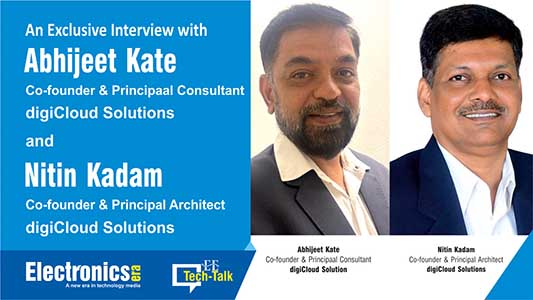
Electronics Era: digiCloud was founded in 2016, well before agentic AI became a boardroom conversation. How has the nature of what your clients actually need from you changed over the last three to four years?
Abhijeet: When we started in 2016, I remember sitting across from a manufacturing client in Pune who said, “I just want all my customer data in one place so my sales team stops fighting over who owns which account.” That was the extent of the ask. Today, that same client calls me and says, “Abhijeet, my team is spending 40 percent of their time just answering status queries and sending follow-ups. Can your system start doing that for us?”


Three to four years ago, clients saw CRM as a record-keeping system. They wanted to know what happened. Now they want the system to act, to anticipate, suggest, and execute. We recently deployed a lead scoring system for an industrial equipment distributor. Previously, their sales team manually sifted through hundreds of leads every week. Now the system automatically scores leads based on engagement patterns, purchase history, and external signals like company growth indicators. The sales team no longer asks “who should I call?” They ask “why did the system prioritise this lead over that one?” The conversation has shifted from data capture to decision intelligence.
The other change is speed of expectation. In 2018, if we delivered a project in six months, clients were happy. Now, mid-market clients want tangible value in six to eight weeks. They see their competitors moving faster and they know that waiting means losing ground.
Nitin: From a technical standpoint, the implications have been enormous. In 2016, I was mostly writing Apex triggers, building validation rules, and designing page layouts. The complexity was in the interface and basic workflow logic.
Last year, I spent three months architecting a system that ingests data from six different sources: an on-premise ERP from the early 2000s, a modern manufacturing execution system, three supplier portals, and PDF invoices arriving via email. The client wanted an AI layer that could look across all this data and automatically flag discrepancies between purchase orders and actual deliveries. The technical challenge was not building the AI. It was creating a reliable, real-time data pipeline from systems that were never designed to talk to each other.
What occupies most of my thinking now is data latency and consistency. When one system updates inventory every 24 hours and another does it in real time, the AI ends up making decisions on stale data. That is a serious operational risk. My job has evolved from building features to architecting data trust. I spend more time on data governance, error handling, and fallback mechanisms than on writing business logic. Clients do not see this work, but it accounts for roughly 70 percent of what makes AI useful rather than dangerous.
Electronics Era: You work with manufacturing and industrial clients among others. In your experience, where does AI-driven CRM and enterprise automation actually create operational impact on the shop floor or in the supply chain, and where does it fall short?
Abhijeet: Let me give you two real examples, one where AI delivered significant impact and one where it failed completely.
The success: we worked with a mid-sized auto components manufacturer whose biggest operational problem was managing customer inquiries about delivery status. Their customers, mostly large OEMs, would call, email, or WhatsApp asking where their shipment was. A customer service team of eight people was spending 60 percent of their time tracking down information across multiple systems. We implemented an AI agent that could access their ERP and logistics systems, translate that data into plain language, and respond to queries through WhatsApp and email. Within three months, those eight people were handling four times the volume without additional hiring, and response time dropped from hours to seconds. The team could finally focus on actual problem-solving instead of acting as information clerks.
The failure: the same client asked us to build an AI system that could automatically adjust production schedules based on real-time machine availability and material shortages. We built a sophisticated model, integrated it with their manufacturing execution system, and it failed. The shop floor manager, someone with 25 years of experience, could listen to a machine and know whether it would run smoothly that day or break down. He could look at a batch of raw material and sense whether it would cause quality issues. The AI had no access to any of that. It also could not replicate his supplier relationships. He could call someone and get material delivered in four hours by promising future business. No model can account for that kind of human negotiation.
The honest answer: AI creates real impact in exception handling and routine queries. It falls short wherever the decision requires physical observation, relationship-based judgment, or knowledge that exists in someone’s head and has never been written down.
Electronics Era: When a mid-market company approaches you saying they want to implement agentic AI, what is the first thing you look at before any conversation about technology even begins?
Abhijeet: My first question is almost rude. I ask them: “Are your customers complaining about something specific, or are you just excited about the technology?”
We have had at least five conversations in the last year where a CEO read about Agentforce or some AI agent product and called us saying they needed to implement it immediately. My response is always to slow down. Not because I do not believe in the technology, I absolutely do, but because I have seen too many companies buy expensive AI tools that go unused because there was no clear problem to solve.
The first thing I look at is their customer interaction data. Not their sales pipeline or their financials. Specifically, what are their customers asking about? What are the repetitive questions? Where are the complaints and the bottlenecks? I ask for customer service logs, email threads, WhatsApp conversations, anything that shows what customers actually want.
If that data is not organised, that is my first red flag. Last year, a pharmaceutical distributor came to us wanting an AI agent for order processing. When I asked for their customer interaction data, they showed me a folder of 5,000 scanned PDFs from fax machines, in 2025. The AI conversation could not even begin because the data was not machine-readable. We spent the first three months digitising and structuring their incoming orders. They now have a functioning AI agent, but only because we were honest about the foundational work required.
The second thing I check is internal readiness. I ask to speak with the frontline team, the people who actually interact with customers. If they are resistant, or if they do not understand how an AI would help them, the project is likely to fail. I have seen well-built AI implementations collapse because the sales team felt threatened and quietly undermined the system. My first step is always a data audit followed by a human audit.
Electronics Era: Nitin, you architect CRM and integration systems for clients operating across India, the US, Singapore, and other markets. How different are the data and integration challenges across these geographies, and does one market tend to be more prepared than the others?
Nitin: Let me walk through three recent projects to give you a practical sense of the differences.
United States: we worked with a medical equipment distributor with operations in Texas and California. Their data was relatively clean. They had been using Salesforce for five years, had an established data governance framework, and their IT team understood API integrations. The challenge was scale, not complexity. They processed 50,000 transactions a day across multiple channels, and we had to ensure the AI agent could handle that volume without latency. The integration work was straightforward, cloud-to-cloud, REST APIs, well-documented. The interesting layer was compliance. HIPAA requirements meant we had to be precise about which data the AI could access and how every interaction was logged.
Singapore: we worked with a logistics firm managing shipments across Southeast Asia. Singapore has some of the strictest data localisation requirements I have encountered. The challenge was not integrating systems; it was data sovereignty. We had to architect a solution where certain data never left Singapore’s borders, even though their parent company was in Europe and they used a US-based CRM. We built a data mesh architecture where AI models could access data across regions without physically moving it. Singaporean clients are technically sophisticated. They come with clear requirements and understand the constraints. The conversations are genuinely nuanced.
India: we are currently working with a textile manufacturer in Mumbai with three factories, each running different software. One uses Tally, another a custom-built system from 2008, and the third a basic ERP that has never been updated. None of these systems communicate with each other. Their sales team uses Salesforce, but inventory data is manually entered at the factory level and is often two days old. I have had to write custom scripts to pull data from Excel spreadsheets, PDF reports, and a legacy FoxPro database.
The summary: the US is technically prepared, with the infrastructure and talent in place. Singapore is process-prepared, with strong governance and compliance frameworks. India is aspirationally prepared. The appetite and willingness are genuine, but the legacy infrastructure is a real problem that most clients would rather not acknowledge. The gap in India is not motivation. It is the underlying mess that needs to be sorted before AI can do anything useful.
Electronics Era: WhatsApp as a CRM and enterprise workflow channel is something your team has deployed for industrial clients. Can you walk us through how that actually works in a manufacturing context and what it changes for the people using it?
Nitin: Let me walk through how we implemented this for a steel tubing manufacturer in Gujarat, because the architecture is what makes it work.
The problem: dealers were sending orders via WhatsApp to individual sales reps. The rep would note it down, enter it manually into the ERP, and WhatsApp back a confirmation. Three failure points: manual entry errors, orders lost because someone forgot to reply, and zero visibility for management.
Here is what we built.
First, the integration layer. We connected the WhatsApp Business API directly to Salesforce, with a middleware layer that handles message parsing. Every incoming WhatsApp message automatically creates a case or lead in Salesforce. The message, sender details, and timestamp are logged against the customer record.
Second, the workflow engine. For routine orders, a simple AI model reads the WhatsApp text, extracts product codes and quantities, and creates a draft order in the ERP. A human approves it with one click. For non-standard requests such as custom sizes or urgent deliveries, the system routes the message to the appropriate sales or production team member.
Third, proactive updates. When an order is dispatched, the ERP triggers a webhook that sends the dealer a WhatsApp message with tracking details and an estimated delivery time. We also send a reminder two hours before delivery, asking the dealer to confirm someone will be available to receive it.
Fourth, escalation logic. If a dealer queries a delayed order, the AI checks the ERP, determines the reason, and drafts a response automatically. If the delay exceeds 24 hours, it loops in a human manager and schedules a follow-up call.
The biggest technical challenge was session management. WhatsApp is a conversational channel, and we had to maintain context across multiple messages. The AI needed to remember that a dealer asked about Order 1245 in the morning and connect that to a follow-up in the afternoon. We built a state machine within Salesforce that tracks the conversation thread and passes context to each new interaction.
Abhijeet: For the dealers, most of whom run small operations without sophisticated systems, the experience changed significantly. They could send a WhatsApp message at 10 PM and receive an automated acknowledgment, with a real response by 9 AM the next morning. The sense of dealing with a responsive, professional company went up considerably.
For the sales reps, and this is the part I value most, the job actually became easier. They had been spending hours manually entering orders and chasing delivery updates. The system now handles routine work and they only step in for exceptions. One rep told me, “I feel like I am actually selling now, instead of being a data entry clerk.” That is the real transformation: moving people from transactional work to relationship-driven work.
For management, the visibility was significant. Order volumes, response times, and customer activity across all dealers were now visible in real time. One manager told me, “I used to make decisions based on gut feel. Now I have actual data.”
The impact on retention was measurable. In the first six months after deployment, repeat order rate increased by 22 percent. Dealers cited ease of doing business as the primary reason for staying.
Electronics Era: Salesforce is the platform you have built your practice on. As AI capabilities get embedded deeper into platforms like Salesforce, what does that mean for mid-market Indian companies that have not yet invested in proper CRM infrastructure?
Nitin: The honest reality check I give every mid-market client in India: if you do not have clean data, the latest AI features on Salesforce are expensive toys.
We recently had a client, a pharmaceutical distributor in Mumbai, who came to us after attending a Salesforce event. They were excited about Agentforce and wanted to deploy AI agents to handle customer calls. When we looked at their Salesforce instance, 35 percent of account records had duplicate entries, 20 percent had incomplete addresses, and their product catalogue had not been updated in two years. The AI would have produced unreliable outputs consistently.
What Salesforce has done is lower the technical barrier. You no longer need a data science team to build AI agents. Agentforce lets you configure autonomous agents that can reason across data, take actions, and improve over time. For a mid-market company in India, that means competing with larger enterprises on service quality without a large IT budget.
The catch is this: the platform handles the AI, but you have to handle the data. Data Cloud helps unify data from multiple sources, but it is a tool, not a solution. You still need to clean, deduplicate, and standardise your data. No platform can do that for you.
From a purely technical perspective, Salesforce has made AI deployment genuinely accessible. The pre-built models for lead scoring, case classification, and sentiment analysis are solid. For most mid-market clients, we are not building custom AI. We are configuring existing capabilities. The skill required is less about machine learning and more about understanding business rules. What should the AI do with a lead that has not opened an email in 30 days? That is the kind of question that drives the work.
Abhijeet: The business readiness gap in India is cultural and process-related, not technological.
When I sit across from a mid-market CEO and ask, “Are you ready for an AI that will sometimes make mistakes?” most say no. They want a system that is 100 percent accurate, because they are used to human judgment as the safety net. But AI is not perfect, especially in the early stages. Readiness is not about deploying the technology. It is about building the trust and processes to manage errors when they occur.
I tell clients: your sales team makes mistakes every day. They forget to follow up, they misquote prices, they enter wrong data. You accept that as human error. But you will not accept the same from the AI. That mindset has to change. AI should be judged on whether it improves overall outcomes, not whether it is perfect.
The other readiness issue is process discipline. We implemented an AI for a client that suggested follow-up tasks based on deal stage. The sales team ignored the suggestions because they were used to doing things their own way. When we asked why, they said the system did not understand their relationships. The suggestions were actually sound. They just were not trusted. We had to spend time demonstrating that the AI’s recommendations were based on patterns the team had not noticed themselves. Once they saw it identifying opportunities they had missed, they began using it.
The core learning: AI adoption is a change management project, not a technology project. Indian companies that succeed are those where the founder or CEO explicitly champions the change, uses the AI themselves, and holds the team accountable for results.
Electronics Era: Both of you come from enterprise software backgrounds and chose to build a company focused on the mid-market and MSME segment. What was the thinking behind that and what do you understand about that customer that larger system integrators tend to miss?
Abhijeet: Honestly, people thought we were making a mistake in 2016. Enterprise software was where the money was. Large contracts, long implementations, predictable revenue. But we saw something different. Mid-market companies were being completely ignored by the large system integrators because they were not big enough to justify the effort. Yet these companies were growing, they had ambition, and they were frustrated with being treated as secondary clients.
Nitin: What we realised early on is that the mid-market is actually harder to serve than the enterprise segment. Enterprise clients have dedicated IT teams. They know what they want and they have the budget for it. Mid-market clients often do not have a clear picture of what is possible. Their budgets are tight and they need the system to work immediately. You cannot hide behind a 12-month implementation timeline. If you do not deliver value in 90 days, you have failed.
Abhijeet: There are three things we understood about mid-market clients that larger system integrators tend to miss.
First, they need a partner, not a vendor. They do not have internal expertise, so they are trusting us to guide them. If we recommend something that does not work for them, they do not just blame the technology. They blame us. That accountability makes us invested in their success in a way a large SI managing 50 projects at once simply cannot be.
Second, they value speed over perfection. A mid-market company would rather have a system that works 80 percent well today than wait six months for a 99 percent solution. Large system integrators are trained to deliver enterprise-grade implementations, which usually means over-engineered and late. We deliver something working quickly and iterate from there. Clients appreciate seeing progress and being part of the refinement.
Third, they have founder-owner dynamics. The founder is often still running the business. Decisions are made quickly, but they are also personal. When the founder is invested in the outcome, the implementation moves faster and adoption is stronger.
Electronics Era: Where do you see the intersection of agentic AI and industrial or manufacturing enterprise systems heading over the next two to three years, and what should Indian companies be doing right now to make sure they are not starting from scratch when that moment arrives?

Abhijeet: I see the future as collaborative autonomy. Not AI replacing humans, but AI and humans working together in ways that amplify each other’s strengths.
Right now, most manufacturing clients use AI for discrete tasks: handle this query, flag this risk, score this lead. In the next two to three years, we will see networks of agents coordinating across the enterprise. A supply chain agent notices that a key raw material is delayed. It communicates with a production planning agent that reschedules the manufacturing run. The production agent talks to a customer service agent that proactively reaches out to affected customers. The service agent generates personalised messages and sends them. No human touched that process. The platform capabilities to make this real are being built right now.
My caution for Indian companies: build your data foundation today. If you have not unified your customer data, cleaned your product catalogue, and connected your CRM to your ERP, you will be starting from scratch when this moment arrives. Competitors who invested in data quality will be well ahead.
The companies that win will be those that treat AI not as a project but as a capability built incrementally. Start with one agent. Make it work well. Build trust. Then add another. Over two to three years, you will have a coordinated system. If you wait until 2028 to begin, you will be playing catch-up.
Nitin: From an architecture perspective, we are moving toward event-driven, composable systems. Traditional integration is like plumbing. You connect System A to System B with a pipe. When you have 20 systems, you end up with 190 pipes. It becomes unmanageable.
The future is event grids and data fabrics. Instead of point-to-point connections, systems publish events such as order created, shipment delayed, or inventory updated, and agents subscribe to the events that matter to them. This is more scalable, more flexible, and far easier to maintain. Platforms like Salesforce Data Cloud are essentially building this for their ecosystem.
The technical challenge I am preparing for is agentic orchestration. If you have ten agents working autonomously, how do you ensure they do not conflict? What if the supply chain agent and the customer service agent are optimising for different outcomes? You need an orchestration layer, a conductor agent that coordinates the others. This is not available off the shelf today, but I expect early versions to emerge in 2026 and 2027.
My practical advice for Indian companies: invest in API-first architecture. If your systems cannot expose clean APIs, you cannot participate in an agentic future. Move away from legacy point-to-point integrations and build a modern integration layer that abstracts the complexity of your backend systems. That is the insurance policy that keeps your options open.
Also, start thinking about data contracts, which are formal agreements between systems about what data will be shared, in what format, and with what latency. This is standard practice in enterprise environments but rare in the mid-market. Without data contracts, AI agents will be making decisions based on data they do not fully understand.
The next two to three years will be defined by the move from experiments to production. Companies that go from proof of concept to scaled deployment will have a significant advantage. Those stuck in perpetual experimentation will fall behind. The technology is ready. The question is whether Indian companies are prepared to take on the change management, data hygiene, and process discipline that success actually requires.