


ADAS, electric powertrains and over-the-air updates are changing what automotive memory must do. Embedded flash is harder to integrate at advanced process nodes, and ReRAM has now passed one of the industry’s toughest reliability qualifications.
By Gideon Intrater VP of Systems and AI, Weebit Nano

A modern car runs on software. Software manages almost everything that makes a car a car: the steering, the braking, the battery, the cameras, all the cool new entertainment, heads-up display (HUD) and other features that have arrived alongside electrification. Some of that software has only microseconds to respond. For example, when an automatic braking system decides whether to act, its processor cannot afford to wait for a slow memory access.
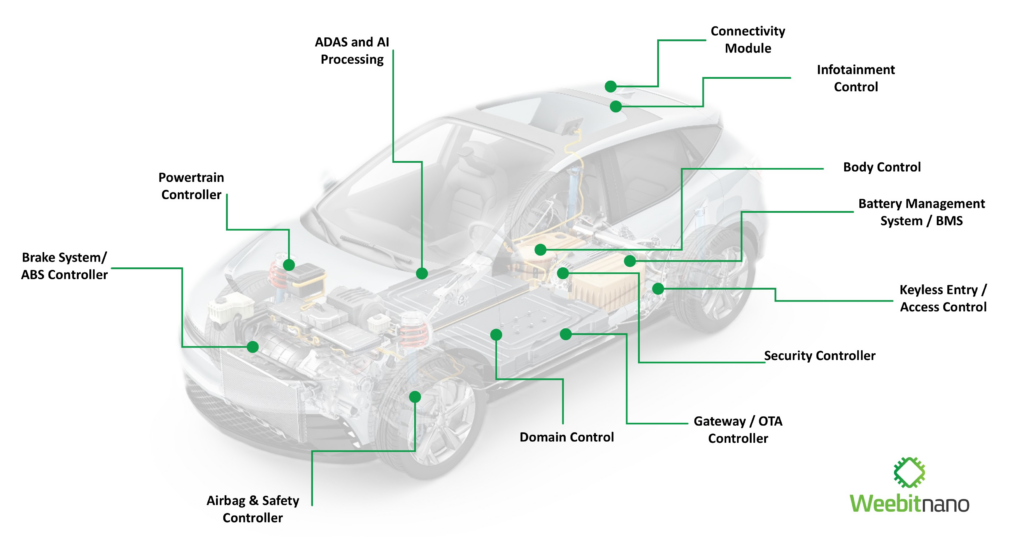
Above: Some places NVM is used in a vehicle

Memory has become a critical enabler of the software-defined vehicle. It must deliver predictable performance while also providing reliable, secure and scalable storage for the growing amount of software and data modern vehicles rely on.
Memory therefore sits inside a strict timing budget. Every instruction the processor runs is fetched from memory using precious time. In a consumer device, an occasional slow fetch goes unnoticed; in a vehicle deciding whether to brake, the timing must be known and bounded. Embedded flash has filled this role for years: dense, low-cost and well understood, storing firmware, calibration data and other code that changes rarely. The demands on it are now growing.
Advanced driver assistance and AI-enabled vehicle functions have moved more software into the safety-critical path. Lane keeping, automatic emergency braking, sensor fusion, and autonomous driving all depend on code and data that must be accessed reliably and often in real time. Engineers certifying these systems need to know the worst-case execution time of each critical routine, not the average.
Conventional memory architectures make that figure hard to establish. A cache keeps recently used instructions close to the processor, so most accesses are fast. A cache miss adds latency that is hard to predict for any single run. Branch prediction and speculative execution behave in a similar way, improving typical performance while complicating worst-case analysis.
In an ISO 26262 design, this unpredictability must be accounted for: the engineer must prove that a safety-critical function always completes within its allotted time, and statistical speed-ups make that proof harder to construct.
One common answer is tightly coupled SRAM, wired directly to the processor for fast, guaranteed timing. SRAM is costly in area and power, and the volume of safety-critical code keeps rising, so holding all of it there becomes expensive. Designers need embedded memory that combines predictable performance with the density and scalability required by modern automotive systems. Embedded ReRAM can provide a compelling alternative by providing substantially higher density than SRAM while maintaining the predictable access characteristics needed for many embedded automotive applications.
The software-defined vehicle also changes how often automotive memory is written. Vehicle software was once programmed in the factory and rarely altered. In today’s cars, especially EVs, over-the-air updates add features and fix faults throughout a vehicle’s life.
This raises the importance of endurance and integrity of updates. A controller that once received a single factory programming may now be rewritten many times, each write performed in a vehicle in service. The memory also must retain its contents for many years across a wide temperature range. Compared with other consumer devices, automotive systems may perform many more frequent writes into their non-volatile code storage, and each one carries far greater reliability requirements. A single instance like that, under warranty, can eat the entire profit margin on a vehicle.
Non-Volatile Memory (NVM) at advanced nodes
Embedded flash is also becoming harder and more costly to integrate as logic processes advance. Below roughly 28nm, adding flash to a logic process can require far too many process steps. As automotive processors migrate to more advanced nodes for greater compute performance and lower power, designers are increasingly evaluating alternative embedded non-volatile memory technologies that scale more naturally with advanced logic processes.
Some designs address this challenge by moving non-volatile memory off-chip. External flash is workable, but fetching data from it needs to cross chip boundaries, adding latency and variation to timing that a real-time system needs to control. It actively moves in the wrong direction for today’s automotive design imperatives. It also raises component count.
Automotive chipmakers are therefore looking for embedded non-volatile memory technologies that not only scale with advanced logic, but also support the increasing software, AI and reliability demands of next-generation vehicles. MRAM, phase-change memory and ReRAM are the main candidates.
ReRAM stores data by changing the resistance of a thin material layer rather than by holding charge on a floating gate. The storage element is built in the back-end-of-line layers above the transistors, so it can be added to a logic process without the scaling limits of embedded flash.
Reads are fast and their latency is consistent. The consistent latency lets a processor execute code directly from the non-volatile memory without copying it into SRAM first. ReRAM also writes individual words without the block-erase step required by flash. This simplifies software updates, reduces write latency and supports more efficient incremental updates, data logging and parameter storage throughout a vehicle’s lifetime. Because it does not rely on stored charge, it is inherently tolerant to ionizing radiation effects that can disrupt charge-based memories.
Designing for automotive with ReRAM
Electric powertrains are a demanding environment for memory. A traction inverter switches high currents and voltages, generating heat and electrical noise. A battery management system runs continuously, monitoring cells, recording data and controlling charge and discharge over the life of the pack. Some of this hardware operates at temperatures approaching the 150°C ceiling of AEC-Q100 Grade 0, and the memory in it has to retain data and keep working throughout.
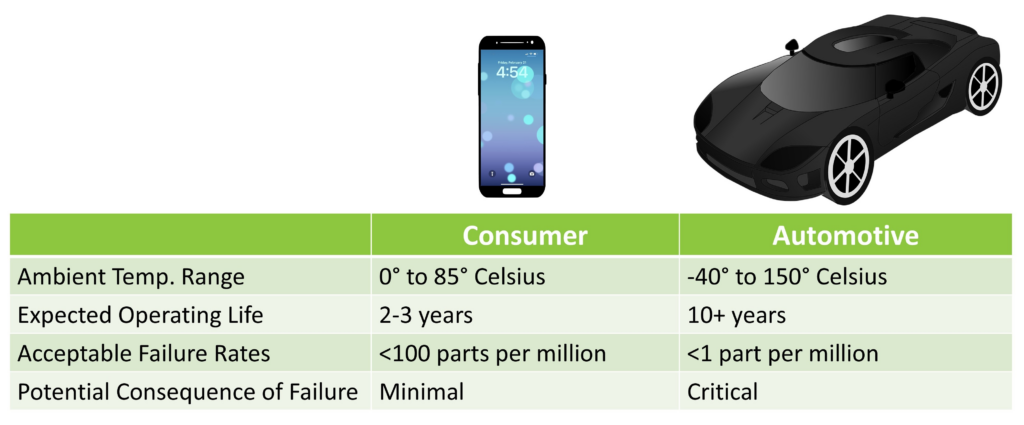
Above: consumer versus automotive requirements
High temperature is a particular problem for flash memories that store data as electrical charge, because charge leaks away faster as temperature rises. ReRAM’s resistive storage does not depend on retained charge, so its retention characteristics under elevated temperature differ fundamentally from those of charge-based memories. It is also less sensitive to the switching noise around power electronics, and its endurance suits systems that log operating and battery data continuously.
Automotive parts are held to a defect rate close to zero; an automotive memory is expected to approach less than one defective parts per million. Reaching that level is a design problem as much as a process one.
The main tool is error correction. The memory stores extra bits alongside each data word and uses them to detect and repair errors on read, and the strength of the code sets how many bit errors a word can survive. For a given raw bit error rate, a two-bit correcting code meets consumer defect targets, while automotive targets generally require three-bit correction.
AEC-Q100
A new memory technology has to show more than good laboratory results: automotive customers want measured reliability from manufactured parts under environmental stress.
AEC-Q100 is the main qualification standard for automotive integrated circuits, and it sorts parts into four temperature grades. Grade 0 is the most severe, covering −40°C to +150°C for the harshest locations, such as near the engine or the power electronics. Grades 1 to 3 relax the upper limit to 125°C, 105°C and 85°C for less exposed positions.
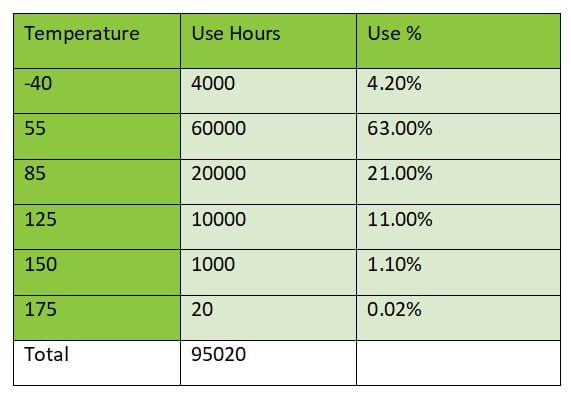
Above: An example of a calculation for an automotive mission profile
The standard is built around a mission profile, a model of how a part is used over a service life of 15 to 20 years. A component spends most of that time at moderate temperature and only a small fraction near its ceiling, and the qualification weights its test time to match those proportions.
Qualifying a non-volatile memory runs several test families. Endurance cycles the memory to its rated write count. High-temperature operating life holds it powered at maximum temperature for an extended period. Data retention bakes programmed parts, often above the operating maximum, to confirm they keep their contents. Low-temperature retention with read-disturb checks that repeated reads do not corrupt stored data.
In March 2025, Weebit Nano reported that its embedded ReRAM module had completed AEC-Q100 qualification in a 130nm CMOS process. The qualification covered endurance, data retention and high-temperature operating life, with the module tested at 150°C and completing up to 100,000 write cycles. That gives automotive chipmakers measured reliability data from manufactured silicon rather than projections from test structures.
The commercial stakes are large. Yole Intelligence valued the automotive semiconductor market at US$52 billion in 2023 and forecast US$97 billion by 2029, with growth driven largely by electrification, ADAS and rising software content. Each of those trends adds to the demands placed on embedded memory.
Security
Memory placement also affects vehicle security, which is now a regulated requirement. UN Regulation 155 and the ISO/SAE 21434 standard require carmakers to manage cybersecurity risk across a vehicle’s life, and an external flash chip works against that. It exposes a bus that can be observed and a package that can be physically attacked to read or alter its contents.
Moving the non-volatile memory onto the SoC removes that external interface and shrinks the attack surface, because code and keys that stay on-die are harder to reach. ReRAM adds a further property. Because information is stored as the resistance of a conductive filament rather than as an electrical charge, ReRAM offers security characteristics that differ from conventional floating gate memories.
The same physics supports hardware security features. Small, uncontrolled variations between ReRAM cells can form a physically unclonable function (PUF), a per-chip fingerprint that is expensive to copy and can seed cryptographic keys. This allows embedded memory to support hardware security features as well as code storage.
Passing qualification is one step toward an automotive design win. Automotive buyers also want assurance of supply, especially after the shortages of 2021: more than one source, mature processes and a credible roadmap before committing a memory to a platform that might easily ship for a decade.
Weebit licenses its ReRAM into several foundries. Software is ready for production and a 130nm BCD process at DB HiTek, aimed at power-management and mixed-signal automotive parts, is in qualification. Newer customers for the technology include onsemi and Texas Instruments, a major automotive supplier. This spread suits automotive customers, who prefer not to depend on a single fab.
Next generation
Vehicles will keep adding sensors, AI capabilities, compute and software, and more of that software will need to run within tight timing limits or be updated after the car is in service. These requirements demand memory that scales with advanced logic, operates reliably at high temperature and offers predictable timing.
Memory is becoming an architectural choice rather than a component selected late in design. Embedded flash may well stay in the automotive memory mix, particularly in mature processes where its cost and reliability are established. As processors move to smaller nodes and vehicles become increasingly software-defined and AI-enabled, embedded ReRAM is emerging as an attractive option for designers seeking scalable, reliable and predictable embedded non-volatile memory.