


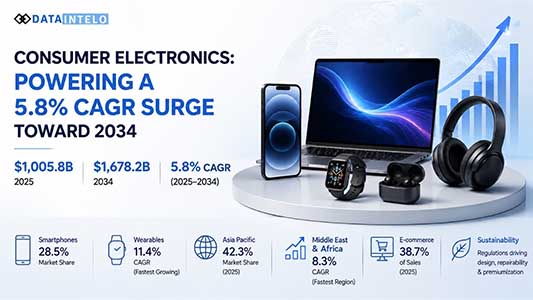
The consumer electronics industry has had the past three years to get used to shocks, from spikes in demand during the time of the pandemic to the supply chain issues of semiconductors and inflation causing belts to tighten. Projections for the consumer electronics industry by Detaintelo stand at $1,005.8 billion in 2025, reaching $1,678.2 billion by 2034, at a CAGR of 5.8%. For an industry this mature, that is not a boom number. It is, however, a durable one, and durability is what boardrooms are increasingly pricing in after several years of volatile demand signals. This particular cycle deserves more attention not due to its growth rate in general but rather where this growth is taking place and how regulations and technology change its borders.
KEY TRENDS
- The worldwide consumer electronics market is estimated to be worth $1,005.8 billion in 2025 and $1,678.2 billion in 2034, with a CAGR of 5.8%.
- 5G adoption, on-device artificial intelligence and batteries are the top-three technologies driving growth in consumer electronics demand.
- The Asia Pacific region maintains the position of being the main driver for the growth of the market, having 42.3% market share, whereas the Middle East & Africa, and Latin America are the most rapidly developing regions, growing with a CAGR of 8.3% and 7.1%, respectively.
- Smartphone retains its leading position within the segment, having a market share of 28.5%, whereas wearables is the most rapidly developing product segment, with a CAGR of 11.4%.
- The influence of regulation, especially the Digital Product Passport in Europe and the Right to Repair mandates, is as big of a factor as any technology on product design, warranties, and margins.
What’s Actually Driving the Numbers
Three forces are converging to underwrite this growth, and none of them is new what has changed is how deeply they are now embedded in product roadmaps.
5G and connectivity upgrades. Upgrades facilitated by subsidy deals provided by carriers, as well as mmWave/sub-6 GHz modem compatibility, keep pushing users towards getting new smartphones and tablets, especially in North America, Europe, and even Southeast Asia and Gulf countries. The story of connectivity is no longer limited to phones; wearables, AR headsets, and health monitoring devices also rely on high bandwidth for cloud synchronization capabilities.
On-device AI as the new upgrade trigger. The upgrades enabled through the subsidization arrangements made by the carriers, along with the compatibility of mmWave/sub-6GHz modem, keep compelling users to replace their existing smartphones and tablets with newer versions in North America, Europe, and even Southeast Asia and Gulf regions. Connectivity does not revolve around only telecommunication these days; even wearables, augmented reality devices, and health sensors need high bandwidths to synch with the cloud.
Battery chemistry finally catching up to demand. Runtime gains of 20–30% in flagship devices, fast-charging that delivers 80% capacity in 30 minutes, and early movement toward silicon-dominant and solid-state architectures are quietly removing one of the biggest historical objections to heavier on-device compute: battery anxiety. This matters more than it sounds extended-range wireless earbuds, portable displays, and always-on wearables are only commercially viable because battery technology has closed the gap.
Where the Growth Is Concentrated
Regional dynamics tell a more interesting story than the headline CAGR. Asia-Pacific continues to dominate with 42.3% of worldwide revenue share – about $425 billion in 2025 – with the help of manufacturing capacity in China, Japan, South Korea, and Vietnam, and increased middle-class demand in India and Southeast Asia. However, it is in other areas that the highest growth is occurring: the Middle East & Africa area is growing at a rate of 8.3% CAGR due to liberalization of telecommunication regulations and rising middle classes in such countries as Nigeria and Kenya, while Latin America shows growth of 7.1% CAGR with mobile-first consumers in Brazil and Mexico skipping the desktop computing phase.
North America and Europe, on the other hand, show lower growth driven by margins – 4.2% and 3.8% CAGR, respectively – with premiumization, sustainability regulations, and service attach rate being key drivers.
Concerning the products, smartphones still represent the core product type with 28.5% share and 6.1% CAGR; nonetheless, it is the edge that brings about really exciting developments, namely, the growth rate of wearables being 11.4% CAGR, which means more than twice the industry average and is fueled by the health monitoring capabilities (ECG, blood oxygen and glucose trend) which turn wearable devices from a mere fashion accessory into something more oriented towards people’s health concerns. Television sets have reached their maturity stage in developed geographies with -0.8% CAGR due to the cord-cutting trend.
The Regulatory Layer Decision-Makers Can’t Ignore
Sustainability regulation has moved from a marketing talking point to a design constraint. The European Union’s Digital Product Passport requirements and forthcoming Right to Repair legislation are compelling manufacturers to build for repairability, extend warranty periods, and guarantee spare-parts availability changes that add compliance cost but also open a pricing lever, since consumers in these regions are showing willingness to pay a 5–10% premium for demonstrable sustainability commitments. Battery recycling mandates requiring 90% material recovery in parts of Europe are pushing manufacturers to stand up take-back and refurbishment infrastructure well ahead of when it becomes commercially optional.
For senior decision-makers, the practical implication is that “sustainability” is no longer a CSR line item — it is quietly becoming an access requirement for the EU and a differentiation lever everywhere else, which means product, legal, and supply-chain teams need to be aligned earlier in the design cycle than has historically been the norm.
Adoption Patterns Worth Watching
Two adoption shifts stand out for anyone allocating budget against this industry. First, e-commerce is not just growing it is restructuring the distribution stack. Digital media is growing at an annual rate of 9.2%, accounting for 38.7% of worldwide sales, while putting pressure on the specialty retail and supermarkets segments which used to benefit from walk-in customers. Second, the financing of consumer electronics in emerging countries is gradually turning out to be a demand multiplier, as “buy now and pay later” and microfinance-facilitated device purchases are expected to rise to 40% of unit sales from currently around 15% until 2034”.
Industrial and commercial applications of ostensibly “consumer” hardware are also worth flagging. Ruggedized consumer electronics platforms — the same sensor stacks and compute modules found in flagship phones — are increasingly substituting for purpose-built industrial equipment in asset monitoring, logistics, and quality control, a trend growing at 8.9% CAGR and one that blurs the line between consumer and industrial electronics procurement in ways that category-specific budgets haven’t fully caught up to yet.
Reading the Risks
The growth story isn’t risk-free. Manufacturing overcapacity in China and Vietnam is compressing margins across mainstream categories, pushing undifferentiated players toward cost-only competition. Issues in semiconductor supplies and the politics between major manufacturers will continue to jeopardize the product launch timing and inventory management in the exact period – holiday quarter or flagship launch – when it’s important. Moreover, there is another more silent problem of cannibalization: as smartphones equipped with AI technologies start to replace both tablets and laptops for productivity and entertainment tasks, product categories that lack strong replacement story might face replacement cycle deceleration, while smartphones themselves remain stable.
The Bottom Line

5.8% CAGR till 2034 does not mean creation of an innovative category: it means finding of the new replacement trigger (AI, connectivity, battery life) for the mature industry (which has been already growing for years) just as old ones (basic specifications improvements) are running out of steam. The more useful message for the decision-maker is hidden behind the above figure: growth is shifting towards wearable devices, volumes in the developing regions, e-commerce and regulation driven premiumization, while TV and standard laptops will grow at single-digit rates in mature regions. Being positioned against the right places of the growth becomes more important than ever before. Read A Full Report: https://dataintelo.com/report/consumers-electronic-market
Author Bio –
Ashish Kolte is a Marketing Manager at DataIntelo with expertise in marketing, market intelligence, and business strategy. He combines marketing insights with industry research to analyze market trends, identify growth opportunities, and provide data-driven perspectives on emerging industries and global business developments.