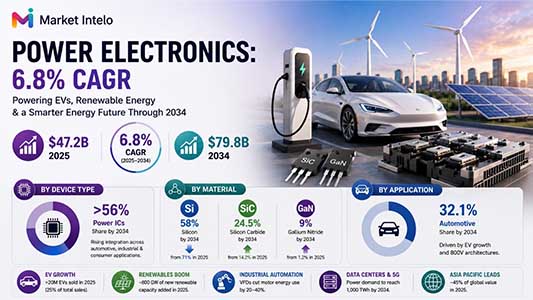
Power electronics does not usually get the attention that goes to the latest AI accelerator technologies, but it is the case that the power electronics sector forms the backbone of all electrification developments that receive coverage. Each electric car, each solar inverter, and each hyperscale data center rack requires the use of power electronics to deliver energy. A recently published report by Market Intelo the value of the global power electronics industry is expected to be around $47.2 billion in 2025 and to reach $79.8 billion by 2034, with a CAGR of 6.8%.
Inside the Forecast: Segment and Material Shifts

The report’s breakdown of the power electronics industry by device type, material, and application is where the forecast becomes genuinely useful for planning. Power ICs which include regulators, drivers, and power switches are expected to reach more than 48% of the market today and grow beyond 56% in 2034, due to an increasing level of integration within the automotive, industrial, and consumer segments. The rest of the market is shared between power discrete components and power modules, with power modules becoming increasingly important due to electric vehicles, renewable energy inverters, and industrial motors.
In terms of materials, the forecast provides the best glimpse of the direction the industry is moving, as silicon’s proportion drops from 71% in 2025 to 58% in 2034, while silicon carbide (SiC) moves up from 14.2% to 24.5%, while gallium nitride (GaN), currently 1.2% of the market, expands by more than seven times to 9% of the industry in 2034. As far as applications go, the forecast sees the automotive segment move ahead of consumer electronics as the largest one and growing from 24.2% to 32.1% in 2034, thanks to the rapidly developing EV sector, which Yole projects to grow at 18.5% per year. Just that one prediction alone – of automotive becoming the largest segment of the power electronics industry – is perhaps the most important planning signal of all for anyone looking to invest in power semiconductor R&D or manufacturing in the coming decade.
Recent Developments Setting the Pace
Supplier activity across the power electronics industry right now lines up closely with the forecast. Wolfspeed recently unveiled its fifth-generation SiC MOSFET platform for 750V–1200V devices, rolling out through 2026–2027. Onsemi signed a collaboration agreement with GlobalFoundries to co-develop 650V-class GaN-on-silicon products on its 200mm line, widening the GaN manufacturing base beyond a handful of established industry players. Infineon is ramping the first phase of what it calls the world’s largest 200mm SiC fab, in Kulim, Malaysia, to close the gap between automotive demand and wafer supply.
STMicroelectronics introduced galvanically isolated gate drivers built for the 800V EV architectures now becoming standard across the industry. And Infineon signed an MoU with LS ELECTRIC to co-develop high-efficiency DC power infrastructure for AI data centers — a sign that compute infrastructure is now a first-order demand driver for the power electronics industry, alongside the automotive and renewable energy sectors.
What’s Actually Driving the Industry
But still, electric cars continue to be the driving force behind growth, albeit not quite evenly distributed from a regional perspective. The global sales of electric cars surpassed 20 million units in 2025 one-fourth of the total car sales with the IEA predicting about 23 million in 2026 that represent almost 30% of the whole vehicle market. Europe experienced the highest growth rate compared to the other major electric vehicle regions in 2025 at 30%.
While China continues to be the largest region in terms of electric vehicles, it is also experiencing zero growth for the first time this decade, while U.S. electric vehicles are down 45% year-over-year. Every EV carries far more power electronics content than the combustion vehicle it replaces an onboard charger, DC-DC converter, and traction inverter and the shift from 400V to 800V battery architectures raises the performance bar those semiconductors must clear. SiC’s 2–3 percentage point efficiency gain over silicon in traction inverters translates directly into real-world range, which is why it is becoming the default choice across the EV power electronics industry.
Renewable energy is the second engine of growth. The world added about 800 GW of renewables capacity in 2025, marking a year-on-year increase of 16%, where solar PV capacity topped 600 GW for the first time and the total solar capacity climbed to more than 2,800 GW accounting for the most generation capacity installed in the world. The country of China alone added almost 500 GW of new capacity. Every gigawatt needs proportional inverter and converter hardware, and battery storage a segment expanding at CAGRs several analysts place above 25% is the fastest-growing sub-segment feeding this side of the power electronics industry.

Industrial automation adds a steadier layer of demand to the industry: variable frequency drives cut motor energy consumption 20–40% versus fixed-speed operation, making power electronics a bankable efficiency retrofit regardless of subsidy cycles. Data centers and 5G represent the fastest-rising segment of the industry, as AI workloads push power consumption higher and hyperscalers increasingly design custom power delivery architectures. The report puts global data center power consumption on a path from 750 TWh in 2025 to 1,000 TWh by 2034 a trajectory tied directly to sustained ICT growth.
Regional Outlook and Regulatory Developments
Asia Pacific remains the power electronics industry’s center of gravity, commanding roughly 45% of global value, with China’s EV manufacturing scale and renewable build-out doing much of the work. Europe holds a strong second position in the industry on the back of decarbonization policy and Europe’s leading EV growth rate. North America’s position in the industry is more complicated: a strong industrial and defense manufacturing base offsets a sharp pullback in EV incentives and renewable project support, with the IEA revising its 2025–2030 U.S. renewable growth forecast down nearly 50%.
The regulatory development most underpriced by power electronics procurement teams is China’s use of critical-mineral export controls. China controls roughly 98% of global refined gallium production the base material for GaN power semiconductors and used licensing restrictions on gallium and germanium as leverage in its technology dispute with the U.S., tightening to a near-total export ban in December 2024 before a one-year suspension was negotiated in November 2025.
That suspension expires on November 27, 2026, after which full restrictions could return and disrupt the GaN supply chain. The U.S. is trying to build a domestic counterweight roughly $750 million in CHIPS Act funding is going toward expanding Wolfspeed’s SiC manufacturing capacity but whether that capacity arrives before the deadline is one of the more consequential open questions facing the industry.
Technology Trends and Case Studies
Wide-bandgap semiconductors are moving from premium option to default choice. Tesla was the first major automaker to adopt SiC at scale, with BYD and Hyundai among the more recent high-volume adopters. Integration is compressing the bill of materials, as Intelligent Power Modules bundle switches, gate drivers, and protection circuitry into single packages that shorten OEM time-to-market Thermal management is evolving into a separate discipline, owing to increased power density, especially in EV inverters and AI power delivery in data centers.
The GaN partnership between onsemi and GlobalFoundries demonstrates how the industry is solving its capacity bottleneck by not requiring all the GaN players to construct a separate fab but by adopting a foundry approach, similar to that of the semiconductor industry decades ago. The Infineon–LS ELECTRIC partnership shows suppliers co-developing power delivery architectures alongside infrastructure partners before a facility even breaks ground — mirroring how Tier 1 suppliers already sit inside vehicle platform design in automotive, rather than bidding on a finished spec.
Challenges and What This Means for Decision-Makers
Wide-bandgap fabrication capacity remains genuinely constrained — new SiC and GaN fabs cost billions and take years to bring online, so allocation, not raw demand, is often the binding constraint today. China’s gallium and germanium licensing clock adds a live geopolitical risk on top of that. Competitive pricing pressure from lower-cost Chinese manufacturers, such as BYD Semiconductor and San’an Optoelectronics, is compressing margins on commoditized components even as premium wide-bandgap segments hold up better.
For engineering leaders, component decisions made today silicon versus SiC, discrete versus module will shape efficiency, cost, and time-to-market for years, given how capacity-constrained wide-bandgap supply remains. For procurement leaders, the concentration of manufacturing in Asia Pacific alongside a gallium licensing deadline set for November 27, 2026 argues for dual-sourcing and earlier supplier engagement rather than late-cycle qualification. For strategists tracking where electrification capital is landing, the power electronics industry remains a reliable proxy: it grows wherever EVs, renewables, industrial automation, or AI infrastructure investment is genuinely happening — and the regional divergence within that growth, not just the headline CAGR, is where the real signal lies through 2034.
Reference: https://marketintelo.com/report/power-electronics-market