



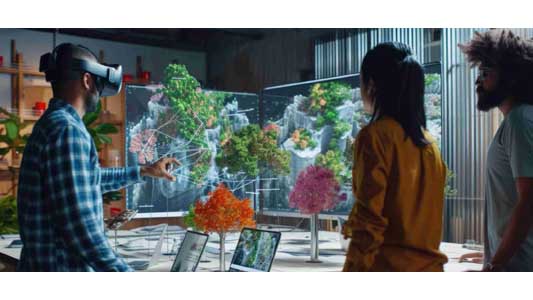
Physical space has quietly become a technology decision. For most of the digital era, organisations treated classrooms and meeting rooms as containers, four walls into which they poured projectors, cables and codecs, and measured success by uptime rather than by what people actually experienced inside them. Artificial intelligence has inverted that logic. When a display can recognise handwriting, frame a speaker automatically, translate a lesson as it is being delivered or summarise a discussion before participants leave the room, the room itself becomes the interface. The question confronting decision-makers in 2026 is therefore no longer which devices to procure. It is about what kind of human experience a space is designed to produce.
That reframing arrives at a moment of genuine strain. Microsoft’s 2025 Work Trend Index, built on trillions of productivity signals and a survey of 31,000 knowledge workers across 31 markets, found that employees are interrupted roughly every two minutes during core hours, around 275 times a day. The same research recorded that 53 per cent of leaders believe productivity must rise even as 80 per cent of the global workforce reports lacking the time or energy to do its work. Classrooms tell a parallel story. Teachers juggle digital content, continuous assessment and attention spans that fragment quickly in front of passive media. Sprawling, disconnected technology created much of this fatigue, and intelligently designed space is emerging as the corrective. Nowhere is that shift more visible than in Indian public policy.
Policy Has Already Wired the Nation’s Classrooms
India has effectively legislated the intelligent classroom into existence. Under the ICT and Digital Initiatives component of Samagra Shiksha, 146,040 smart classrooms stand approved across states and union territories, as the Union Education Minister informed the Lok Sabha in 2025, while the Ministry of Education’s own scheme records show more than 1.2 lakh ICT labs sanctioned since inception. Each eligible school can draw a non-recurring grant of Rs 2.40 lakh for two smart classrooms along with recurring support for e-content and electricity. The National Education Policy 2020 supplies the pedagogical mandate, explicitly encouraging investment in virtual labs, digital repositories, online assessment and technology-integrated teaching practice.
Beneath the hardware sits an equally deliberate push on people and connectivity. Nearly 14.8 lakh tablets have been sanctioned for primary school teachers under the same scheme, and the Union Budget 2025 committed BharatNet broadband to every government secondary school in rural areas, closing the last-mile gap that stranded earlier digitisation drives. The intent is unmistakable. A smart classroom is being defined not as a screen on a wall but as a connected, teacher-led learning environment.
Demand at this scale reshapes supply. Import-led models struggle to serve procurement that runs through the government e-marketplace, insists on responsive after-sales networks in tier-2 and tier-3 towns and increasingly asks for AI features that work in Indian languages. Domestic manufacturing of interactive displays under the Make in India programme has consequently moved from aspiration to competitive necessity, and panels assembled in industrial corridors such as Greater Noida now compete on service response, uptime guarantees and localisation rather than on landed cost alone. Policy has built the pipeline. Capital is now deciding what flows through it.
Follow the Capital, Not the Panel
Investors have noticed that value is migrating upward from glass to intelligence. Global Market Insights values the worldwide interactive flat panel display market at USD 12.6 billion in 2024 and projects it to reach USD 25.7 billion by 2034 at a compound annual growth rate of 7.5 percent. The more revealing movement sits inside that headline figure. As Asian production capacity expands and average selling prices compress, hardware alone commands thinner margins every year, while embedded intelligence such as handwriting recognition, voice control, automatic camera framing, noise suppression and real-time translation has become the differentiator institutional buyers actually cite in tenders. Pricing power is shifting toward the software suites, content ecosystems and AI services that ride on the display, a pattern familiar to anyone who watched smartphones evolve from devices into platforms.
Buying behaviour is changing in step with these shifts. Procurement that once sat with an audio-visual integrator now runs through committees of CIOs, HR leaders, facilities heads and academic councils, and these committees evaluate proposals on room utilisation, meeting equity, learning outcomes and engagement analytics rather than on lumens and port counts. India’s corporate demand adds its own multiplier. With more than 1,700 global capability centres operating in the country and hybrid collaboration now structural rather than temporary, every review between Bengaluru and Boston depends on rooms that make distributed teams feel equally present.

A note of caution belongs in every boardroom conversation on this subject. Industry veterans know the failure mode well. A panel procured as a status symbol ends up used as an oversized television, its touch layer untouched, its software unopened, the investment quietly written down within a budget cycle or two. Deployments succeed when they begin with the behaviours an institution wants to change, whether teacher confidence, meeting discipline, or hybrid inclusion, and work backwards to the technology, treating training and after-sales support as part of the product rather than an afterthought. Experience-led thinking is not a slogan. It is the discipline that separates productive assets from expensive shelfware, and it points directly at what these rooms should actually feel like.
From Installed Technology to Lived Experience
Step into a well-designed intelligent classroom, and the technology is nearly invisible. A teacher writes on a low-parallax touch surface as naturally as on paper, and generative AI converts that handwriting into structured notes, calls up a three-dimensional simulation of the concept being taught and assembles a quick formative quiz matched to each learner’s pace. Lessons stop being broadcasts and become conversations. Personalised learning journeys, long promised by edtech, finally turn practical when the intelligence lives in the room rather than in a distant server hall, with the teacher remaining at the centre of the experience instead of being displaced by it. Classroom evidence keeps repeating the same pattern. When students touch, annotate and manipulate content directly, curiosity and attention convert into stronger motivation and visibly better participation.
Meeting rooms follow the same design grammar. An AI camera frames whoever is speaking so that remote colleagues see faces rather than a distant conference table, voice commands start a session in seconds, any participant shares content wirelessly from a personal device, and a summary of decisions and actions is ready before the room empties. Every one of those capabilities attacks the friction documented in the productivity research cited earlier. Minutes once lost to adapters, log-ins and manual note-taking return to actual thinking, and hybrid participants stop being second-class attendees. Meeting equity, until recently an HR talking point, becomes an engineering outcome of the space itself.
Fidelity matters more than the industry usually admits. People disengage from surfaces that lag, glare or blur, which is why 4K clarity, responsive multi-touch and immersive audio are not luxury specifications but preconditions for attention. Experiential AV extends the same principle to the whole room. Lighting that adapts to content, acoustics tuned for natural speech and displays that render a beating heart or a load-bearing truss in lifelike detail turn abstract material into something learners and teams can inhabit. Indian deployments add their stress test, with ambient noise, variable power and lighting, and heavily shared devices, which makes rugged engineering and low-glare surfaces as consequential as any AI feature on the specification sheet. Sensory quality, in other words, is pedagogy and productivity by another name.
Trust will decide how far the intelligence is allowed to go. Rooms that listen, watch and transcribe raise legitimate questions about consent and data residency, and India’s Digital Personal Data Protection Act has given those questions statutory teeth. Institutions will increasingly favour architectures that process voice and video on the device itself, keep student and employee data within defined boundaries and give administrators clear control over what is recorded and retained. Vendors who treat privacy as a design input rather than a compliance checkbox will find it a durable source of advantage, particularly in government and education procurement where scrutiny runs highest.
A useful test emerges for any administrator or CXO weighing an intelligent space. Judge the room not by what it contains but by what it removes. Cables removed, sign-in screens removed, the dead minutes at the start of every class or call removed, the nagging doubt over whether the far end can hear removed. Human-centric design in AV means the technology recedes so completely that people forget it is there, and what remains is a group of learners or colleagues fully present with one another. That is the standard against which the next procurement cycle will be judged.
The stakes are ultimately individual. A student in a tier-3 town who can walk through a working 3D model of the human heart in her government school. A first-time manager who runs a global review without touching a cable. A teacher who reaches home on time because the assessment built itself during the lesson. These are the real returns on intelligent spaces, and they compound in ways no balance sheet fully captures. The organisations that lead the coming decade will design for the way people actually learn and work and then let intelligence disappear into the surface. The brilliance, in the end, was never in the panel.