


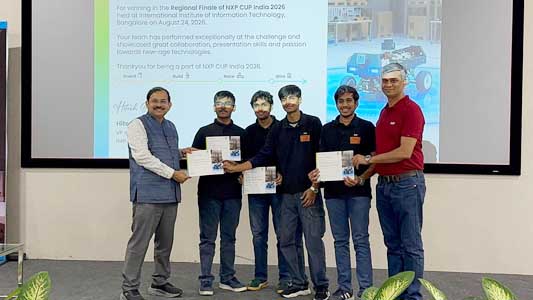
Bengaluru: A four-member student team from the Manipal Institute of Technology (MIT), Bengaluru, a constituent unit of the Manipal Academy of Higher Education (MAHE), an Institution of Eminence Deemed-to-be University, has won the Regional Final of the NXP Cup India 2026, demonstrating its capabilities in artificial intelligence, robotics and autonomous systems. The win has secured the team a place in the national-level Grand Finale scheduled for November.

Competing as Team MAVERIC, the students topped the regional round held on August 19 with an autonomous robotic solution designed for medical response applications. The team comprises Mandava Mohan Sai Koushik, Tushar S Chillal, Aditya Sinha, and Akshat Chauhan.
The challenge tested the students’ ability to integrate multiple engineering capabilities into a single autonomous system. Their solution was designed to navigate complex environments, identify patients, map appropriate pickup and delivery points, recognise road signs and safely transport patients to the correct hospital.
The NXP Cup India, organised by NXP Semiconductors, challenges engineering students to develop mobile robotics prototypes using technologies including artificial intelligence, machine learning, computer vision, LiDAR, sensor integration, object recognition, obstacle avoidance and autonomous navigation. The 2026 edition is centred on Autonomous Medical Response, requiring teams to apply these technologies to a complex healthcare-related mobility challenge.
The regional competition was conducted in a virtual environment using the Gazebo robotics simulator. As regional winners, Team MAVERIC will now receive an NXP MR-Buggy3 hardware development kit and move from simulation to physical implementation. The students will have to adapt, refine and test their solution on the robotic platform before competing at the national Grand Finale.
Congratulating the students, Dr Madhu Veeraraghavan, Pro Vice Chancellor, MAHE Bengaluru, said, “This accomplishment demonstrates our students’ ability to translate classroom learning into practical solutions for real-world challenges. What is particularly encouraging is their ability to bring together multiple technologies and work collaboratively towards a solution with potential societal relevance. Experiences such as these build not only technical competence, but also the problem-solving ability, adaptability and confidence required to contribute to rapidly evolving fields such as artificial intelligence, robotics and autonomous systems,”
Dr Iven Jose, Director, MIT Bengaluru, said, “Team MAVERIC’s achievement reflects how innovation, teamwork and hands-on learning can translate into competitive success. The NXP Cup challenges students to work at the intersection of robotics, artificial intelligence and autonomous systems, while solving a meaningful real-world problem. We congratulate the team and look forward to seeing them take their solution from simulation to the physical platform at the Grand Finale.”
“The development phase had its ups and downs, but we learnt a great deal throughout the journey. The experience will directly support our larger goal of building an autonomous go-kart. The institution provided us with the facilities and support needed to understand autonomous systems, and we are now working on implementing our simulated code on real-world hardware. We hope to perform well and win at the national finale,” said Team MAVERIC.
The regional victory highlights the students’ ability to work across AI, robotics, computer vision and autonomous navigation while responding to a problem with real-world relevance. It also reflects MIT Bengaluru’s emphasis on experiential and industry-oriented learning, where students are encouraged to move beyond theoretical understanding and build, test and refine technological solutions.
Team MAVERIC will now focus on converting its successful virtual prototype into a working autonomous robotic system. At the NXP Cup India 2026 Grand Finale in November, the team’s technical efficiency, system integration and ability to perform in a physical environment will be put to the test as it competes at the national stage.