


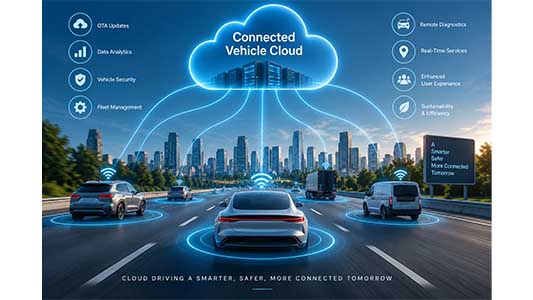
The automotive industry is undergoing a fundamental shift. Vehicles are no longer viewed simply as mechanical products assembled with fixed hardware and software. Increasingly, they function as connected digital platforms capable of communicating with cloud systems, receiving software updates, processing data, and delivering new services throughout their operating life. This transition is creating strong opportunities for the Connected Vehicle Cloud Market, as automakers seek reliable infrastructure to manage the growing flow of data between vehicles, drivers, applications, and mobility networks.
According to Persistence Market Research, the global connected vehicle cloud market is expected to be valued at US$240.4 billion in 2026 and is projected to reach US$572.6 billion by 2033, expanding at a CAGR of 13.2% during 2026 to 2033. The projected growth reflects increasing investment in connected services, vehicle diagnostics, over-the-air updates, artificial intelligence (AI), fleet management, and digital vehicle experiences.


Software defined vehicles are reshaping cloud requirements
The rise of software defined vehicles (SDVs) is one of the clearest developments influencing the market. Traditionally, vehicle capabilities were closely tied to the hardware installed at the time of manufacturing. Newer architectures are changing that model by shifting more functionality into software and centralized computing systems.
For automakers, this creates the ability to update vehicle functions remotely after delivery. Over-the-air (OTA) updates can improve existing features, address software issues, introduce new capabilities, and enhance vehicle performance without requiring a physical visit to a service center. Behind these capabilities sits a cloud infrastructure that manages software deployment, vehicle data, diagnostics, and communication.
Automakers are also exploring partnerships and standardized architectures to make SDV development more efficient. In August 2026, Honda and Nissan announced plans to jointly develop standardized electronic control units, operating systems, middleware, and vehicle-control software for next-generation vehicles planned from fiscal 2029 onward. Such initiatives underline the industry’s broader movement toward common software platforms and more streamlined vehicle architectures.
AI is expanding the value of connected vehicle platforms
Cloud connectivity is also taking vehicle intelligence well beyond traditional telematics. Earlier systems largely focused on navigation, vehicle tracking, diagnostics, remote locking, and other basic connected functions. AI is now broadening the range of applications.
Cloud-supported AI can help automakers analyze vehicle behavior, identify maintenance requirements, personalize digital services, improve driver assistance systems, and develop intelligent in-vehicle assistants. Large volumes of vehicle-generated information can be processed centrally, allowing AI models and software applications to be refined over time.
The concept of the AI-defined vehicle is gaining attention as manufacturers explore systems capable of adapting to driver preferences, traffic conditions, road environments, and individual usage patterns. This could make cloud infrastructure increasingly important not just for storing information, but also for continuously improving the intelligence embedded within vehicles.
Vehicle data is becoming an important automotive resource
Connected vehicles generate information from cameras, sensors, battery management systems, powertrain components, infotainment platforms, and telematics units. Cloud environments provide automakers with a way to collect and analyze this information across large vehicle populations.
The benefits extend well beyond customer-facing applications. Vehicle data can help manufacturers identify recurring issues, improve vehicle design, support predictive maintenance, analyze real-world performance, and strengthen aftersales services.
India offers a useful example of this development. Tata Motors Passenger Vehicles has highlighted its use of connected vehicle data covering billions of kilometers to support engineering analysis, quality improvement, AI-enabled diagnostics, and software-defined vehicle development. The company has also emphasized data governance and cybersecurity as important elements of its connected vehicle strategy.
Cloud connectivity is changing the customer experience
The growing use of cloud technology is also changing what consumers expect from their vehicles. Remote vehicle monitoring, digital keys, real-time vehicle health information, personalized infotainment, navigation, connected applications, and subscription-based features are becoming increasingly relevant to vehicle ownership.
Mahindra demonstrated this direction in August 2026 with the introduction of a Google Cloud-powered AI assistant in the BE 6 SPORTEQ. The system is designed to interact with more than 200 vehicle functions, including navigation, entertainment, climate control, cabin settings, and vehicle information.
Developments such as this show how cloud-connected AI is moving closer to everyday vehicle use. Instead of treating connectivity as an additional feature, manufacturers are increasingly incorporating it into the broader digital experience offered to customers.
Cybersecurity is becoming integral to connected vehicle development

As vehicles become more dependent on cloud systems, cybersecurity is moving higher up the automotive technology agenda. Modern vehicles communicate with cloud platforms, mobile applications, infrastructure, and third-party services, creating a larger digital environment that must be secured.
Automakers and technology providers are consequently investing in secure OTA updates, encrypted communications, identity management, continuous monitoring, secure boot technologies, and vehicle security operations centers. Data governance is gaining similar importance as manufacturers seek to use vehicle information while addressing privacy and regulatory requirements.
With software controlling an increasing number of vehicle functions, cybersecurity is becoming part of vehicle development from the outset rather than being treated simply as an IT or aftersales concern.
Regional landscape of the Connected Vehicle Cloud Market
North America is expected to remain a leading regional market, supported by its established cloud infrastructure, strong adoption of connected vehicle services, and deep integration between automakers and technology companies. Recent developments such as General Motors’ planned rollout of Google’s Gemini AI assistant to around 4 million U.S. vehicles through over-the-air updates highlight the region’s progress in cloud-enabled vehicle experiences. GM’s continued expansion of OnStar and vehicle data APIs also reflects the growing role of cloud platforms in connected services, fleet applications, and software-defined vehicle development.
Asia Pacific is likely to emerge as a high-growth market, backed by its large automotive manufacturing base, expanding 5G networks, electric vehicle adoption, and rapid development of connected and software-defined vehicles. China, Japan, South Korea, and India are contributing to the region’s momentum through investments in automotive software, connected services, and digital mobility ecosystems.
As vehicles become increasingly software-driven, cloud platforms are moving closer to the center of automotive development. The ability to manage vehicle data, deliver remote software updates, personalize services, and maintain secure connections will become increasingly important.
The future vehicle is likely to be defined not only by its physical components, but also by the digital ecosystem supporting them. Connected vehicle cloud infrastructure is becoming the foundation that allows vehicles to remain intelligent, connected, secure, and continuously upgradeable throughout their lifecycle.