

Since its introduction in 2003, High-Definition Multimedia Interface (HDMI) has become one of the world’s most widely adopted display interfaces, connecting everything from televisions to professional AV equipment and advanced technology solutions. A key factor behind this success is HDMI’s ability to continuously evolve to meet changing demands. Last year, the HDMI® Forum announced the release of the HDMI 2.2 specification, addressing the need for greater bandwidth and performance. This latest milestone represents a significant step forward in HDMI’s evolution, delivering speeds of up to 96 Gbps — nearly double the bandwidth of HDMI 2.1.
The evolution of HDMI 2.2
As HDMI transmission speeds continue to increase, maintaining signal integrity becomes more complex. Higher data rates can introduce interoperability challenges due to signal quality distortions, creating new technical requirements and testing demands. In the table below, you can see the subsequent data rate improvements, showing how HDMI has evolved.


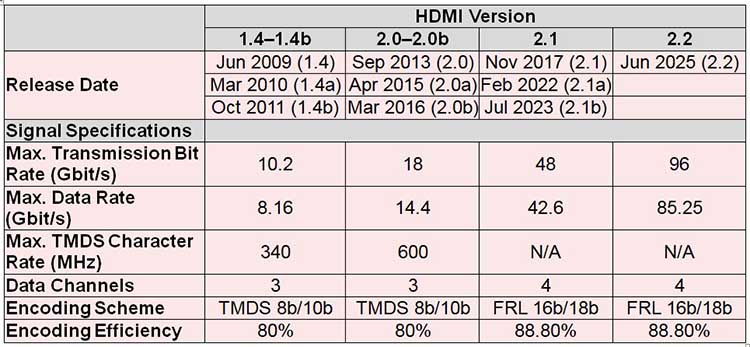
As consumer demand pushes for higher resolutions, faster refresh rates, and richer multimedia experiences, HDMI 2.2 represents the next major step forward in next-generation AV and consumer electronics. Key enhancements include Fixed Rate Link (FRL) capability of up to 24Gbps per lane, support for the new Ultra 96 HDMI® cable with bandwidths of up to 96Gbps and the introduction of latency indication protocol for improving audiovisual synchronization.
These advances are focused on the high-speed connection lines of the HDMI connector. However, because there is no HDMI 2.2 Specification mandated for improvements on the lower speed connections, there will be no changes to HDMI audio capabilities in the form of ARC (Audio Return Channel) or eARC (enhanced Audio Return Channel).

What’s new in the HDMI 2.2 PHY
While HDMI 2.2 brings a whole range of new benefits and advancements, the technology continues to use Non-Return-to-Zero (NRZ) transmission, rather than switching to Pulse Amplitude Modulation (PAM). Although the transmission remains the same, it doesn’t come without a trade-off.
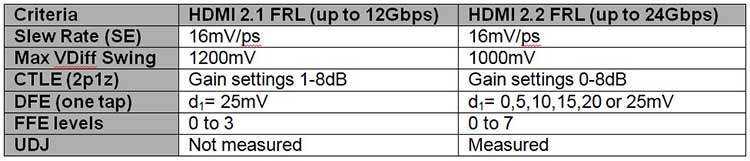
NRZ ensures quick scalability of existing resources as well as ensuring larger margins of signal to noise ratio compared to PAM. However, with the new speeds of up to 96Gpbs, this is pushing traditional NRZ technology infrastructure such as connectors, cables and test equipment to its physical limit, thereby increasing the challenges around usability, engineering and testing. While understanding the enhancements introduced by HDMI 2.2 is important, it is equally critical to recognize the key performance parameters that remain unchanged, such as slew rate. Tabel 2 below outlines some of these criteria’s.
The New Reality of HDMI 2.2 Compliance Testing
HDMI 2.2 changes the demands placed on test equipment across source, sink and cable validation. Engineers often encounter three common challenges; higher bandwidth requirements, more sophisticated signal conditioning techniques and increasingly complex compliance methodologies.
Putting together all the requirements above, one of the main compliance tests (among others) that HDMI 2.2 source devices will need to pass is the electrical data eye diagram test.
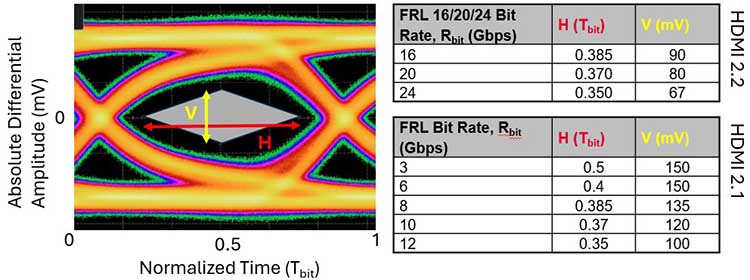
Some significant changes to the test equipment required for HDMI Tx Compliance Testing include:
- An increase in Oscilloscope bandwidth requirement from 20GHz for HDMI 2.1 to at least 25GHz for HDMI 2.2
- New Test Point Adapters rated for HDMI 2.2 are needed
- Supporting equipment, including probes and cables to complement the test setup must be able to handle at least 25GHz bandwidth. This pushes the engineering limits of SMA connecters
These changes highlight the broader impact of HDMI 2.2’s increased bandwidth requirements on compliance testing.
As data rates increase, maintaining signal integrity becomes increasingly difficult. This is reflected in the expanded use of equalization technologies within the HDMI 2.2 specification, including additional Feed Forward Equalization (FFE) settings and new sink compliance requirements. Unlike HDMI 2.1, sink testing now requires waveform generators capable of producing signals that incorporate FFE, creating a new set of demands for test equipment vendors. Consequently, this translates to HDMI 2.2 test times which can be up to 16 times longer than their HDMI 2.1 equivalent. Members of the HDMI Forum are working to optimize and reduce the number of test cases to bring test times down to a more palatable duration.
HDMI 2.2 also introduces stricter validation requirements. Perhaps the most significant change is the introduction of the Ultra96 HDMI® Cable and the move from Cat3 to Cat4 cable certification. While parametric testing using Network Analysers and TDRs remains an important part of compliance, electrical eye diagram testing is no longer a secondary validation step. For HDMI 2.2, a 24Gbps eye diagram test is mandatory for all Cat4 cables, reflecting the industry’s focus on guaranteeing performance at higher data rates.
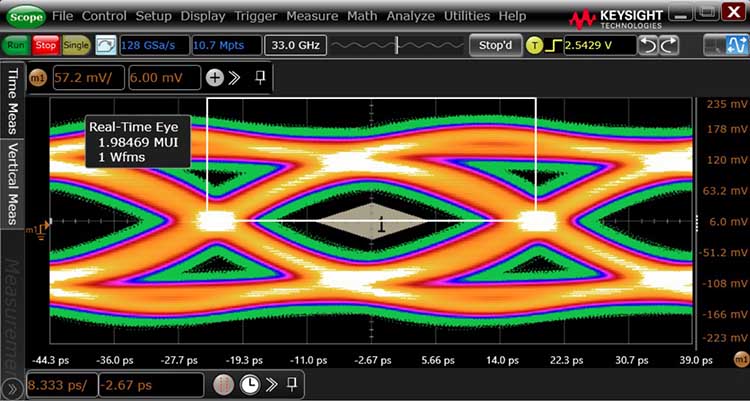
The compliance test setup for cable compliance testing is somewhat complex as it will involve combining both Tx and Rx compliance test setups in order to test the cable.
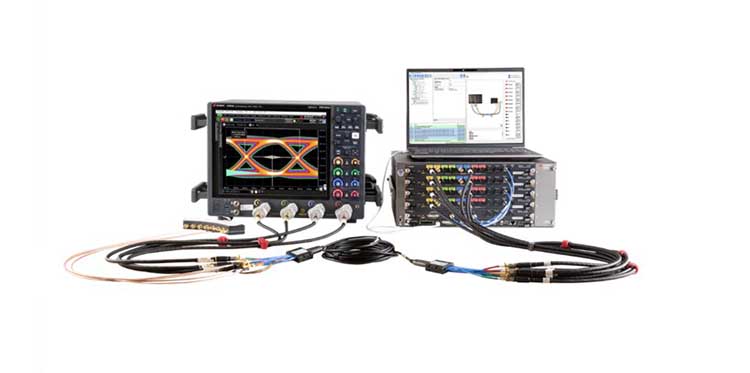
While these new compliance requirements introduce additional complexity for designers and test engineers, they are ultimately driven by a clear industry need: enabling the next generation of high-resolution, high-bandwidth applications. As display technologies continue to evolve, existing interfaces are being pushed to their limits, creating demand for greater bandwidth without compromising reliability or signal integrity.
Building blocks for next-generation, high-resolution and bandwidth application
The demand for higher data bandwidth displays continues to accelerate. As an example, the gaming and AR/VR payload bandwidth is doubling every couple of years and is building on uncompressed 4K/240Hz refresh rates at increasingly higher bit rates. Besides gaming, the fields of medical imaging, machine vision and 8K broadcasting also stand to benefit from higher data rates. By delivering up to 96Gbps of bandwidth, HDMI 2.2 provides the foundation needed to support these emerging applications and will play a critical role in enabling the next wave of innovation in display technology.
About the Author:

Kenneth Lim Kuo Wei is the HDMI Pyramid Lead for Keysight. He also serves as Keysight’s representative in the HDMI Forum and the HDMI Licensing Authority. Kenneth has over 15 years of experience in High-Speed Digital R&D design, test and validation. He is one of the key contributors to the HDMI2.2 source and sink general compliance test specifications.

Ir. Ts. Dr. Lee Yeng Seng is currently a Senior R&D Engineer at Keysight. He represents Keysight in the HDMI Forum. Dr. Lee holds multiple professional recognitions, including SMIEEE, CEng (IET), P.Eng (BEM), P.Tech (MBOT), MIET, MIEM, and ASEAN Chartered Professional Engineer (ACPE). He is one of the key contributors to the HDMI2.2 cable and sink general compliance test specifications.