


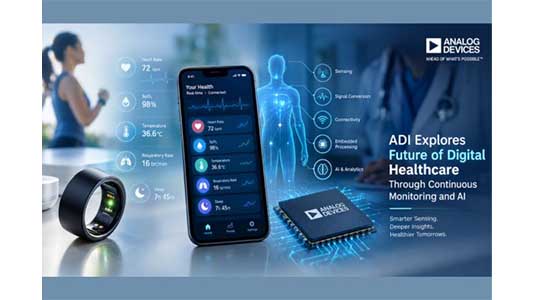
The landscape of healthcare is changing. A paradigm where health is managed primarily using episodic hospitalization and treatments based on symptom onset is being augmented by real-time monitoring, prevention and close-to-the-body healthcare delivery. Wearables, remote patient monitoring platforms and medical devices that connect have an important role in this transition.
In the case of India, the importance of this change lies in the country’s large and dispersed population, the increasing demands for healthcare services, the growth of digital infrastructure and the need to deliver quality healthcare services beyond big cities in India.
From a semiconductor perspective, the challenge lies in the need to deliver healthcare intelligence in increasingly complex forms via devices which are small, comfortable to use and efficient in terms of power consumption and able to provide good physiological data.
This challenge is being tackled by Analog Devices (ADI). The company is delivering precision sensing, signal conditioning, data conversion, connectivity, embedded processing and algorithms at the intelligent edge in order to deliver physical human body signals as high-quality digital information.
India’s Healthcare Landscape Creates a Strong Case for Remote Monitoring

The use of digital technologies is becoming widespread in India’s healthcare sector. The introduction of telemedicine services, digital health platforms, digital diagnostic equipment and electronic health records changes the potential for delivery and access to healthcare services.
However, the needs of India’s healthcare system go well beyond urban hospitals. People living in small cities, towns and rural areas might experience various issues concerning geographical accessibility, lack of specialized care and monitoring of chronic diseases.
Remote patient monitoring presents one technological solution for tackling such issues.
Instead of obliging each and every measurement to be conducted within hospital walls, remote patient monitoring through connected wearable devices allows recording certain physiological measurements in proximity to patients. After this, data can be processed locally and, if necessary, uploaded on a healthcare platform for further processing.
This technology solution is especially pertinent to the management of chronic diseases, elderly care, post-hospital monitoring and preventative healthcare programs.
Thus, the challenge for India is not only to sell more smart watches and other fitness trackers. It is the development of cost-effective, reliable and scalable healthcare electronics solutions.
Healthcare Moves towards Continuous Intelligence
The future digital healthcare solution is no longer about the digitization of medical records or interconnection of traditional medical equipment. This will be achieved when continuous monitoring of the person’s physiological data and analysis of it become possible.
Physiological parameters, such as heart rate, pulse, blood oxygen saturation, body temperature, electrocardiogram (ECG) signals, among others, contain much useful data about a person’s health state. Still, the task of obtaining these parameters in conditions other than hospital is much harder compared to measuring them in conditions of the clinic.
Devices used in such conditions should work regardless of whether a patient is asleep, active, or just living a normal life. These devices should also be able to deal with different lighting and different skin contacts, as well as with other conditions that may change from case to case.
This imposes strict limitations on the electronics architecture.
Sensing element should be able to capture weak physiological signals. Analogue front end has to protect signal integrity and reject the noise. Analogue-to-digital converter has to have adequate resolution and dynamic range. Embedded processing has to be efficient enough to extract the data needed, but at the same time not to consume much energy.
Physical AI Begins with High-Quality Data

The intelligent edge strategy employed by ADI entails positioning sensing and signal processing at the front end of the AI process.
The notion of “physical AI” is defined by the idea of extending intelligence from cloud-based software to physical devices which interact with the world around them. In the case of healthcare, this allows for continuous acquisition of physiological signals instead of solely relying on manually inputted or periodically taken data.
The efficiency of an AI system is limited by the data it receives.
This implies that in the case of healthcare wearables, it is especially important to pay attention to the signal chain that runs from analog sensors to the software.
Small differences in electrical signals may be physiologically meaningful, while noise and motion artifacts may distort the measurement.
Therefore, a top-notch healthcare wearable device demands a well-engineered signal chain.
Sensor → Analogue Front End → Signal Conditioning → Data Conversion → Embedded Processing → Algorithms → Connectivity → Healthcare Insight
This architecture enables intelligence to move closer to the point where physiological information is generated.
Precision Sensing: The Foundation of Wearable Healthcare
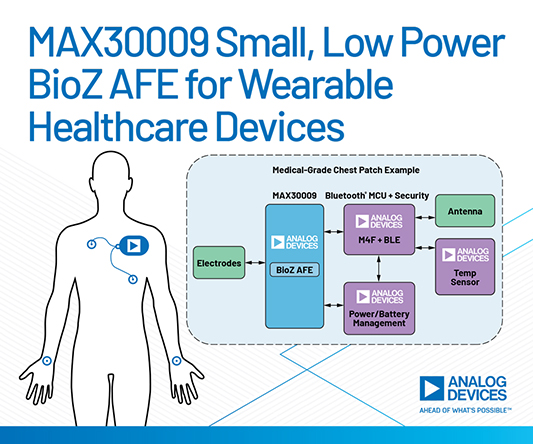
Wearable health-care electronics operate under very harsh environmental conditions. Biosensors need to detect low-level physiological signals via the skin while the device itself is in motion.
For instance, photoplethysmography (PPG) uses light-based technologies for measuring changes in blood volume. This technique is widely used for such parameters as heart rate and blood oxygen saturation. The problem lies in the fact that the required physiological signal may be very weak in comparison to the ambient light, movements and sensor placement variability.
The specialised PPG analogue front-end may resolve the issue because it integrates all the functions necessary for the acquisition and conditioning of optical signals.
MAX86184 PPG analogue front-end is an example of such semiconductor technology that will allow the creation of miniature wearable and health-care platforms. Component-level integration allows one to simplify the system architecture and optimize the signal quality, power consumption and form factor.
Analogously, ECG monitoring requires highly-sensitive analogue circuitry that will be able to acquire electrical signals from the heart and resist interference.
For the developers of wearable devices, the task is not to add more biosensors but acquire higher-quality physiological data while consuming less power and having less complicated architecture.
Smaller Form Factors, Greater Electronics Complexity
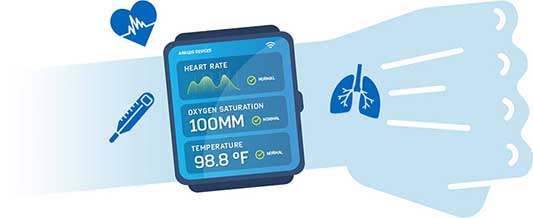
The transition from conventional devices to the new types of wearable electronics, such as smart rings, bands and patches also brings along an additional engineering challenge related to miniaturization.
While a hospital monitor is equipped with sufficiently large batteries, connections and circuit boards, the same cannot be used for a smart ring.
Even the smallest areas of PCB and milliamp-hours of energy become crucial.
Hence, electronics have to provide for maximum integration of all elements. Sensor interfaces, analog front end, power management, microcontroller and wireless communication have to function together within a compact physical form factor.
However, at the same time, wearable devices have to be comfortable for the user.
Hence, an electronic device that needs to be constantly worn should not be bulky, heavy and energy hungry.
Thus, there is a clear connection between semiconductor integration and device design.
India Perspective: Designing for Scale, Affordability and Accessibility
Scale is yet another factor that comes into play when talking about India.
The electronics designed for Indian healthcare purposes might be targeted at very different customer segments – from hospitals equipped with the most advanced technologies located in large cities to small clinics, laboratories, and home-care settings.
This would generate the demand for devices that offer a balance between performance and cost, power consumption, reliability and easy implementation.
For India’s electronics manufacturers and developers of healthcare technology, platforms for semiconductors that help integrate sensors and speed up development could help cut down the amount of engineering needed to take a product from development to market.
It is also possible to come up with dedicated medical and wellness devices that could be used in India for monitoring chronic diseases, senior care, post-surgery surveillance, preventive wellness, and occupational health.
Thanks to both growing electronics manufacturing and digital-health infrastructure, more connected healthcare devices could be developed domestically in India.
As for those connected healthcare devices, semiconductors’ architecture will become important. The sensing must remain accurate irrespective of location and environment of a device, while power consumption will become critical for continuously functioning products.
Power Efficiency Becomes a Healthcare Feature
The battery lifetime is more than just a matter of convenience in continuous monitoring applications; it is also critical in determining the usability and robustness of the system.
Regular charging could prevent users from wearing the device continuously, thus creating holes in the physiological data. In remote monitoring, interrupted functioning could decrease the availability of information to the caregiver or physician.
As a result, power efficiency should be considered throughout the whole signal path.
It involves sensor excitation, analog acquisition, signal processing, wireless communication, and standby mode. Intelligent duty cycling and low-power operation have become essential considerations for designers.
This is especially true for India’s ecosystem of wearable devices, where the product should offer a compact size along with sufficient operating time and affordability.
Sensio: Translating Semiconductor Innovation into Wearable Platforms
The practical implementations of these technologies are reflected by the examples of wearable healthcare platforms from Sensio, including smart rings, smart bands and chest patches.
The Sensio Orbit smart ring serves as a good example of the potential of placing physiological sensing into compact wearable platforms. In addition to being a discrete and continuous-wearing form factor that can be useful in wellness and preventive health applications, smart rings also allow for collecting continuous data.
The chest patch technology is yet another promising development. Contrary to devices placed on the wrist or fingers, a chest-mounted platform allows using a different geometry for physiological sensing and could be useful in remote patient monitoring.
The HSP4 chest-patch reference design proves how specialized semiconductor technologies can be used in developing compact wearable monitoring solutions.
In case of Indian healthcare entrepreneurs, the use of reference designs can prove particularly beneficial as it allows accelerating experiments and product development while giving engineers the chance to concentrate on application-specific software, algorithms, connectivity and user experience.
From Components to Complete Healthcare Ecosystems

The evolution of digital healthcare technologies has also altered the nature of the semiconductor supplier.
All of the following – sensor, analogue front-end, processor, power management and connectivity – need to work together as a platform.
Development kits and reference designs may assist in solving the challenges that engineers encounter in doing this. The MAX30011 EVKit is an example of such a development platform that offers support for ECG sensing technology development.
The importance of such platforms to India’s developing health technology and electronics design environment cannot be underestimated.
Data Quality Will Define the Next Phase of Digital Health
As healthcare systems transition to real-time health tracking, the volume of physiological data will skyrocket. But the mere volume of data alone will not lead to better health care results.
The health care sector requires accurate and high-quality context-based data.
In the age of AI, this will make analogue engineering even more crucial.
Although advanced algorithms can recognize patterns in physiological data, it all comes down to the accuracy of the measurements that support the algorithms.
In India, where the health care system is becoming increasingly distributed, it becomes particularly critical for a health-care device working at patients’ homes to provide accurate measurements under actual environment conditions.
Thus, the future of digital healthcare will be defined by the convergence of precision analogue engineering and AI algorithms.
The Road Ahead for India’s Digital Healthcare Electronics
The development of digital health in India is approaching an era where simply having connections is not enough. The next big chance comes in the combination of a networked environment with precise, constant and smart physiologic monitoring.
Wearables like smart rings, bands, and chest sensors can play a key role in this scenario, especially with the help of semiconductor chipsets optimized for low power consumption and high-quality signals in a small form factor.
From the point of view of India’s electronics sector, this presents an opportunity that goes well beyond consumer wearables. Companies developing medical devices, electronics, semiconductors, and technologies have more chances to play a part in this ecosystem of connected monitoring and intelligent edge computing.