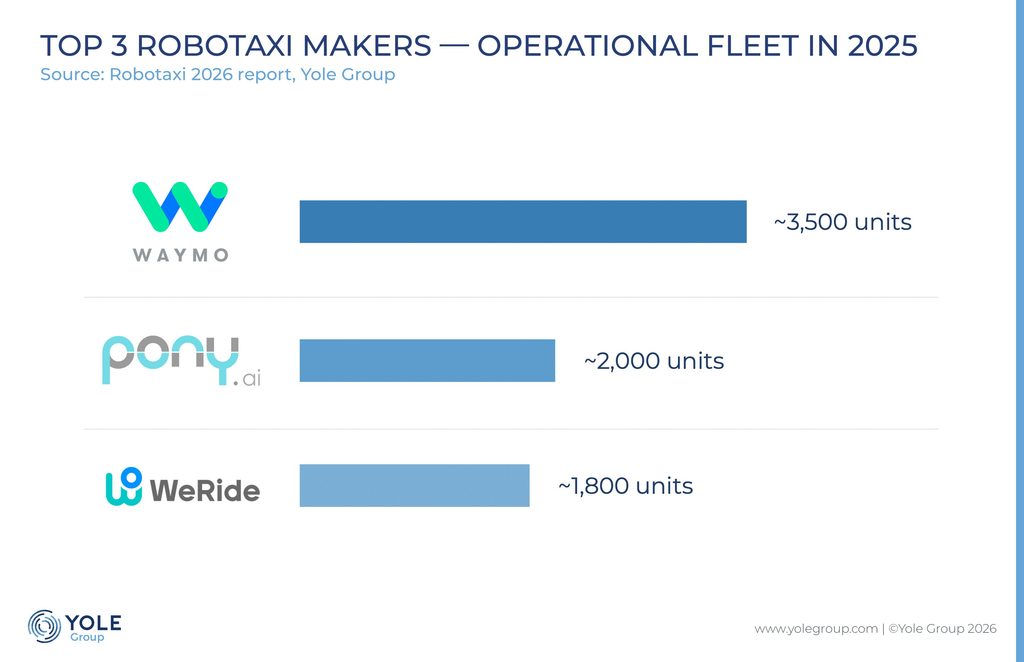




LYON, France – After the hype and the disillusionment of the last decade, the robotaxi is back, and this time on a steady and rapid growth path. Vehicle costs are falling, commercial services are expanding city by city, and the algorithms behind autonomous driving have reached the point where scaling a fleet is both technically feasible and economically defensible. Yole Group’s Principal Analysts, Yu Yang and Pierrick Boulay, identify five factors jointly boosting the market, from a 70% reduction in vehicle bill-of-materials and manufacturing costs to the convergence of L2+ and L4 technology stacks. Against this backdrop, Yole Group releases its latest report, Robotaxi 2026…
Yu Yang, PhD, Principal Lead Analyst, Automotives & Robotics at Yole Group: “The robotaxi industry has shifted from proving that the technology works to proving that the business works. Removing up to 70% of the vehicle cost is what turns a demonstration fleet into a service that can scale, and a handful of operators have now crossed that line.”
Pierrick Boulay, Principal Analyst, Automotive Semiconductors at Yole Group: “The robotaxi does not create a separate semiconductor supply chain. Instead, it stretches the existing ADAS one. The same processor and sensor suppliers serve both markets, and the real differentiator is vertical integration.”