


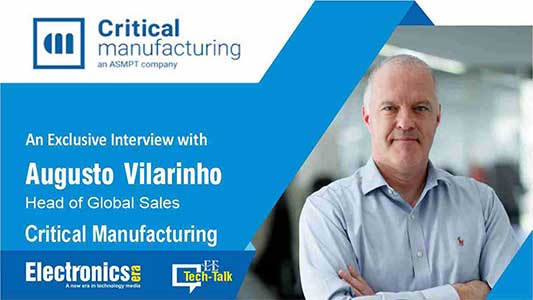
Critical Manufacturing provides an Industrial Operations Platform that brings together MES, connectivity, automation, analytics and trusted AI for high-tech manufacturing. At SEMICON India, the company will exhibit alongside ASMPT and demonstrate how manufacturers can bring equipment, operational systems and production information together to create a more coordinated and intelligent manufacturing environment.
With new semiconductor manufacturing capacity taking shape in India, there is a timely discussion around establishing the right digital production foundations early, including consistent processes, end-to-end traceability and structured manufacturing data that can support operations as they scale. Critical Manufacturing works with semiconductor manufacturers globally on these challenges and has also been strengthening its position across APAC, with a presence in markets including Malaysia, Taiwan, Japan and India, and most recently through its partnership with UST to expand MES implementation and engineering support across India and Southeast Asia.
EE: Why are India and Southeast Asia strategically important to Critical Manufacturing’s APAC expansion?
Augusto: India and Southeast Asia are where the world’s new assembly, test and packaging capacity is being built. Under the first phase of the Semiconductor India Program, the government approved 10 semiconductor manufacturing projects with combined investment commitments of about INR 1.60 lakh crore – two fabs and eight packaging plants, several already in pilot or commercial production. And the next phase is bigger: Semicon 2.0 was approved with a total outlay of INR 1,27,500 crore, extending support beyond chip making into equipment, materials, advanced packaging, design and talent.
Not a replacement of something old.
Southeast Asia complements that with an established base of packaging, test and electronics operations that are modernizing at the same time.
For us the two regions are one connected play. We run them as a single coordinated effort under the same business unit leadership, with the same partners, so knowledge, references and engineering capacity move freely between them.
EE: What manufacturing challenges are currently driving MES adoption across the region?
Augusto: Five keep coming up:
- Moving off legacy systems. Many operations still run on production software designed for a different era: rigid, heavily customized, expensive to change. The technical challenge is manageable; the harder part is the courage to replace a system people have worked around for fifteen years. The companies making that decision now are the ones that will be able to move fast later.
- Traceability and Connectivity. customers both demand full lot-to-device history and audit-ready data. Manual data input doesn’t survive commercial volume.
- Package complexity. Advanced packaging and system-in-package flows don’t just get more complex: they change constantly. New package types, new test flows, new customer requirements. If every change needs an IT project, the factory is permanently behind its own roadmap.
- The skills gap. Engineering graduates are plentiful; deep semiconductor process experience is not. Guided workflows and automatic equipment data capture reduce how much a new operator has to know, added with a MES provider with proven experience in the field.
- Deciding locally. This one is underestimated. Some plants can choose their own production platform; others wait on a corporate decision made far from the shop floor. A capable MES is as strategic an investment as a new building or a new line. It shapes what the plant can do for the next decade. Sites that treat it that way, and have the authority to act on it, move considerably faster than those that don’t.
EE: What role do partners play in your India strategy?
Augusto: India is a partner-led market for us, by design. The geography, the pace of the build-out and the local specifics all mean a manufacturer is better served by an implementation team that is in-country.
So our model is straightforward: we bring the platform, the semiconductor and electronics domain depth via our specialists, and the methodology. Our partners bring local delivery capacity, established relationships with Indian manufacturers, and engineers who stay in the market and build expertise across projects.
We include in our partner list global services organizations with significant presence and investment in India’s semiconductor build-out. We work with Indian and international system integrators where their automation, IT or plant-level strengths fit a particular customer. We’d rather have the right team on a project than insist on a single route to market.
EE: How will the partnerships with local System Integrators improve MES implementation and engineering support for Indian manufacturers?
Augusto: Implementation happens locally, in-country. Our partners built a dedicated Critical Manufacturing practice inside its India semiconductor and manufacturing business, with engineers trained and certified on our platform.
For a manufacturer that means shorter response times, no dependency on flying consultants in, and support in the same time zone during ramp-up, which is exactly when it matters most. It also means the domain expertise stays in India and compounds across projects, rather than leaving with each project team.
EE: How is MES evolving from a production-management system into the digital backbone of the connected factory?
Augusto: The old model was three separate things: an MES for execution, an IIoT layer for equipment data, and analytics tools sitting on top. They rarely spoke the same language, and improvement depended on integration projects and customizations rather than daily work. This still happens in several of our competitors.
In our case, what manufacturers need now is one foundation – execution, equipment connectivity and intelligence on a shared data model.
That’s what turns MES into a backbone rather than a system of record. When the data model is common, insights can act directly inside the workflow instead of ending up on a dashboard nobody opens.
EE: What does an AI Copilot actually bring to an engineer or operator on the factory floor?
Augusto: Access. The information was always in the MES – but getting it meant navigating deep menus, waiting for a dashboard someone built in advance, or asking a specialist.
Our Copilots remove that bottleneck. Anyone can ask in plain language: “Where is this lot right now?” or “What caused the most downtime yesterday?” and get an answer in seconds, drawn from governed production data via our unified and contextualized data platform.
Practical use cases already in the product include shift handover summaries, maintenance guidance pulled from equipment manuals, and document summaries.

The real value isn’t the AI. It’s who is now allowed to ask the question.
EE: Can you give us a real-world example of how an operator could use an AI Copilot to solve a production problem?
Augusto: Take a bonder that starts producing marginal results mid-shift. Instead of escalating and waiting, the operator asks the Copilot for the machine’s status and recent history. Then ask what rework reasons have been logged on that operation. Then ask maintenance assistant what the manual says about that specific alarm code – and get the relevant procedure without reading 400 pages. And that is only the most elementary usage of AI to assist the operator. The next level is to automatically detect the issue, investigate the root cause and possible solution through AI capabilities and either propose a solution (in supervised mode) or implement the solution itself (fully automated).
Minutes instead of two hours, and no specialist pulled off another task. At the end of the shift, the handover summary is generated automatically, so the next team starts informed.
EE: How do AI, MES, IIoT and analytics work together to create the “factory of the future”?
Augusto: They only work if they’re one system rather than four.
- IIoT connectivity captures data directly from equipment – international and domestic tools alike, through a single integration layer instead of fragile custom scripts per machine.
- MES provides the structure: what the process is, what step this lot is on, what “good” looks like.
- Analytics run inside that structure, so insight arrives with context already attached.
- AI closes the loop: recommendations and actions that feed back into execution in real time, most importantly by using one single and unified platform, where stored data is previously contextualized and optimized for AI usage.
That closed loop is the whole point. Data goes up, decisions come back down, and it happens while the work is happening.
EE: What opportunities do you see in India’s electronics and semiconductor manufacturing expansion?
Augusto: Three, in order of near-term maturity:
- Assembly, test and packaging. The bulk of approved investment. These facilities are being built now and need their production platform selected before ramp.
- Automotive and power semiconductors. India’s EV growth is creating domestic demand for automotive-grade devices, which brings strict traceability requirements with it.
- Electronic components. The components scheme is bringing PCB, display, camera module and passive component manufacturing into India – a large and, for us, very natural segment.
And most certainly, the shift from commodity packaging into advanced packaging and compound semiconductors is where the most interesting engineering will be.
- Looking toward 2030, what will the factory of the future look like, and what role will Critical Manufacturing play in building it?
It won’t look dramatically different from the outside. The difference will be that the factory improves itself while it runs, rather than improving between projects.
Concretely: one platform instead of a stack of tools; a process model that engineers change themselves in days rather than commissioning IT projects; intelligence embedded in the workflow rather than reported afterwards; and one standard replicated across sites with room for local adaptation.
Our role is to be that foundation. The system manufacturers run their operations on. In India specifically, we intend to be the platform on which this generation of facilities is built, not retrofitted onto them later.