

Technology often moves faster than brands and reputations. The best match-up for your next design may come from a manufacturer you have yet to discover—even though some of the world’s largest companies already design its technology into their products.
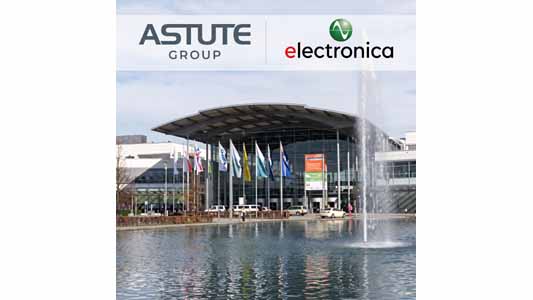
That is the thinking behind Astute Group’s presence at electronica 2026. In Hall C5, Stand 421, Astute Technology brings together franchised manufacturers trusted by major OEMs and system builders, but whose capabilities remain among the industry’s best-kept secrets. Through application demonstrations and practical engineering conversations, we’ll help you discover components and technology partners you may not have considered, with the design-in support to move forward confidently.
Taking place at Messe München from 10–13 November, electronica provides an opportunity to explore those possibilities with our team. Bring a specification, an unresolved engineering problem or an early concept. The starting point is what you want to build, including its performance targets, power budget, operating environment and commercial constraints.
Visitors will be able to explore application demonstrations featuring Axelera AI, XMOS, Sensory, Alif Semiconductor and Octavo Systems. Seeing technologies in action can make their potential clearer, giving engineers a basis for discussing implementation and the support needed to progress towards a working design.
More intelligence, closer to the device
High intelligence with low-power local processing is central to this year’s presentation. Engineers developing smart devices increasingly need to process information close to where it is captured. How much intelligence can fit within the available power, space and thermal budget—and how readily can it be integrated?
Axelera AI will be a key feature of Astute’s edge AI presentation. Its Metis processing technology and acceleration hardware are designed for inference in embedded and edge systems, supported by the Voyager software development kit. For visitors exploring machine vision, automated inspection or intelligent monitoring, it offers a route to discuss bringing AI into a deployable product.
Alif Semiconductor brings AI-enabled microcontrollers and fusion processors combining local processing, dedicated neural acceleration and power management. Its approach is relevant to compact, battery-powered products where intelligence must work within tight energy limits, giving visitors another architecture to consider against their application’s demands.
Moving from a promising architecture to working hardware introduces its own challenges. Octavo Systems helps simplify that step through System-in-Package technology. Its portfolio includes devices combining processors from Texas Instruments or AMD with memory, power management and supporting components in a compact package. Reducing the complexity of these core connections can free engineering time for the features that distinguish the finished product—a practical link between discovery and faster design.
Smarter ways to sense, listen and respond
Intelligence also depends on how a device senses its surroundings and responds to people. XMOS, Sensory and Azoteq bring complementary capabilities here. XMOS provides voice-processing platforms, including low-power far-field voice designs using Sensory’s TrulyHandsfree recognition technology. This creates opportunities for local wake-word detection and voice commands in products where responsive, accessible control matters.

Sensory also illustrates why a manufacturer’s profile may tell only part of its story. Its technology has been deployed in billions of devices, including voice functionality in Samsung smartphones. An introduction at Astute’s stand could connect you with expertise you have already encountered in a finished product without knowing the company behind it.
Azoteq adds capacitive and inductive sensing, with haptic IC families combining sensing and actuator-driving functions. For wearables, appliances and industrial controls, that integration can help deliver tactile feedback within a compact interface. Displays and HMI extend the discussion to how information is presented and how users interact with the finished product.
Building security into the design
Security decisions belong early in development. SCI Semiconductor develops CHERI-based microcontrollers and processors using hardware-enforced memory protection and compartmentalisation to address classes of software vulnerability. Its contribution is memory-safe computing, helping designers build stronger boundaries into their systems.
Quantum Dice addresses the quality of randomness used in cryptographic systems. Its quantum random number generators incorporate continuous verification through DISC technology, providing assurance about the entropy being generated. For teams addressing the Cyber Resilience Act, these technologies offer security foundations to evaluate within a wider approach to product design, vulnerability management and lifecycle support.
Stay ahead on electronics news
Join the electronics industry Astute Engineer newsletter
Supporting the complete system
The exhibition also connects intelligent devices with the infrastructure supporting them. Edgecore Networks brings open networking switches and SONiC-based solutions for data centres, opening conversations about network capacity, software choice and building infrastructure that can accommodate changing workloads.
In robotics and automation, RLS provides magnetic encoder technology for position and motion feedback. Knowing where a mechanism is—and how it is moving—is fundamental to controlled movement. RLS gives visitors a specialist partner to consider for robots, collaborative machines and automated equipment.
For demanding environments, Mercury Systems and VadaTech bring rugged embedded computing capabilities. Mercury offers processing boards for aerospace and defence, while VadaTech spans embedded boards, chassis and integrated platforms. Both are relevant to teams balancing processing performance with environmental resilience, integration requirements and long service lives.
Memory and storage complete the picture. Apacer, Innodisk and Exascend offer options for industrial and embedded applications, where suitability extends beyond capacity and headline speed. Operating temperature, endurance and data integrity all matter. Innodisk’s iCell and Exascend’s Dual Power Loss Protection illustrate how a specialist supplier’s technology can address a specific reliability requirement.
Let us make the introduction
Keeping pace with technology takes time, particularly when the most suitable manufacturer sits outside your existing supplier list. Astute helps you identify which options deserve closer evaluation and what questions to ask before committing to a design. A demonstration or conversation could reveal a component you had overlooked, a different approach, or a partner whose experience fits your project.
Next step: visit Astute at Hall C5, Stand 421, to discuss component selection and design-in support. The perfect fit may be a manufacturer you have yet to meet. Let us make the introduction.