



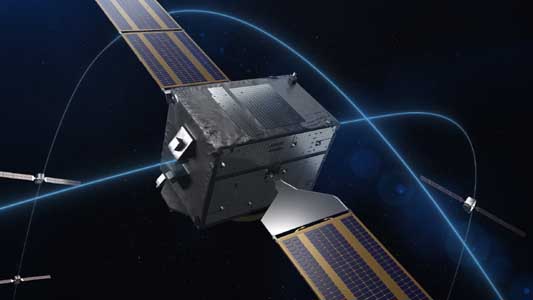
Rome – Two additional satellites dedicated to the Galileo Second Generation constellation have been awarded to Thales Alenia Space, a Joint Venture between Thales (67%) and Leonardo (33%), in the frame of the on-going contract with the European Space Agency (ESA), acting in the name and on behalf of the European Union Agency for the Space Programme (EUSPA) for the benefit of its owner, the European Commission. It now leads the deliveries to a total number of eight Thales Alenia Space-built satellites for the Galileo Second Generation constellation.

Increased performance, robustness, resilience and cybersecurity protection
Leveraging highly innovative technologies, including digitally configurable antennas and inter-satellite links, these satellites, together with the six already under construction by Thales Alenia Space, will enhance the accuracy of Galileo while improving the robustness and resilience of its signals against interference and jamming. Galileo Second Generation satellites will boost European industry competitiveness while strengthening Europe’s sovereignty in the navigation field. This second generation is equipped with a more robust and reliable architecture, enhanced cybersecurity protection to ensure greater service availability, and a 15-year operational lifetime. These two new satellites will be integrated and tested in the company’s Space Smart Factory, one of Europe’s smartest, digital and reconfigurable satellite manufacturing facilities, located in Rome, Italy.
“I would like to sincerely thank ESA, EUSPA and the European Commission for renewing their trust in our company,” said Giampiero Di Paolo, Deputy CEO and Senior Vice President for Observation, Exploration and Navigation at Thales Alenia Space. “This latest achievement further reinforces Thales Alenia Space’s leading role in Galileo Second Generation, bringing our total contribution to eight satellites, in addition to our responsibility for the Ground Mission Segment. This new milestone strengthens our position at the forefront of European space navigation. Combined with our leading role in the Celeste In-Orbit Demonstration constellation, which is paving the way for a future Low Earth Orbit navigation layer alongside Galileo’s Medium Earth Orbit infrastructure, this unique combination of capabilities will deliver unprecedented positioning accuracy and unlock a wide range of new applications, from autonomous cars and trains to drones.”
Hervé Derrey, Thales Alenia Space CEO, stated: “The award of these two additional satellites reaffirms the confidence that the European Commission, EUSPA and ESA place in Thales Alenia Space to deliver one of Europe’s most ambitious space programs. Leveraging our unmatched expertise in satellite constellations and navigation systems, we are proud to contribute to the next generation of Galileo, enhancing its performance, security and resilience. This program is a cornerstone of Europe’s strategic autonomy and will help shape the future of space-based navigation services for decades to come.”
ESA Director of Resilience, Navigation and Connectivity Laurent Jaffart: “With these contracts, ESA and European industry are safeguarding the continuity of Europe’s satellite navigation services, responding to the evolving needs of users, and strengthening Europe’s strategic autonomy. These contracts represent an investment in Europe’s ability to navigate its own future, independently and with confidence.”