


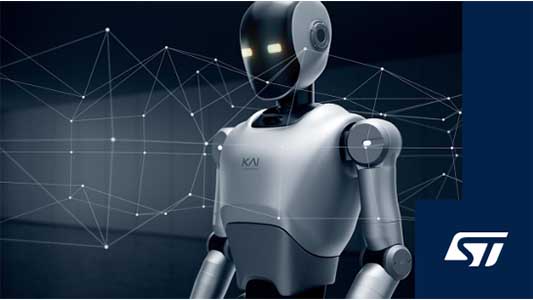
The development of humanoid robots is proving to be an exciting field in the industry, combining artificial intelligence (AI), sensing, embedded processing, machine vision, and precise motion control. These robots are designed to function in a human-like environment and are expected to revolutionize the manufacturing, logistics, medical and service industries. But in order to realize these capabilities, it will take more than just intelligent AI software and advanced mechanical design. What is needed is an extremely complex electronic system which is able to sense its surroundings, process information and coordinate movement.
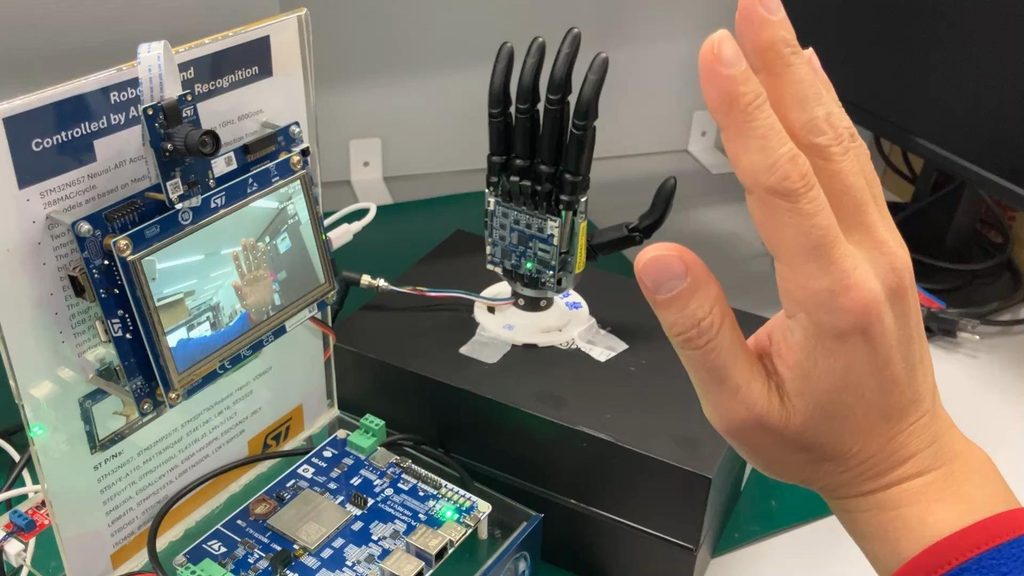
During the press conference titled “Robotics Segment Strategy,” Allan Lagasca, Senior Director of Marketing, Applications Robotics Segment Strategic Program (SSP), Smart Industrials Segment, Worldwide APX Management, SM&A, STMicroelectronics R&D Co. Ltd., Shenzhen, explained how STMicroelectronics is assisting in the development of humanoid robotics.

The presentation included details on the company’s segmentation in the robotics industry, the technical issues involved in developing humanoid robots, the wide range of semiconductors available, system engineering and strategic partnership with key ecosystem partners such as Leopard Imaging, among other important information. In summary, the main objective of ST was to position itself as a strategic enabler for robot developers.
Robotics: A Diverse and Expanding Market
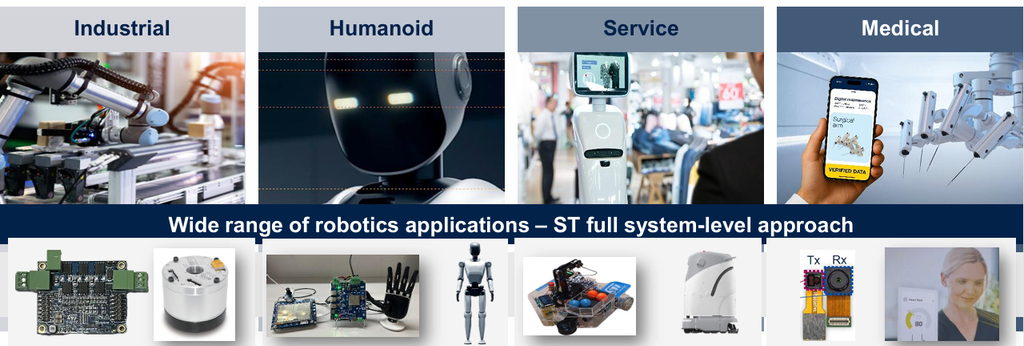
Robotic technology is viewed by STMicroelectronics as a broad technology market consisting of different application areas like industrial robots, collaborative robots, autonomous mobile robots, service robots, and humanoid robots.
Different considerations are relevant to each application area. For example, industrial robots need accuracy, repeatability, and reliability. Collaborative robots have to be safe, while autonomous mobile robots rely heavily on navigation, obstacle detection, and awareness of surroundings. Service robots have to work in dynamic environments with minimal human supervision.
The complexity of the architecture of the humanoid robots unites many of the above requirements in one. The robot design is based on the human body and features multiple articulation points, sensing capability, cameras, processing systems, and actuators.
This provides good possibilities for development of semiconductor products capable of performing sensing, processing, connectivity, power management, and motion control. By developing solutions applicable to various types of robots, ST can cover general requirements and needs of more specific humanoid platforms.
The approach of STMicroelectronics reflects an important industry tendency: the future of the robotics lies not in optimization of individual parts but in their integration into the system.
Overcoming the Challenges of Humanoid Robot Development
Creating a robot that looks like a human and can function in the real world poses some technical difficulties. While robots meant to carry out routine tasks are easy to make, creating a humanoid robot is difficult because of its ability to sense the environment and move physically.
Perception and environmental awareness are fundamental requirements. In order for robots to be able to work, they need to be able to locate objects and calculate distance between them. Cameras can supply vision data, whereas IMU, time of flight, and others can supply data regarding motion and orientation.
Motion control and balance represent another major challenge. Walking, balance, going up steps, and handling objects demand coordination between many actuators. Proper sensor input and proper control electronics are necessary for accurate and stable motion.
Power efficiency and thermal management are equally important. Humanoids have to supply many sensors, processors, communication ports, and controls for their motors in light of the constraints imposed by battery capacity and size.
Roboticists also need to think about reliability, safety, cybersecurity, and integration of hardware and software for artificial intelligence.
The hardware may be very advanced but fail to deliver a solution if not able to interact.
Such problems prove that it is important to have a broad-based semiconductor strategy backed up by system engineering and cooperation with roboticists.
ST’s Broad Semiconductor Portfolio for Humanoid Robots
STMicroelectronics is addressing robotics requirements through a broad portfolio of semiconductor technologies that can support multiple functions within a humanoid robot.
Intelligent sensing: ST’s MEMS sensors, inertial measurement units, environmental sensors, and time-of-flight technologies can help robots gather information about movement, orientation, surroundings, and distances. Such information supports applications ranging from balance and stabilisation to navigation and object awareness.
Embedded processing: Microcontrollers and microprocessors provide the foundation for controlling electronic subsystems, processing sensor data, managing communications, and executing real-time tasks. These technologies can complement higher-performance computing platforms that handle demanding AI workloads.
Motor control and power management: Humanoid robots rely on coordinated actuation to perform movements ranging from walking to precision manipulation. ST’s motor-control technologies, power semiconductors, and power-management solutions can help developers design efficient and responsive electronic drive systems.
Connectivity and interfaces: Reliable communication between sensors, processors, controllers, and actuators is essential to system performance. Connectivity and interface technologies help establish the communication infrastructure required to coordinate different robotic subsystems.
The value of this portfolio lies in its breadth. Rather than addressing only one function, ST can support developers across several electronic building blocks, enabling them to select technologies according to their performance, power, size, and integration requirements.
System Engineering: Connecting Components into Complete Solutions
An important factor for ST’s robotics strategy is the use of system engineering. In complex robotic systems, each of the parts needs to function together in a well-designed architecture.
Take the example of a humanoid robot moving in an unknown setting. Its sensors need to gather data, its processing systems need to make sense of the data, and its control systems need to co-ordinate its motion. All these are performed by working along with its power management and communications systems.
System engineering assists designers in understanding such complexities right from the design phase. System engineering allows selecting the right components, integrating them into subsystems, optimizing their performance, and identifying any possible bottlenecks in the design process.
With its wide range of products and application expertise, ST can assist clients in evaluating whether a particular technology fits into the overall architecture of their robots. This is especially pertinent to robotics start-ups who wish to speed up development and handle complexity issues in hardware, software, and mechanical systems.
Speaking the Customer’s Language
The ST business model focuses on the understanding of customers’ needs in the context of the application.
In case of robotics, developers usually start from such problems as the improvement of the balance, better visual perception, lower power consumption, higher precision in motion, or miniaturization of functions in one design. In order to solve such problems, semiconductor companies need not only to recommend certain parts but also to know the full application.
It is possible to assist developers in the identification of proper technology and method of integration if you work with them on their design goals, limitations of the system and product road map.
For instance, the hand of a humanoid robot needs a miniature sensing and motor control, whereas the subsystem of navigation needs cameras, inertial sensing, and computing.
In this way, each application is different and the customer-oriented engineering plays an important role in this field.
Partnership with Leopard Imaging: Advancing Robotic Vision

Another component in the strategy of ST is robot perception. The camera helps the humanoid robot perceive visual information from its environment.
The collaboration between ST and Leopard Imaging was mentioned by the company. Leopard Imaging specializes in cameras and imaging systems for various applications, such as robotics and artificial intelligence systems.
Collaboration within the ecosystem allows to combine the competencies of semiconductor technologies and imaging systems. The camera solution should satisfy the demands of the robot platform in terms of image quality, integration, size, power consumption, and compatibility with downstream systems.
The combination of visual information with data from other sensors, like an inertial one, can help developers create the complete perception architecture for navigation, object detection, manipulation, and human-robot interaction.
The collaboration can also simplify the work of developers by offering technology components complementing their products, enabling them to focus on their unique competencies in creating their platforms.
Enabling Robots for the Real World
The next generation of humanoid robotics will depend on stepping away from controlled demonstrations and into real-world operation.
Robotics will need to deal with variable lighting conditions, unknown objects, uneven ground, unforeseen obstacles, and different loads. Performance versus battery capacity, thermal constraints, maintenance needs, and cost have to be balanced as well.
All of the above necessitates the tight integration between the sensors, processing capabilities, movement control, power, and software systems. Reliability and safety will have to be kept in mind during design, especially if the goal is to have robots working alongside people.
The ST range of products can help in meeting such challenges, while the system-level focus of ST can assist in considering the performance of the whole robot.
ST: A Strategic Enabler of Humanoid Robotics
With the further development of humanoid robotics, semiconductor companies will be even more important in helping to develop smarter, more efficient, and more responsive robots.
The presentation by Allan Lagasca focused on how STMicroelectronics uses its semiconductor portfolio together with system engineering, client engagements, and partnerships to solve problems related to humanoid robotics development. The idea behind this concept is that the development of humanoid robots requires not only one but several technological solutions developed simultaneously.
This is why through the support of sensors, embedded processing, motor control, power supply, and communication systems, ST strives to help robotics developers to solve the existing challenges.
In conclusion, the success of humanoid robotics will be based on how well robots will be able to perform outside the lab environment. In this way, the semiconductor company helps robotics developers to make their dream come true.