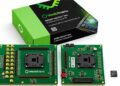


For decades, processor marketing ran on a simple scoreboard of clock speeds and core counts. That scoreboard no longer matters much. The accelerated processing unit (APU) combines CPU, graphics and, increasingly, a neural processing unit (NPU) on one package. It is now the architecture through which AI reaches laptops, consoles and edge devices.
Polaris Market Research values the market at USD 18.32 billion in 2025 and projects USD 83.60 billion by 2034, an 18.39% CAGR. For executives, the real question is who will control the full stack that makes local AI usable.
From Clock Speed to Compute Density

The value of a processor now sits in how well its components work together. Premium chips pair CPU, GPU and NPU cores with very large shared memory pools. Apple’s M5 Ultra, for example, scales to 512 GB of unified memory.
This changes how the market should be read. Unit shipments increasingly understate value, because each chip delivers far more compute and commands a higher price. Growth will come from richer silicon per device, not simply more devices.
NPU performance has become the headline spec, with AMD at up to 60 TOPS, Intel at 50 and Qualcomm at 80. But raw TOPS is a weak buying signal on its own. A powerful NPU that developers cannot easily access is an expensive idle block. Operating-system integration, AI frameworks and driver maturity decide whether the silicon earns its premium.
On-Device AI Is the Growth Engine
The AI PC segment is forecast to grow at a 27.86% CAGR, the fastest in the report. Laptop APUs already hold the largest form-factor share at 36.72%.
The business case is straightforward. Running inference locally reduces cloud costs, cuts latency and keeps sensitive data on the device. These benefits matter most to enterprise buyers, who weigh total cost of ownership, security and manageability above peak benchmark scores.
OEMs sit at the center of this shift. They account for 34.72% of end-use demand, and their design decisions lock in which silicon reaches the mass market long before launch day.
Competitive Landscape: A Duopoly Becoming an Ecosystem War
AMD and Intel still anchor the market, with x86-based APUs holding 54.86% share. Their advantage is compatibility: decades of Windows applications, drivers and enterprise software.
That moat is being tested from several directions:
- Apple controls silicon and hardware together, which lets it optimize across the whole product.
- Qualcomm and MediaTek are pushing Arm-based Windows laptops, with Arm-based integrated SoCs forecast to grow at 23.18% CAGR.
- NVIDIA’s RTX Spark, a Windows chip pairing an Arm CPU with a Blackwell GPU, signals that the discrete-GPU leader wants a place inside the integrated processor too.
Long-cycle console programs add stability. AMD has said it is developing silicon for Microsoft’s next Xbox, targeting 2027, alongside work for Sony’s next PlayStation. These multi-year programs give suppliers demand visibility that retail PC cycles cannot.
New entrants face real barriers: advanced packaging capacity, memory-bandwidth limits, thermal budgets in thin devices, and the sheer weight of software compatibility.
For more information, visit @ https://www.
Regional Insights: Design Power vs. Growth Velocity
North America led with 40.18% share in 2025. Its strength lies in chip design, platform relationships and commercialization, while manufacturing and packaging remain spread across global supply chains.
Asia Pacific is the growth story, at a projected 21.72% CAGR. Taiwan and South Korea contribute advanced production and packaging. Export controls are pushing China toward domestic processors such as Huawei’s. India raised its Semiconductor Mission outlay from USD 8 billion to USD 13.5 billion in September 2026, a long-term bet on ecosystem building.
Europe held 21.84% share, driven by enterprise refreshes plus automotive and industrial electronics. Slower corporate AI adoption tempers its pace, and the European Chips Act is building regional design capacity, though most processors used there are still designed elsewhere.
Latin America (5.12%) and Middle East & Africa (4.40%) are affordability-driven. Growth there depends on PC modernization and on lower-cost AI-capable platforms.
The Risks Executives Should Price In
The biggest near-term constraint is memory. As manufacturers shift capacity toward high-bandwidth memory for AI servers, DRAM and NAND prices have risen through 2026. Entry-level and mid-range systems feel this most, because OEMs there have little room to absorb higher costs.
Thermal limits add a second squeeze. Packing more compute into compact devices raises both cooling demands and bill-of-materials costs. Suppliers that balance performance, power and price will outperform those chasing peak specs.
Future Outlook: Where the Next Dollar Goes
Data center APUs are projected to grow at 24.68% CAGR. AMD’s Instinct MI300A already shows how tightly coupled CPU and GPU compute can serve AI and high-performance workloads. Chiplet packaging, as in Apple’s two-die UltraFusion design, is becoming the preferred way to scale performance beyond a single large die.
Beyond PCs, edge computing and automotive electronics offer fresh demand for compact chips that run graphics and AI within strict power limits.
Conclusion
The APU market is shifting from a component race to a platform race. Suppliers that pair strong silicon with software support, memory architecture and OEM relationships will capture the premium. Buyers should evaluate platforms, not spec sheets. Investors should watch ecosystem depth as closely as chip performance. The 2034 market is likely to reward those who treat the APU as the foundation of the AI device, not just another processor.
Read More @ www.polarismarketresearch.
𝐀𝐛𝐨𝐮𝐭 Us: