

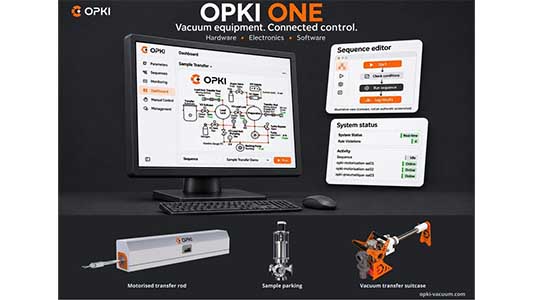
GARDANNE, France – OPKI, a manufacturer of high and ultra-high-vacuum equipment, today announced OPKI ONE, a platform combining control software and modular electronics. Scheduled for launch in December 2026, it will allow laboratories and industrial users to operate OPKI equipment, custom systems and compatible third-party devices through one interface, and automate installations already in service.
OPKI designs and manufactures manual and motorised sample transfer rods, vacuum transfer suitcases, load-lock chambers and in-vacuum sample storage systems (sample parking). The company also designs and builds complete vacuum systems around each application. OPKI ONE extends this offering with shared control, monitoring and automated sequences.
Coordinating equipment from different manufacturers
A vacuum installation often combines pumps, valves, pressure gauges and motion controllers from different suppliers, each with its own controls. OPKI ONE is designed to coordinate compatible devices so operators can monitor the installation, run configured procedures and review the sequence of events from the same interface.
“A researcher should be able to imagine their ideal setup, choose the equipment they need and make it all work together safely. With OPKI, we want to give them that freedom.”

Valentin Blanchard, co-founder of OPKI
From sample handling to complete vacuum systems
OPKI’s equipment covers the main stages of sample handling: transfer rods move samples under vacuum, load-lock chambers allow samples to enter or leave without venting the main chamber, sample parking systems provide storage under vacuum between process steps, and vacuum transfer suitcases carry samples between compatible instruments.
For applications requiring a complete installation, OPKI integrates vacuum chambers, sample handling, pumping, preparation modules, electronics and control into a custom system. Its engineering work spans process requirements, design, assembly and integration, combining OPKI equipment with compatible third-party components where needed.
Automating systems already in use
For existing installations, OPKI ONE offers a route to modernising control while retaining compatible equipment. OPKI reviews each device model, its interfaces, available commands and feedback to define what can be monitored, controlled and automated. The same platform can be used for new OPKI systems and custom installations.
The platform supports manual operation, graphical recipes, a configurable dashboard, safety interlocks and event logging. Modular electronic racks coordinate motion, pneumatics and heating. Three access levels distinguish operators, expert users and administrators. The system operates on a local network and does not require an internet connection.