Electronics Era

  • About Us
  • Advertise with Us
  • Contact Us
  • e-Mag
  • Webinars
Header logo on website
Advertisement
Advertisement
Menu
  • Home
  • News
    • Industry News
    • Product News
  • TECH ROOM
    • Sensor
    • VR / AR
    • Embedded
    • Medical Electronics
    • Industry 4.0
    • Robotic
    • Automation
    • Smart Machine
    • Component
    • MCU
    • Manufacturing
    • Security
    • Policy
    • Telecom
      • 5G/6G
  • Semiconductor
    • AUTOMOTIVE ELECTRONICS
      • EVs
      • HEVs
      • ADAS
      • Connected Cars
    • IoT-Internet of Things
      • Development Kit
      • IoT Design
    • Power Electronics
      • AC-DC/DC-DC Converters
      • Mosfets
      • IGBTs
      • LEDs
  • A & D
  • T & M
    • 5G testing
    • Oscilloscopes
    • SDN & NFV
    • RF & Wireless
  • AI/ML
  • RENEWABLES
    • Sustainability
    • Solar Magazine
  • Future Tech
    • Data Center
    • Cloud Computing
    • Big Data Analytics
  • Webinars
  • Editor’s Pick
    • Tech Article
    • Tech Blog
    • White Papers
    • EE-Tech Talk
    • Market Research
    • Videos
  • EE Awards
    • EE Awards 2025
    • EE Awards 2024
  • MORE
    • E-Mag
    • Events
    • MAGAZINE Subscription
    • Contact Us
Home TECH ROOM Aerospace & Defence Electronics

Microchip Technology Expands RT PolarFire® FPGA Portfolio with New Spaceflight Qualifications

Qualification milestones expand device options for mission-critical space applications

Vishaka Vardhan by Vishaka Vardhan
November 20, 2026
in Aerospace & Defence Electronics, Semiconductor
Reading Time: 3 mins read
Microchip
Share on FacebookShare on TwitterShare on LinkedIn

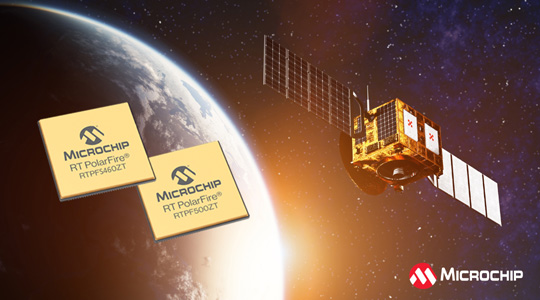
Microchip Technology is strengthening its portfolio of high-reliability aerospace and defense solutions with new spaceflight qualifications for its radiation-tolerant (RT) PolarFire® FPGA and SoC families. The RT PolarFire FPGA RTPF500ZT

has achieved Defense Logistics Agency (DLA) Qualified Manufacturers List (QML) Class V qualification, the highest qualification standard for space microelectronics. Additionally, the RT PolarFire SoC FPGA RTPFS460ZT has completed QML Class Q and MIL-STD-883 Class B qualifications. These milestones provide developers with flight-ready components for systems with stringent reliability requirements.

“As space applications demand greater onboard processing capability within increasingly constrained SWaP budgets, developers need technologies that maximize performance without increasing power consumption or thermal complexity,” said Shakeel Peera, corporate vice president of Microchip’s FPGA business unit. “Our RT PolarFire portfolio combines a power-efficient, radiation-tolerant architecture designed to be immune to radiation-induced upsets and defense-grade security to help developers reduce system power, simplify thermal management and build highly integrated, mission-critical space systems.”

 The majority of SRAM-based FPGAs typically require configuration scrubbing to correct radiation-induced upsets which can remain undetected between scrubbing cycles and increase power consumption. RT PolarFire devices use configuration technology designed to eliminate configuration Single-Event Upset (SEU) concerns. The devices’ power-efficient operation helps address the thermal limits of space platforms, and defense-grade security helps protect mission-critical systems while reducing system complexity. With high reliability and radiation tolerance, RT PolarFire devices are designed for aerospace and defense applications, from satellite payloads and constellations to human-rated spacecraft and deep-space missions.

The flight proven QML-V qualified RTPF500ZT RT PolarFire FPGA features Single-Event Latch-Up (SEL) radiation performance and in-flight programmability for mission-critical space applications requiring high reliability for demanding missions. The RTPFS460ZT RT PolarFire SoC FPGA combines programmable logic with an integrated Microprocessor Subsystem (MSS) featuring 64-bit RISC-V® processor cores and is qualified to MIL-STD-883 Class B and QML Class Q. Available development kits, together with a common RT PolarFire architecture and tool flow help streamline evaluation, prototyping and flight-system development.

MIL-STD-883 and QML qualification establish testing, manufacturing and quality requirements for microelectronic devices used in high-reliability aerospace and defense applications. MIL-STD-883 defines uniform environmental, mechanical and electrical test methods, while QML Class V under MIL-PRF-38535 establishes space-level quality and reliability assurance requirements. Together, these requirements help customers address stringent reliability and mission assurance needs for critical space applications. Visit the website to learn more about Microchip’s full portfolio of radiation-tolerant FPGAs.

Development Tools

The RTPFS460ZT development kit enables evaluation and prototyping of the RT PolarFire SoC FPGA, and both devices are supported by Microchip’s Libero® SoC Design Suite for overall design and development and the Mi-V® ecosystem for RISC-V development. Together, these resources provide a cohesive environment to evaluate the architecture, validate designs and reuse engineering work as programs progress toward flight hardware.

Pricing and Availability

For pricing and more information, contact a Microchip sales representative or authorized worldwide distributor.


Tags: aerospaceDefenseMicrochip Technology
Vishaka Vardhan

Vishaka Vardhan

Join Our Newsletter

* indicates required
Electronics Era

Electronics Era, India's no.1 growing B2B news forum on Electronics and Cutting Edge Technology is exploring the editorial opportunity for organizations working in the Electronics Manufacturing Services(EMS) Industry.

Follow Us

Browse by Category

  • 5G testing
  • 5G/6G
  • AC-DC/DC-DC Converters
  • ADAS
  • AEIS
  • Aerospace & Defence Electronics
  • AI/ML
  • Automation
  • AUTOMOTIVE ELECTRONICS
  • Big Data Analytics
  • Blockchain
  • Cloud Computing
  • Component
  • Connected Cars
  • Data Center
  • Editor's Desk
  • EE-Tech Talk
  • Electronics Components
  • Embedded
  • EVs
  • Future Tech
  • HEVs
  • Industry 4.0
  • Industry News
  • IoT Design
  • IoT-Internet of Things
  • LED & Lighting
  • LEDs
  • Manufacturing
  • Market Research
  • MCU
  • Medical Electronics
  • Mosfets
  • News
  • Oscilloscopes
  • Policy
  • Power Electronics
  • Product News
  • RENEWABLES
  • RF & Wireless
  • Robotic
  • SDN & NFV
  • Security
  • Semiconductor
  • Sensor
  • Smart Machine
  • SMT/PCB/EMS
  • Sustainability
  • T & M
  • Tech Article
  • Tech Blog
  • TECH ROOM
  • Telecom
  • Uncategorized
  • VR / AR
  • White Papers

Recent News

oorjan

India’s Renewable Energy Paradox: More Solar Capacity, but Is There Enough Storage?

November 20, 2026
ASUS

ASUS Announces Availability of ProArt GR1X

November 20, 2026
  • About Us
  • Advertise with Us
  • Contact Us

© 2022-23 TechZone Print Media | All Rights Reserved

No Result
View All Result
  • Home
  • News
    • Industry News
    • Product News
  • TECH ROOM
    • Sensor
    • VR / AR
    • Embedded
    • Medical Electronics
    • Industry 4.0
    • Robotic
    • Automation
    • Smart Machine
    • Component
    • MCU
    • Manufacturing
    • Security
    • Policy
    • Telecom
      • 5G/6G
  • Semiconductor
    • AUTOMOTIVE ELECTRONICS
      • EVs
      • HEVs
      • ADAS
      • Connected Cars
    • IoT-Internet of Things
      • Development Kit
      • IoT Design
    • Power Electronics
      • AC-DC/DC-DC Converters
      • Mosfets
      • IGBTs
      • LEDs
  • A & D
  • T & M
    • 5G testing
    • Oscilloscopes
    • SDN & NFV
    • RF & Wireless
  • AI/ML
  • RENEWABLES
    • Sustainability
    • Solar Magazine
  • Future Tech
    • Data Center
    • Cloud Computing
    • Big Data Analytics
  • Webinars
  • Editor’s Pick
    • Tech Article
    • Tech Blog
    • White Papers
    • EE-Tech Talk
    • Market Research
    • Videos
  • EE Awards
    • EE Awards 2025
    • EE Awards 2024
  • MORE
    • E-Mag
    • Events
    • MAGAZINE Subscription
    • Contact Us

© 2022-23 TechZone Print Media | All Rights Reserved

Advertisement
Advertisement