




Electric vehicles (EVs) are transforming how Indians travel — cleaner, quieter, and increasingly smarter. While batteries and motors often grab attention, it is electronics systems that orchestrate energy flow, charging behavior, safety, and connectivity.
India’s EV market is now growing rapidly, supported by government subsidies, expanding charging networks, and ambitious adoption targets. Electronics innovations are not just enhancing vehicle performance — they are enabling EVs to integrate with the grid, connect to services, and deliver a better user experience.
India sold nearly 2 million EVs in FY 2025, marking a ~17 % year-on-year growth in EV registrations across two-, three-, and four-wheelers
A: Smarter Power Electronics — More Miles Per Charge
Figure 1: Power Flow Inside an EV
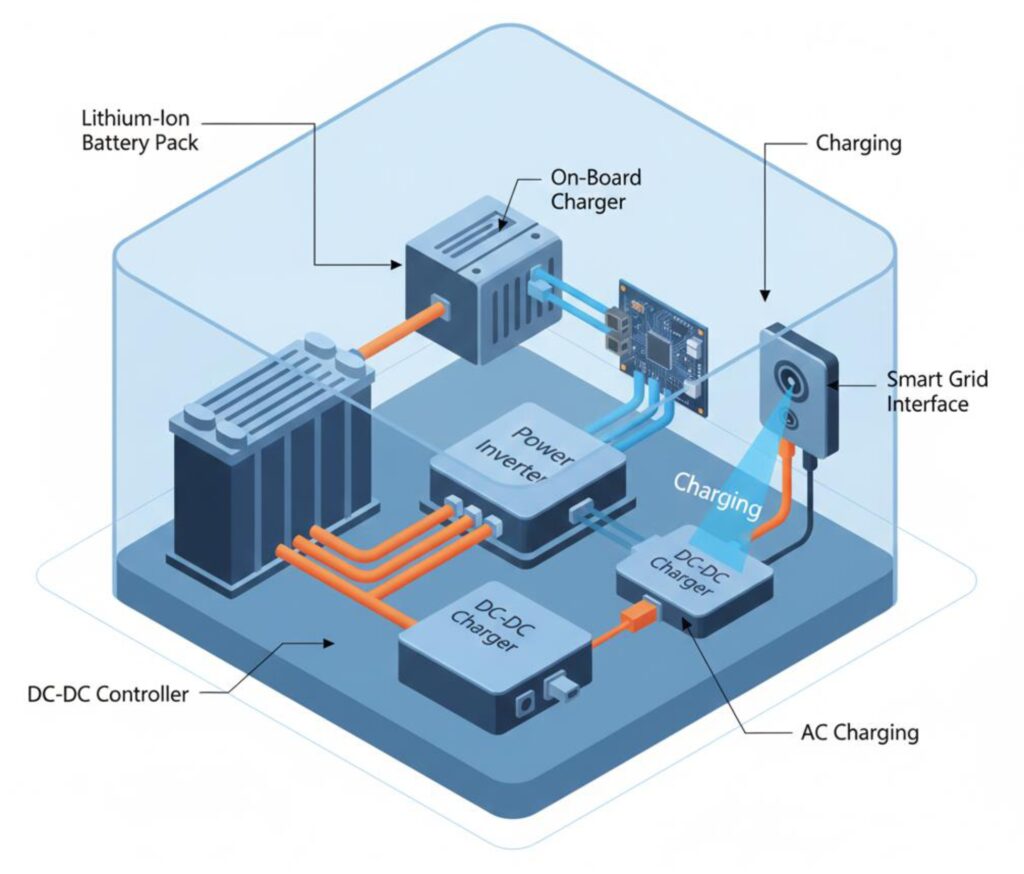
Modern EVs rely on advanced electronics to manage how battery power is used. Better power management means vehicles can travel farther on the same battery — critical in countries like India where range confidence is key.
New electronics materials and designs are helping EV systems run more efficiently and stay cooler — a real advantage on hot Indian roads and long highway runs.
For vehicle makers and buyers alike, better power electronics translate into longer driving range and greater confidence — a central factor in increasing EV adoption.
B: Faster, Smarter Charging
Figure 2: Charging Evolution
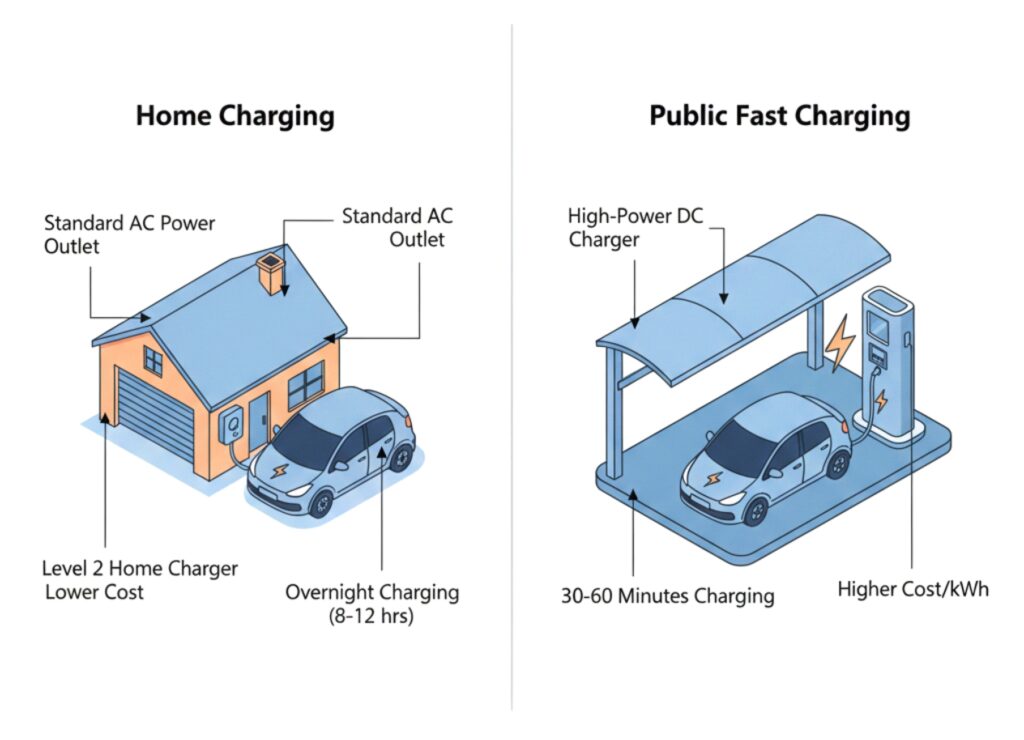
Charging is one of the biggest factors shaping EV adoption. Improved electronics are enabling faster, more intelligent charging — whether at home or on the road.
India’s public charging network has expanded rapidly from a few thousand to over 25,000 stations by early 2025, supported by government programs and industry partnership.
Technology to Watch
- Ultra-fast charging electronics
- Electronics for two-way power flow (allowing EVs to feed power back to homes or the grid)
Smarter charging not only reduces waiting time but could allow EVs to serve as energy resources during power outages or peak demand periods.
C: Safer, More Reliable Vehicles
Figure 3: Electronic Monitoring Systems in Evs
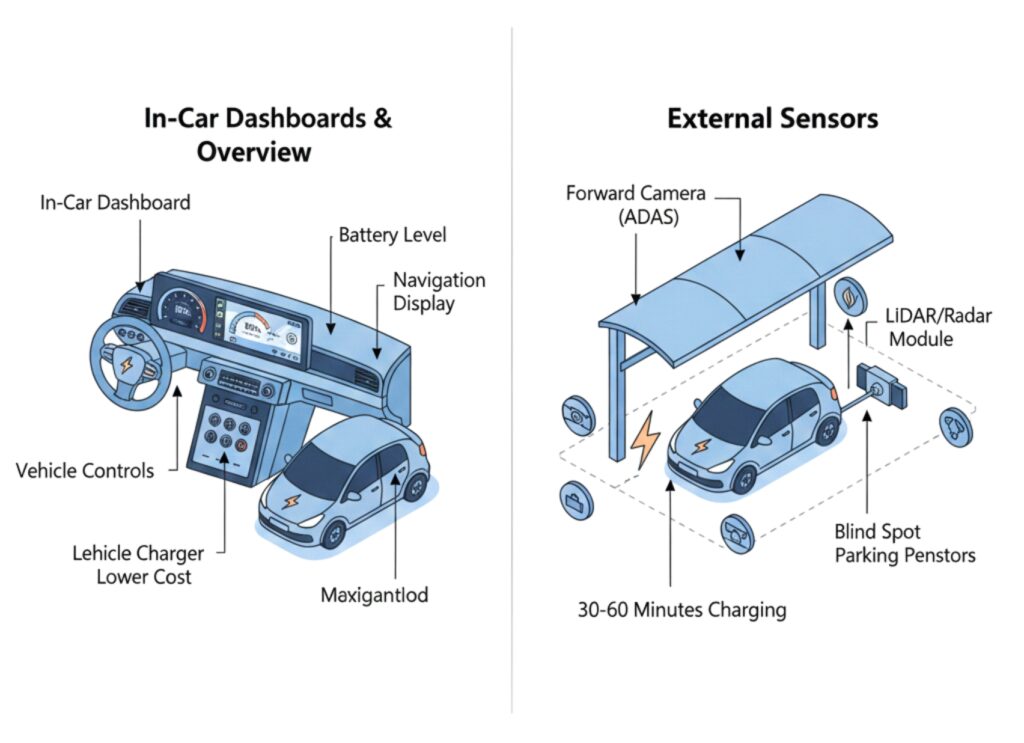
Electronics are not just about performance — they also help keep EVs safe and reliable. Modern systems continuously watch battery conditions, temperature, and power flow, reducing risk and prolonging component life.
India Policy Boost
Programs like FAME-II and state initiatives have put a spotlight on safety and quality standards for EV components, including electronics and charging infrastructure.
Safety and reliability strengthen consumer trust, making EVs a more convincing choice for families and fleet operators alike.
D: Connected, Upgradable Vehicles
Figure 4: EV Connectivity Ecosystem
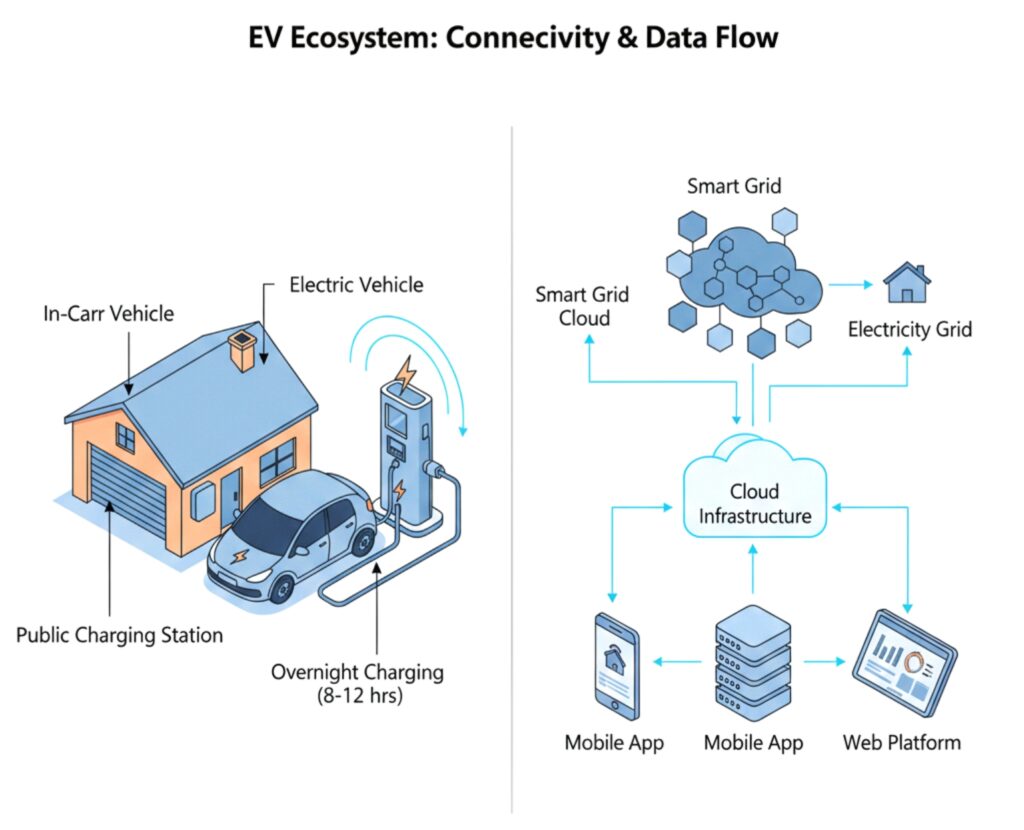
Today’s EVs are more like connected computers on wheels. Over-the-air updates allow features to improve over time, and connectivity enables remote diagnostics and predictive maintenance — removing the need for frequent physical servicing.
What’s Growing in India
- Connected services for battery health, navigation, and charging
- Telemetry and remote diagnostics tailored to Indian usage patterns
A smarter EV experience builds customer loyalty and lowers long-term ownership costs.
E: EVs as Part of India’s Energy System

Figure 5: EVs Interacting with Power Grid
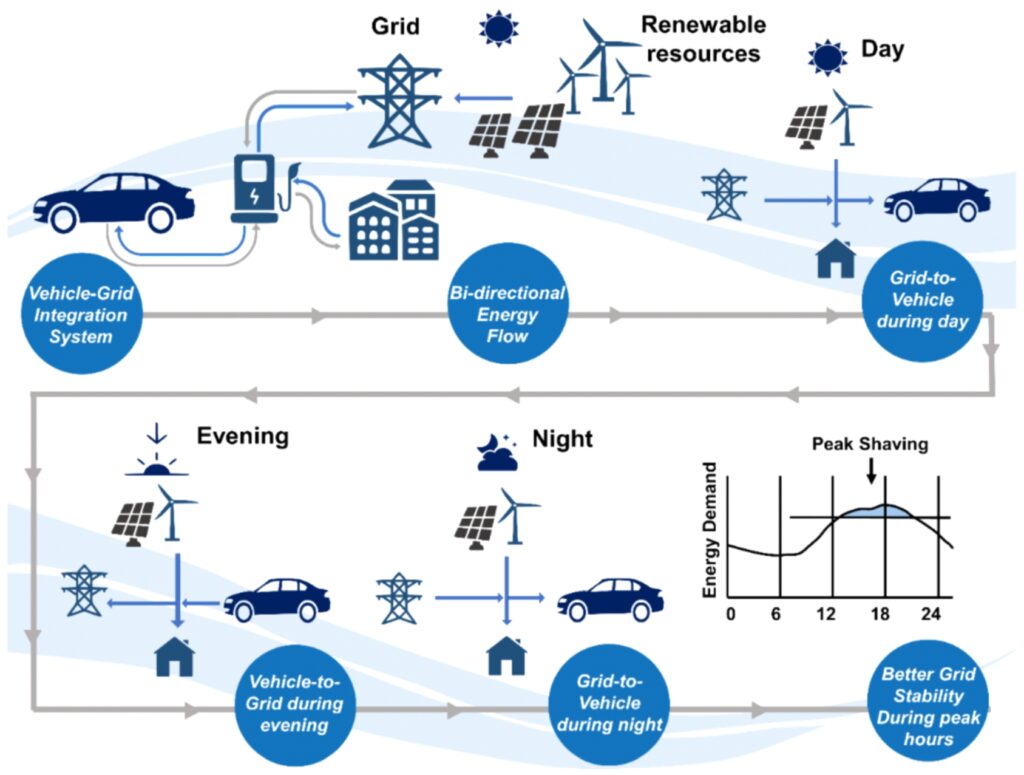
India’s growing renewable energy rollout increases the value of EVs that can charge when clean energy is abundant. Future charging systems may even help balance grid supply and demand, with EVs acting as mobile energy assets.
Policy & Market Tailwinds
- India targets EVs to be ~30 % of total new vehicle sales by 2030, backed by central and state incentives.
- Financial support for public charging infrastructure and EV deployment schemes are expanding nationally.
EVs could play an active role in India’s clean-energy transition — not just on roads, but within the wider power ecosystem.
India Focus Sidebar
EV Market Momentum
- ~19.7 lakh EVs sold in India in FY 2025 (~17 % growth).
- EV charging points increased more than five-fold since 2022.
- FAME-I, II, PM E-DRIVE, PLI for ACC Batteries, SPMEPCI, EMPS and other schemes have supported millions of EV purchases and thousands of chargers.
- State policies (e.g., Telangana EV and ESS Policy) further boost local adoption and production.
Conclusion
In India’s evolving mobility landscape, electronics is the hidden power behind EV adoption — optimizing range (wide band semiconductors using SiC/GaN, advanced BMS), enabling smarter charging (800V EV architecture, bidirectional charging), improving safety (real time battery health monitoring, advanced thermal runaway detection), and connecting vehicles (SDVs, OTA updates, AI enabled vehicle analysis) to services and power systems (smart-grid ready EV electronics, digital coordination). As government support, infrastructure, and consumer confidence grow, these electronic innovations will be key to India’s transition to a cleaner, smarter mobility future.

About the Author:
Gopalakrishnan VC, Director Automotive and EV Sector, Government of Telangana