


The global 5G Fixed Wireless Access Market is entering a transformative growth phase as telecom operators, enterprises, and governments increasingly adopt next-generation wireless broadband solutions to bridge connectivity gaps. Driven by expanding 5G infrastructure, rising demand for fiber-like internet speeds, and digital transformation initiatives, the market is witnessing unprecedented momentum across residential, commercial, and industrial applications.
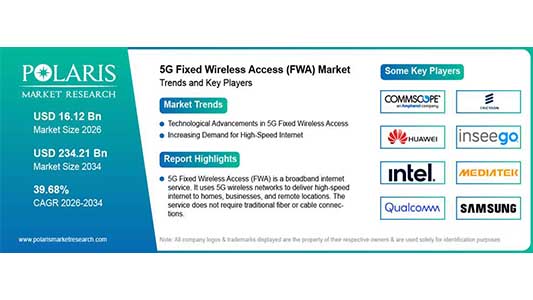
According to the latest Polaris Market Research report, the global 5G Fixed Wireless Access Market was valued at USD 11.57 billion in 2025 and is projected to reach USD 234.21 billion by 2034, registering an impressive CAGR of 39.68% during 2026–2034. The remarkable growth reflects the increasing deployment of advanced 5G technologies, wider spectrum availability, and growing investments in wireless broadband infrastructure worldwide.
Market Overview

5G Fixed Wireless Access (FWA) delivers high-speed broadband internet using 5G radio networks instead of traditional fiber or cable infrastructure. The technology enables telecom operators to provide reliable internet connectivity to homes, businesses, and industrial facilities without extensive underground cable deployment.
As digital economies continue to expand, organizations require scalable, low-latency, and cost-effective connectivity solutions. 5G FWA has emerged as a practical alternative for underserved and rural regions while also supporting urban broadband expansion where fiber deployment is expensive or time-consuming.
Growing adoption of smart homes, cloud computing, remote work, online education, IoT ecosystems, and digital enterprises continues to strengthen market demand. Additionally, the integration of edge computing with 5G infrastructure is creating new opportunities across manufacturing, healthcare, logistics, transportation, and smart city applications.
Browse Full Insights:
https://www.polarismarketresearch.com/industry-analysis/5g-fixed-wireless-access-market
Key Market Growth Drivers
Increasing Demand for High-Speed Broadband Connectivity
Consumers and businesses expect uninterrupted, high-speed internet for cloud applications, video conferencing, gaming, streaming, and enterprise operations. 5G FWA provides gigabit-level performance without requiring extensive wired infrastructure, making it an attractive broadband alternative.
Expansion of 5G Network Infrastructure
Telecommunication companies are investing heavily in nationwide 5G deployments. The increasing availability of Sub-6 GHz and mmWave spectrum is significantly improving network capacity, coverage, and service quality, accelerating adoption of fixed wireless broadband solutions.
Growing Enterprise Digital Transformation
Businesses are rapidly deploying digital technologies including AI, IoT, automation, and edge computing. These applications require reliable, low-latency connectivity, encouraging enterprises to implement private 5G FWA networks for enhanced operational efficiency and secure communications.
Rural Broadband Development Initiatives
Governments across multiple regions continue investing in digital inclusion programs to eliminate the urban-rural connectivity gap. 5G Fixed Wireless Access offers a cost-effective solution for delivering broadband services in remote and underserved locations where fiber installation remains economically challenging.
Emerging Market Opportunities
The future of the 5G Fixed Wireless Access Market extends well beyond residential internet services. Several emerging applications are expected to generate significant revenue opportunities throughout the forecast period.
The rapid expansion of smart cities is increasing demand for connected infrastructure capable of supporting intelligent transportation systems, public safety networks, environmental monitoring, and smart utilities.
Industrial automation initiatives are creating new use cases for private wireless networks that enable machine-to-machine communication, predictive maintenance, robotics, and real-time manufacturing analytics.
Healthcare providers are increasingly adopting telemedicine, remote diagnostics, connected medical devices, and digital healthcare platforms that depend on ultra-reliable, low-latency connectivity.
Similarly, educational institutions and remote work environments continue to require high-performance broadband services, further strengthening long-term market demand.
Market Segmentation Highlights
The market is segmented based on offering, frequency, demography, application, and region.
By offering, the services segment accounts for the largest market share due to increasing demand for managed network services, deployment support, maintenance, and system integration.
Based on frequency, deployments across Sub-6 GHz, 24–39 GHz, and Above 39 GHz continue to expand, allowing operators to optimize coverage and network performance according to geographic and infrastructure requirements.
From a demographic perspective, urban areas currently dominate market adoption, while rural deployments represent one of the fastest-growing segments as governments prioritize broadband accessibility.
By application, the residential segment remains the largest contributor owing to rising consumer demand for high-speed home internet, while commercial, industrial, and government applications continue to witness rapid expansion.
Regional Analysis
North America
North America currently leads the global 5G Fixed Wireless Access Market due to extensive 5G infrastructure deployment, strong investments by leading telecom operators, and widespread consumer adoption of next-generation broadband services. The region also benefits from high digital maturity and favorable regulatory support.
Europe
Europe continues experiencing steady market growth as governments encourage digital transformation and broadband expansion initiatives. Increasing enterprise adoption of private 5G networks and smart manufacturing solutions further supports regional demand.
Asia-Pacific
Asia-Pacific is expected to register the fastest growth during the forecast period. Rapid urbanization, expanding telecom infrastructure, growing smartphone penetration, and significant investments in smart city development are driving large-scale deployment across major economies including China, Japan, South Korea, and India.
Latin America, Middle East & Africa
Emerging economies across these regions are witnessing rising investments in digital infrastructure, creating substantial opportunities for telecom operators to expand broadband coverage through 5G FWA technologies.
Competitive Landscape
The competitive landscape remains highly dynamic as technology providers, semiconductor manufacturers, network equipment vendors, and telecommunications companies continue investing in innovation, strategic collaborations, and network expansion.
Future Outlook
The 5G Fixed Wireless Access Market is expected to remain one of the fastest-growing segments within the global telecommunications industry. Increasing demand for affordable broadband, rapid 5G rollouts, enterprise digital transformation, and continuous technological advancements will continue driving market expansion over the coming decade.
As telecom operators accelerate infrastructure investments and governments prioritize universal broadband access, 5G FWA will play a crucial role in reshaping the future of global connectivity. The technology’s ability to deliver fiber-like performance with faster deployment and lower infrastructure costs positions it as a strategic solution for both developed and emerging markets.
With continued innovation in wireless networking, edge computing integration, private 5G deployments, and smart infrastructure development, the 5G Fixed Wireless Access Market is poised to become a foundational component of next-generation digital ecosystems worldwide.
Read More @ www.polarismarketresearch.com