
Electronics Era

  • About Us
  • Advertise with Us
  • Contact Us
  • e-Mag
  • Webinars
Header logo on website
Advertisement
Advertisement
Menu
  • Home
  • News
    • Industry News
    • Product News
  • TECH ROOM
    • Sensor
    • VR / AR
    • Embedded
    • Medical Electronics
    • Industry 4.0
    • Robotic
    • Automation
    • Smart Machine
    • Component
    • MCU
    • Manufacturing
    • Aerospace & Defence
    • Security
    • Policy
    • RENEWABLES
      • Sustainability
  • Semiconductor
    • AUTOMOTIVE ELECTRONICS
      • EVs
      • HEVs
      • ADAS
      • Connected Cars
    • IoT-Internet of Things
      • Development Kit
      • IoT Design
    • Power Electronics
      • AC-DC/DC-DC Converters
      • Mosfets
      • IGBTs
      • LEDs
  • T & M
    • 5G testing
    • Oscilloscopes
    • SDN & NFV
    • RF & Wireless
  • AI/ML
  • Telecom
    • 5G/6G
  • Future Tech
    • Data Center
    • Cloud Computing
    • Big Data Analytics
  • Webinars
  • Editor’s Pick
    • Tech Article
    • Tech Blog
    • White Papers
    • EE-Tech Talk
    • Market Research
    • Videos
  • EE Awards
    • EE Awards 2025
    • EE Awards 2024
  • MORE
    • E-Mag
    • Events
    • MAGAZINE Subscription
    • Contact Us
Home Semiconductor AUTOMOTIVE ELECTRONICS

Driving Infrared Communications Made Easy

Author: Graeme Clark, Principal Product Engineer

Vishaka Vardhan by Vishaka Vardhan
October 21, 2025
in AUTOMOTIVE ELECTRONICS, Tech Article
Reading Time: 3 mins read
ra4c1
Share on FacebookShare on TwitterShare on LinkedIn

Many of today’s low-power applications require a simple, short-range method of contactless communications, without a cable. This way of contactless communication can be used for configuration or data collection, but the added cost and complexity of a radio link is not preferred.

An infrared communications link is often the best solution and can be found in many different products, such as utility meters, wearables, and remote controls. However, implementing such a link on a typical microcontroller is not so easy. To avoid saturating the IR diode, we typically want to drive the diode with a low-frequency signal, and then this has to be modulated by the communications data, which typically means an external modem chip is used. With its associated cost, we tend to generate a low-frequency signal with a timer and use some external components to mix this with the output of a serial port. This not only uses external components, but we also need to use several I/O pins for each of these functions.


In this article, we’ll look how we can use the SCI/AGT gate function to mix the output of the Renesas’ RA4C1 microcontroller’s Asynchronous General-Purpose Timer (AGT) with the output of SCI5 or the on-chip IrDA interface, to easily generate the signal required to efficiently drive an infrared diode without the need for external components or an excessive number of I/O pins.

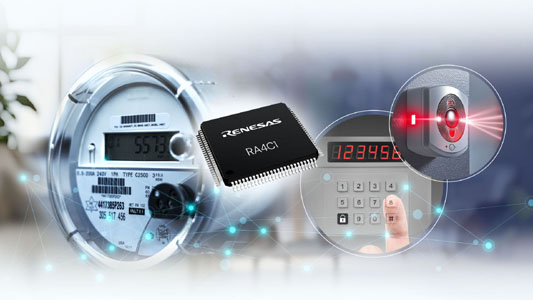
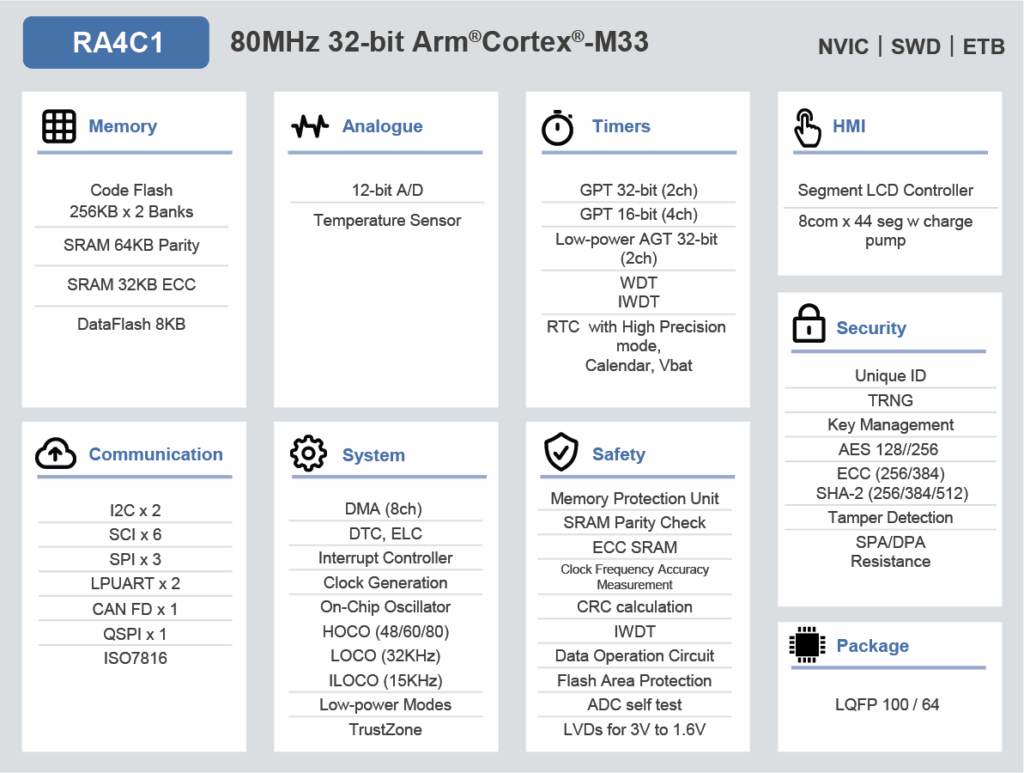
The RA4C1 is a low-power microcontroller (MCU), supporting up to 80MHz operation that can operate from voltages down to 1.6V. The device has many low-power peripherals such as low-power timers, low-power UARTs, and a segment LCD controller. The RA4C1 is the first product of the RA MCU family with the SCI-AGT mask circuit implemented to make it easy to drive IR diodes, as you can see in the circuit diagram below.
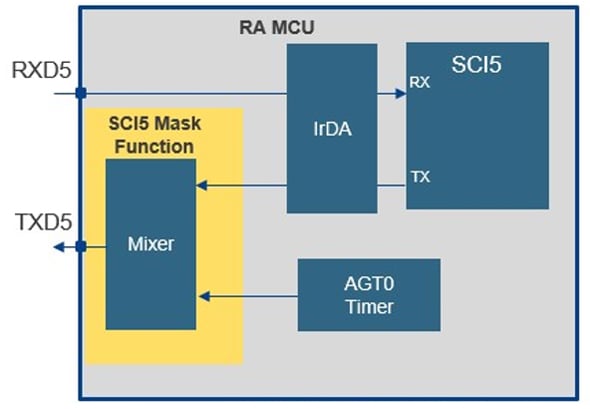
Figure 1. SCI AGT Mask Function

The circuit is very simple in operation. Users can use the output of SCI5 to modulate the carrier frequency generated by the AGT timer, as shown in the diagram below. This can then be used to directly drive the IR diode.
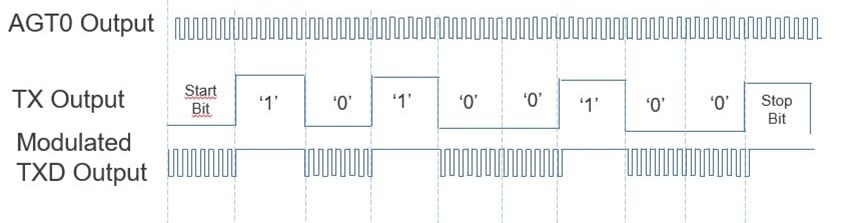
Figure 2. UART Frame

Users can also choose to use the output of the IrDA circuit on the RA4C1 to modulate the carrier. You can choose to either output the direct modulated output or use the output with phase inversion, as shown in the diagram below.
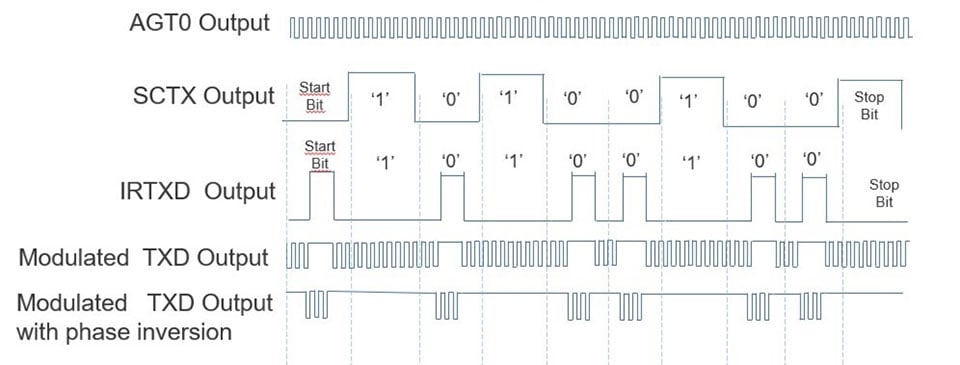
Figure 3. IrDA Frame

This simple circuit makes it much easier for the users to generate the signals required to send information across an infrared interface, reducing the additional components required on the PCB and reducing the number of pins on the MCU for such a function.

Vishaka Vardhan

Vishaka Vardhan

Join Our Newsletter

* indicates required
Electronics Era

Electronics Era, India's no.1 growing B2B news forum on Electronics and Cutting Edge Technology is exploring the editorial opportunity for organizations working in the Electronics Manufacturing Services(EMS) Industry.

Follow Us

Browse by Category

  • 5G testing
  • 5G/6G
  • AC-DC/DC-DC Converters
  • ADAS
  • Aerospace & Defence
  • AI/ML
  • Automation
  • AUTOMOTIVE ELECTRONICS
  • Big Data Analytics
  • Blockchain
  • Cloud Computing
  • Component
  • Connected Cars
  • Data Center
  • Editor's Desk
  • EE-Tech Talk
  • Electronics Components
  • Embedded
  • EVs
  • Future Tech
  • HEVs
  • Industry 4.0
  • Industry News
  • IoT Design
  • IoT-Internet of Things
  • LED & Lighting
  • LEDs
  • Manufacturing
  • Market Research
  • MCU
  • Medical Electronics
  • Mosfets
  • News
  • Oscilloscopes
  • Policy
  • Power Electronics
  • Product News
  • RENEWABLES
  • RF & Wireless
  • Robotic
  • SDN & NFV
  • Security
  • Semiconductor
  • Sensor
  • Smart Machine
  • SMT/PCB/EMS
  • Sustainability
  • T & M
  • Tech Article
  • Tech Blog
  • TECH ROOM
  • Telecom
  • Uncategorized
  • VR / AR
  • White Papers

Recent News

Konica Minolta

Konica Minolta India Brings Together Strategic Partners to Chart the Next Phase of Growth at Annual Strategic Partner Conference 2026

June 5, 2026
AlphaSpaceX (Shenzhen) Technology Co.,

Electronics Era Interacts with CollinZhang Founder & CEO of AlphaSpaceX (Shenzhen) Technology Co., Ltd.

June 5, 2026
  • About Us
  • Advertise with Us
  • Contact Us

© 2022-23 TechZone Print Media | All Rights Reserved

No Result
View All Result
  • Home
  • News
    • Industry News
    • Product News
  • TECH ROOM
    • Sensor
    • VR / AR
    • Embedded
    • Medical Electronics
    • Industry 4.0
    • Robotic
    • Automation
    • Smart Machine
    • Component
    • MCU
    • Manufacturing
    • Aerospace & Defence
    • Security
    • Policy
    • RENEWABLES
      • Sustainability
  • Semiconductor
    • AUTOMOTIVE ELECTRONICS
      • EVs
      • HEVs
      • ADAS
      • Connected Cars
    • IoT-Internet of Things
      • Development Kit
      • IoT Design
    • Power Electronics
      • AC-DC/DC-DC Converters
      • Mosfets
      • IGBTs
      • LEDs
  • T & M
    • 5G testing
    • Oscilloscopes
    • SDN & NFV
    • RF & Wireless
  • AI/ML
  • Telecom
    • 5G/6G
  • Future Tech
    • Data Center
    • Cloud Computing
    • Big Data Analytics
  • Webinars
  • Editor’s Pick
    • Tech Article
    • Tech Blog
    • White Papers
    • EE-Tech Talk
    • Market Research
    • Videos
  • EE Awards
    • EE Awards 2025
    • EE Awards 2024
  • MORE
    • E-Mag
    • Events
    • MAGAZINE Subscription
    • Contact Us

© 2022-23 TechZone Print Media | All Rights Reserved

Advertisement
Advertisement