


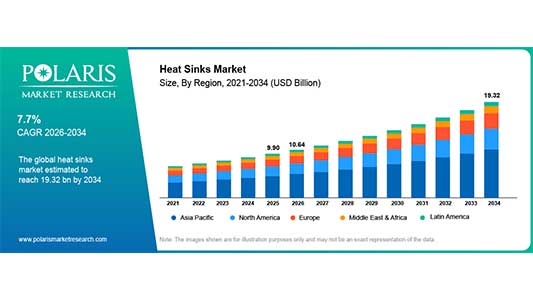
For decades, the heat sink was among the least glamorous parts of a computer: a block of finned aluminum that nobody noticed until it failed. That anonymity is ending. NVIDIA has said its AI devices are quickly passing 1,000 watts per chip, a level at which air alone struggles to keep silicon within safe limits. Thermal management has moved from the margins of the bill of materials to the center of data center design. The heat sinks market, valued at USD 9.90 billion in 2025 and projected to reach USD 19.32 billion by 2034, is being reshaped by a single question: what happens when the chip runs hotter than the cooler can handle?
The Industry Shift Behind the Heat Sinks Market
The honest answer is that the product is splitting in two. Extruded aluminum designs still hold the largest share of the market, at 35.42%. They are cheap to make, easy to customize and well suited to consumer and industrial electronics. Aluminum is the dominant material, with a 45.28% share.
At the high end, the story is different. Liquid cold plates, which carry heat away from a chip through circulating coolant rather than fins and airflow, are forecast to grow at 12.78% annually, well ahead of the overall market’s 7.7%. Copper is also gaining ground in applications where aluminum cannot move heat fast enough.
The pressure comes from the demand side. Data centers and AI servers already account for 28.64% of heat sink demand, and every new generation of accelerators pushes power density higher. Electric vehicles add a second source of pressure: silicon carbide power modules in EVs need serious cooling, and the automotive and EV segment is projected to grow at 8.22% a year.

What the Heat Sinks Market Means for Businesses
The opportunity is in the price tag. Liquid cooling modules sell at several times the price of air coolers, so a supplier that moves up the technology curve earns far more on each socket it serves. For server makers and hyperscale operators, the calculation runs the other way: thermal design is no longer something to settle at the end of a project. It decides how densely racks can be packed and which chips can be deployed at all.
The challenges are real. Liquid cooling is eating into traditional air-cooled demand in high-end computing, so suppliers built around fins and fans face a choice: add capability or accept a shrinking niche. Entry barriers are also high. New vendors must pass platform-specific testing before supplying AI server programs, advanced manufacturing needs precision skills such as skived fins and brazed cold plates, and demand is concentrated among a small number of very large buyers.
Even so, air cooling will not disappear. Liquid cooling is more likely to change which heat sinks matter than to replace them. Consumer electronics, telecom and power equipment will keep buying cost-effective designs. Vapor chambers and heat pipes remain important in air-cooled AI servers, where they spread heat from hotspots into the fins.
For more information, visit @ https://www.
Regional Dynamics: Where the Heat Is Made and Managed
Asia Pacific led the market with a 42.46% share in 2025, and the reason is practical: this is where electronics are built. China, Japan, South Korea and Taiwan host dense semiconductor and server supply chains, and EV production adds to demand. China’s EV sales rose from 11.2 million units in 2024 to 13.2 million in 2025. Taiwanese thermal suppliers have reported record monthly revenue on the back of liquid cooling orders.
North America is expected to grow at 7.54% a year, driven less by manufacturing than by consumption. Hyperscalers are building at enormous scale. Meta alone has committed to invest more than USD 600 billion in the United States by 2028 in AI and data center infrastructure, and every rack in those buildings needs cooling.
Europe, with 20.36% of the market, is following a similar path through data center and automotive electronics investment, including Amazon’s USD 39.8 billion commitment in Spain. A quieter story is emerging elsewhere: new fabrication capacity outside Taiwan, such as Tata Electronics’ USD 11 billion plant in Gujarat, India, could eventually pull thermal suppliers closer to new manufacturing clusters.
Competition Moves From Components to Systems
The market remains fragmented, but its strategic logic is changing. Eaton’s USD 9.55 billion acquisition of Boyd Thermal showed that power-management companies now see thermal capability as core to their offering. Ecolab has agreed to acquire CoolIT Systems, and Vertiv bought Strategic Thermal Labs to add cold-plate design and validation. The pattern is convergence: heat removal, power delivery and liquid distribution are being sold as integrated systems.
Taiwanese specialists are scaling in parallel. Asia Vital Components reported May 2026 revenue of NT$15.9 billion, up 61% year on year, on demand for vapor chambers and thermal modules. Delta Electronics has begun shipping a 3 MW coolant distribution unit, and Advanced Cooling Technologies has expanded a Pennsylvania plant to produce cold plates for AI data centers. Differentiation now comes from qualification on specific GPU platforms and the ability to deliver at volume, not from price alone.
What Comes Next
The coming years will likely bring more consolidation along the lines Eaton set out, as larger groups combine heat sinks with liquid cooling and other technologies. Emerging approaches such as two-phase cold plates, where coolant boils at the chip and condenses downstream, may extend cooling capacity further as racks get denser. Local production near new fabs and data center clusters could also reshape supply chains.
The Bigger Business Picture
The significance of this market goes beyond its growth rate. Heat is becoming the binding constraint on computing, and the companies that manage it best will shape how quickly AI infrastructure can scale. For suppliers, the task is to decide where to sit along the shift from fins to fluids. For buyers, it is to treat thermal strategy as a design decision made at the start of a project. The humble heat sink is no longer a commodity at the edge of the system. It is becoming a strategic asset.