


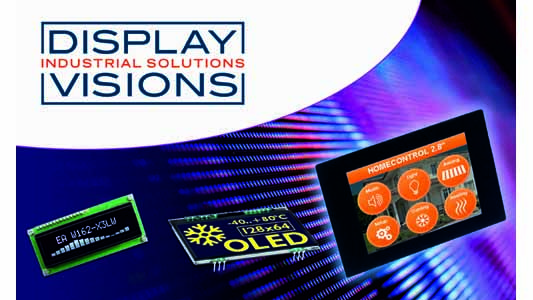
Displays have become an indispensable element of machine interfaces (HMI) – and today they are much more affordable. The Display Visions brand offering includes both universal alphanumeric and graphic modules as well as intelligent displays, adapted to industrial and embedded solutions.
Below we present a cross-section of the brand’s offering Display Visions, which includes both the simplest display models and those with advanced functionality. It is worth noting that the offer includes products made using various technologies: e-paper, LCD, TFT, and OLED. Part of the assortment is supplied with integrated touch panels. The manufacturer also offers a wide selection of mounting accessories. An important advantage of Display Visions products is the long life cycle. This reduces the risk of having to redesign equipment due to the withdrawal of a key component. Most Display Visions products can be purchased directly from TME warehouses. There is also the possibility to order larger volumes.

In this article, we discuss topics such as:
- Display modules with built-in controller
- Classic and universal monochromatic LCD solutions
- Energy-efficient displays made with OLED technology
- Color TFT displays with touch panels
- Capabilities and limitations of electronic paper technology
- Complementary products from the Display Visions offer
Intelligent displays
An “intelligent display” typically refers to a module combining a TFT panel with a graphic controller, memory, and appropriate communication interfaces on one printed circuit board. In the case of Display Visions’ uniTFT solutions, it is similar, with programming carried out by preparing a project in the manufacturer’s dedicated environment. “UniTFTDesigner” enables configuring screens and all interface elements. The rich library of functions contained in the display controller allows you to display graphics and text, draw interface elements (e.g., touch-operated buttons), etc. Objects on the screen can be freely scaled and rotated without loss of quality. Various transition effects and animations are also available, as well as MP3 file support.
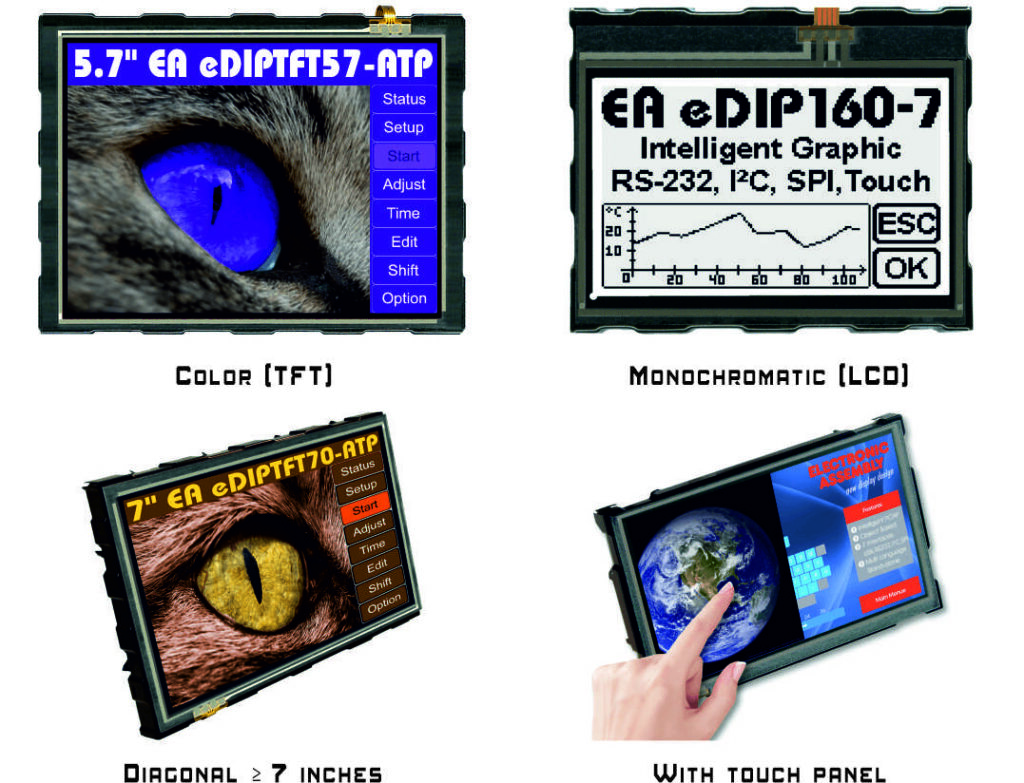
Various models fall under the category of intelligent displays. Of course, the most capable are the versions with a color TFT matrix and touch panel (up to 10.1 inches). The manufacturer also offers simpler versions with similar functionality (e.g., monochromatic LCD models). Modules can communicate with other components via I2C, RS232, and SPI interfaces and be programmed via USB. This allows the display to exchange data with sensors and other system elements, and to implement some simple logical dependencies without constant support from an external microcontroller. Depending on the specific model, the required power supply will range from 3.1V to 35V DC.
For graphic models, buyers have a wider choice of controllers, allowing them to select a solution supported by the most convenient library available for the control unit. Communication can be via both popular serial interfaces and classic parallel connections. Matrix resolutions range from 102×64 to 320×240 pixels.
Display Visions is known for the DOG series (Display On Glass) – compact LCD displays made with Chip-on-Glass, where the controller is integrated directly with the glass of the matrix. The offer includes alphanumeric versions (e.g., 2×16, 4×20) and graphic (e.g., 102×64 or 240×128 pixels), with SPI or I2C interfaces and 3.3 V power supply. Importantly, these displays are compatible with Arduino. Ready libraries, sample programs, and documentation are available for selected models, making this series suitable for embedded systems and prototyping devices.
LCD displays
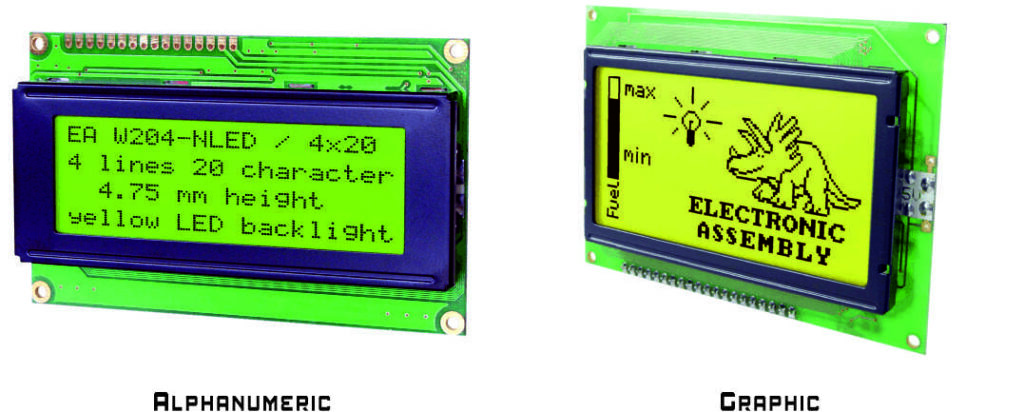
The Display Visions assortment also includes “traditional” monochromatic LCD displays – alphanumeric and graphic. The built-in controller of the former is compatible with the widely used HD44780. Variants operated via I2C and RS232 interfaces are also available. You can find models with configurations from 8×1 to 40×4 characters, where the first value refers to the number of characters and the second to the number of lines. Available in positive and negative display versions. Colors available are black and white, blue, green, and yellow-green with symbol heights ranging from 3.7mm to 12.7mm.
For graphic models, buyers have a wider choice of controllers, allowing them to select a solution supported by the most convenient library available for the control unit. Communication can be via both popular serial interfaces and classic parallel connections. Matrix resolutions range from 102×64 to 320×240 pixels.
Display Visions is known for the DOG series (Display On Glass) – compact LCD displays made with Chip-on-Glass, where the controller is integrated directly with the glass of the matrix. The offer includes alphanumeric versions (e.g., 2×16, 4×20) and graphic (e.g., 102×64 or 240×128 pixels), with SPI or I2C interfaces and 3.3 V power supply. Importantly, these displays are compatible with Arduino. Ready libraries, sample programs, and documentation are available for selected models, making this series suitable for embedded systems and prototyping devices.
OLED displays
The division and functionality of monochromatic OLED displays are similar to those mentioned above. Models include graphic and alphanumeric ones, with various resolutions and colors, controllable via different interfaces. Their main advantage is high color contrast (>1:1000) and deep black. Moreover, an advantage of this group of products is also readability without the need for backlighting, which — depending on the displayed content — can lead to reduced power consumption. Additionally, there are models with an exceptionally low profile (e.g., 2.1mm), equipped with connection tapes (instead of pins) or with a less typical shape (square or round).
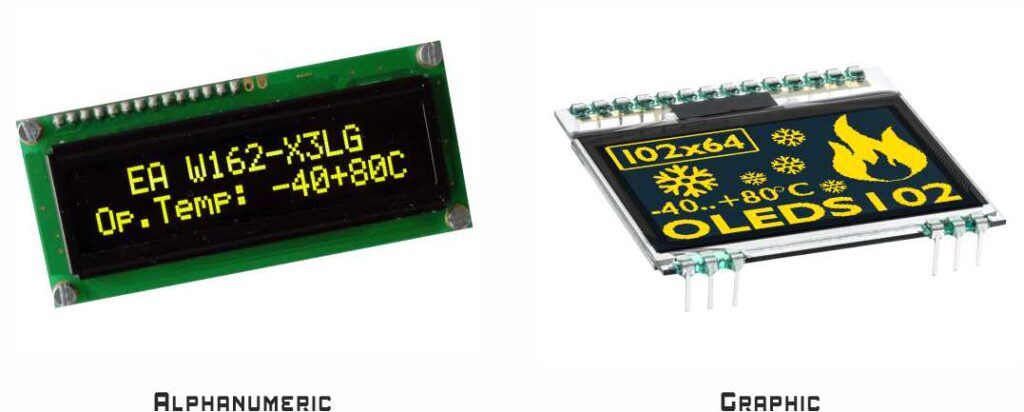
It is worth noting that some of the presented displays have capacitive touch panels, allowing for the construction of more complex interfaces without using physical switches. Equally important, the offer includes models of very small sizes (0.66-inch diagonal) to meet the needs of compact, portable devices.
TFT displays
Display Visions color displays are classic TFT matrices that require control by a microcontroller or computer (also adapted for use with Raspberry Pi). They provide much better image quality and wider viewing angles compared to classic LCD solutions. Some models feature capacitive touch panels. Their interfaces mostly include 8…24-bit RGB and LVDS. Screen diagonals range from 0.96 inches to 10.1 inches with resolutions from 160×80 to 1280×800 pixels. Brightness can reach up to 1400cd/m2 (contrast up to 1000:1), ensuring good visibility even in daylight.
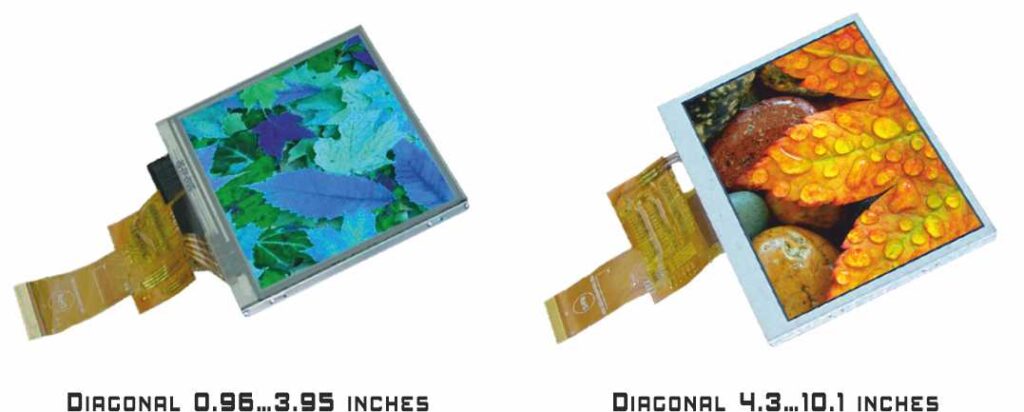
Both the displays themselves and their touch panels have connections implemented as ribbons (pitch 0.3…0.8mm), to facilitate use in compact devices. However, it must be emphasized that the manufacturer foresees the use of its solutions in various applications, primarily in industrial machines.
E-paper
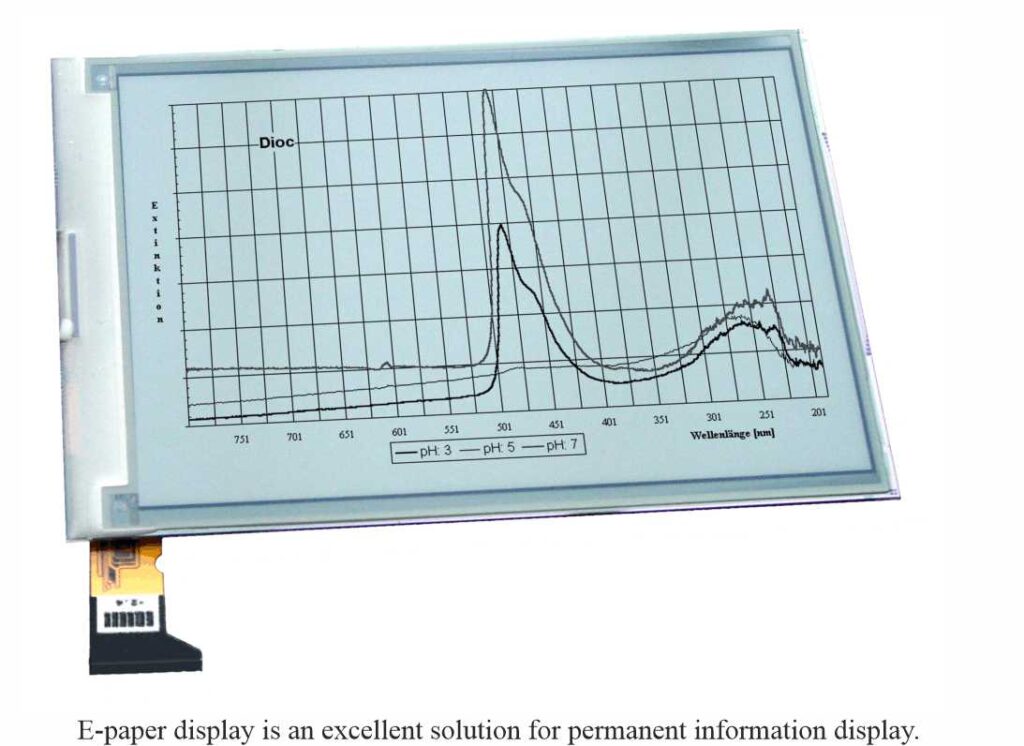
E-paper displays, although characterized by very low refresh rates, offer many advantages: graphics can be displayed on them for a very long time even after power is disconnected, and the image is clear and visible from any angle. These features make such displays popular for presenting statistics, charts, instructions, and other information that does not require dynamic changes. Models offered by Display Visions have resolutions of 172×72, 800×480, and 800×600 pixels. They provide clear images even in poorer lighting conditions because white points reflect light with an efficiency of at least 40%, while the display surface is covered with an anti-reflective coating. Modules use controllers that utilize an 8-bit data bus for fast transmission.
Accessories
Finally, it should be mentioned that TME’s offer includes a wide selection of accessories produced by Display Visions. These are mechanical elements such as frames, connectors (pin, FFC tapes, ribbon cables), and even components like backlight matrices (multicolored, including RGB) or touch panels. Many of these elements are intended for use with specific models of the supplier’s displays.
Accessories
For more information please visit: Transfer Multisort Elektronik – tme.in