


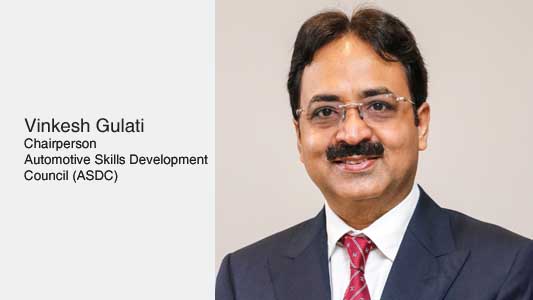
By Vinkesh Gulati, Chairperson, Automotive Skills Development Council (ASDC)
Ask any college student about their dream career and you are likely to hear answers such as Artificial Intelligence, Robotics, Data Science, Startups, Space Technology, or Sustainability. What many young people don’t realize is that all these exciting technologies are now coming together in one industry—the automobile sector. The automobile industry of 2026 is vastly different from what it was a decade ago. Gone are the days when automobiles were associated only with engines, grease, and workshops. Today’s vehicles are intelligent machines powered by software, sensors, artificial intelligence, connectivity, advanced electronics, and clean energy. In many ways, modern cars have become smartphones on wheels.
For students looking to build careers in technology, innovation, and sustainability, the automotive sector offers one of the most exciting opportunities of the coming decade.
India’s rise as the world’s third-largest automobile market is creating unprecedented demand for skilled professionals. As electric vehicles, connected cars, autonomous technologies, and smart mobility solutions gain momentum, companies are searching for a new generation of talent that can think differently and build the future. Imagine working on battery technologies that can charge a vehicle in minutes. Imagine designing software that helps vehicles communicate with each other. Imagine creating artificial intelligence systems that make roads safer or developing mobility solutions that reduce pollution and make cities smarter. These are no longer futuristic concepts—they are real projects being worked on today by young professionals across the globe.
The electric vehicle revolution alone is opening opportunities that did not even exist a few years ago. Battery engineers, EV design specialists, charging infrastructure experts, battery-swapping planners, thermal management engineers, and EV service professionals are among the most sought-after roles in the industry. As India accelerates towards cleaner mobility, the demand for such professionals will continue to grow rapidly.
Equally exciting is the emergence of Artificial Intelligence within automobiles. Modern vehicles already use technologies such as Advanced Driver Assistance Systems (ADAS), predictive maintenance, intelligent navigation, voice recognition, and connected mobility platforms. Behind these innovations are software developers, AI specialists, data analysts, cybersecurity experts, and digital engineers. For students pursuing computer science, electronics, or data science, the automobile industry offers opportunities that are every bit as exciting as the technology sector.
Another misconception among students is that only engineers can build careers in the automobile sector. The reality is far more diverse. Whether a student comes from science, commerce, or humanities, there are opportunities in design, marketing, customer experience, digital media, supply chain management, fleet operations, entrepreneurship, sustainability, and business development.

The startup ecosystem has further expanded possibilities. Across India, young entrepreneurs are launching ventures focused on EV charging, battery recycling, mobility platforms, fleet technology, vehicle diagnostics, connected services, and sustainable transportation. Many of these startups are attracting significant investments and creating entirely new career pathways.
What makes this industry even more attractive is its global relevance. The skills learned in electric mobility, automotive software, AI, battery technology, and advanced manufacturing are transferable across international markets. Students entering the sector today are not just preparing for jobs in India; they are preparing for careers that can take them anywhere in the world.
However, success in this new mobility era will depend on continuous learning. Technical skills, digital capabilities, problem-solving, innovation, teamwork, and adaptability will be just as important as academic qualifications. Students who invest early in future-focused skills will find themselves at the forefront of one of the most transformative industries of our time.
At the Automotive Skills Development Council (ASDC), we see this transformation every day. Young people are increasingly choosing careers in electric mobility, automotive technology, advanced manufacturing, and digital automotive services. Their enthusiasm reflects a larger truth: the future of mobility will be built by today’s youth.
While skilling and career development at the college level remain critical, building awareness at an early age is equally important. To address this, ASDC launched the National Automobile Olympiad (NAO), a first-of-its-kind initiative aimed at introducing students from Classes 6 to 12 to the exciting world of automobiles, mobility, technology, and innovation and growing curiosity among students about the automotive sector.
For college students standing at the crossroads of career decisions, the message is simple. If you want to work with cutting-edge technology, contribute to sustainability, solve real-world challenges, and be part of an industry that is reshaping the future, look closely at the automobile sector.
The next generation of mobility innovators, EV pioneers, AI specialists, and automotive entrepreneurs will not come from somewhere else.
They are sitting in our classrooms today.
And the future is waiting for them.