

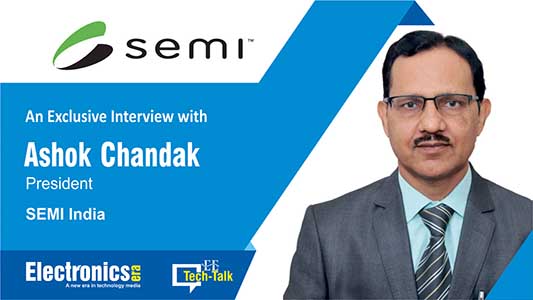
Electronics Era: India has talked about semiconductor manufacturing for years. What is different now, and what signs show the country is moving from plans to production?
Ashok Chandak: The biggest difference today is execution. India has moved beyond policy announcements to project implementation. With over US$22 billion of approved investments across fabs, ATMP/OSAT, and compound semiconductors, multiple facilities are already under construction.


Equally important, global companies now see India as a trusted manufacturing and supply chain partner, supported by strong government policies and proactive state participation. 4 units are already in commercial production in ATMP/OSAT space. The next 18–24 months will see the second wave of commercial production. For IESA, this marks the beginning of a long-term journey from semiconductor consumer to manufacturing powerhouse.
Electronics Era: Fabs often get the headlines, but assembly, test and packaging are becoming an important early part of India’s manufacturing buildout. Why is that a logical place for India to gain traction?
Ashok Chandak: ATMP and OSAT are a natural starting point because they require lower capital investment while creating immediate manufacturing capability. Packaging has also become a technology differentiator, especially for AI, automotive and high-performance computing.
India already has strengths in electronics manufacturing, engineering talent and a growing domestic market. These facilities also stimulate the development of supporting industries such as substrates, chemicals, equipment and testing services, creating the foundation for a broader semiconductor ecosystem.
Electronics Era: Much of the immediate opportunity in India is tied to mature and specialty nodes, not just leading-edge chips. Why are those technologies important?
Ashok Chandak: Most semiconductors used in automotive, industrial, telecom, power electronics and consumer products are built on mature and specialty nodes—not the most advanced process technologies.
These technologies offer stable demand, lower capital intensity and align well with India’s fast-growing markets such as EVs, renewable energy, industrial automation and telecom. These products in volume terms constitutes more than 60% of the global semiconductor demand. India’s strategy should be to build competitive strengths where market demand and national priorities intersect, while gradually advancing toward more complex technologies.
Electronics Era: What needs to develop around the fab itself for India to become a stronger semiconductor manufacturing hub?
Ashok Chandak: A fab alone does not create an ecosystem. India must simultaneously develop suppliers for materials, specialty chemicals, gases, substrates, cleanroom systems, equipment support and precision manufacturing.
Talent is equally critical—not only chip designers but also process engineers, equipment specialists and manufacturing technicians. Customer qualification, quality standards and supply chain reliability will ultimately determine India’s global competitiveness. ISM 2.0 should therefore focus on strengthening the entire semiconductor value chain while continue to attract more FAB projects.
Electronics Era: India already has a strong semiconductor design talent base. How does the country connect that design strength to manufacturing?
Ashok Chandak: India is already a global semiconductor design hub. The next step is connecting design with manufacturing, packaging and system development to create globally competitive products. Product creation for India use cases that can scale up globally should be the focus.
This requires stronger support for startups, easier access to prototyping and packaging facilities, and closer collaboration between design companies, manufacturers and OEMs. The goal is to evolve from “Designed in India” to “Designed, Made and Scaled from India.”

Electronics Era: Advanced packaging, compound semiconductors and wide-bandgap technologies are becoming more important globally. Where does India have the best opportunity?
Ashok Chandak: Advanced packaging, silicon carbide (SiC) and gallium nitride (GaN) are becoming critical for AI, EVs, renewable energy, power electronics and telecom.
These areas align well with India’s market needs and engineering strengths. Rather than competing across every segment, India should build leadership in advanced packaging and compound semiconductors by leveraging its design capabilities, manufacturing ecosystem and growing domestic demand.
Electronics Era: SEMICON India 2026 is focused on “Silicon to Systems: Building the Ecosystem.” What conversations at the event can help India move from individual projects to a connected supply chain?
Ashok Chandak: India’s success depends not on isolated fabs but on building a complete semiconductor ecosystem. SEMICON India 2026 will bring together global industry leaders, suppliers, policymakers, researchers, startups and investors to strengthen collaboration across the value chain. The focus will be on supplier development, localization, talent, advanced manufacturing, AI, R&D and international partnerships. The objective is clear: move from individual projects to an integrated ecosystem that makes India a trusted and resilient global semiconductor hub.