



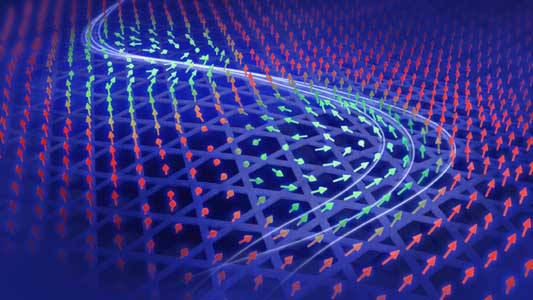
With Moore’s Law reaching the end of its physical limitations, the electronic industry is investigating new computational platforms which would provide higher speed and power efficiency along with greater abilities in terms of data processing. Some of the most promising concepts in the field include spintronics, magnetic skyrmions, and topological electronics—three areas of research that leverage the quantum nature of electrons and not only their electric charge.
Introduction: Beyond Charge-Based Electronics
For more than fifty years, modern electronics has been built around one fundamental principle: controlling the movement of electric charge through semiconductor materials. This approach has enabled remarkable advances, shrinking billions of transistors onto a single chip.
However, continued transistor scaling is becoming increasingly difficult due to:

- Rising leakage currents
- Heat dissipation challenges
- Quantum tunneling
- Power consumption limitations
With the increase in computational requirements of artificial intelligence, autonomous systems, high-performance computing, and edge devices, there is an urgent need for solutions that will alter the way information is stored and processed.
Among the possible solutions, spintronics emerges as one of the most prominent solutions, wherein the inherent spin of the electron serves as the information carrier.
Apart from processing data with the help of electric charge, spintronics allows the processing of information based on the magnetic orientation of the electron, which results in non-volatile operations and energy-efficient operations.
Understanding Electron Spin
Electron Spin
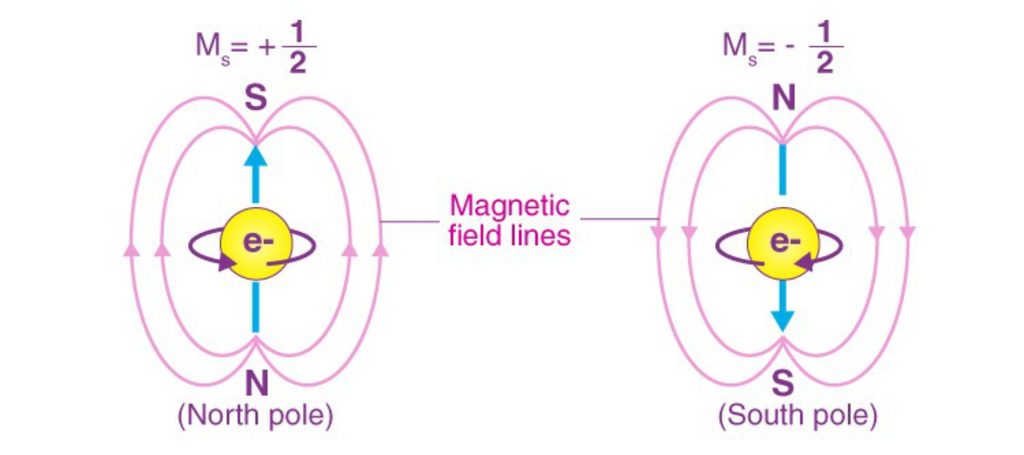
One of the three intrinsic characteristics of an electron is the electron spin. The other two characteristics include the mass of the electron and the charge of the electron. The electron spin is defined as the spin of the electron along its own axis. It is represented as:
||S|| = Ö s (s + 1) h
Where,
- s = a quantized spin vector
- The spin vector is represented by ||s||
- The spin quantum number (s) represents the spin angular momentum and h = Planck’s constant.
The spin quantum number can be expressed as:
n can be any non-negative integer
The allowed values for the spins are 0, 1/2, 1, 3/2, etc.
The intrinsic angular momentum of the Electron is denoted by quantum number 1/2
The total angular momentum (s) is denoted by:
s = Ö n (n + 1) h
s = Ö 1/2 (1/2 + 1) h
S = Ö 3/4 h
Where,
Reduced Planck’s constant = ℏ
ℏ = h/2p
Electron Spin Theory
Like the classical model, the model of electron spin considers the electron as a quantum rather than just a spherical body. This model states that “the electron spin direction and its effect on certain properties such as the magnetic properties of the atom”.
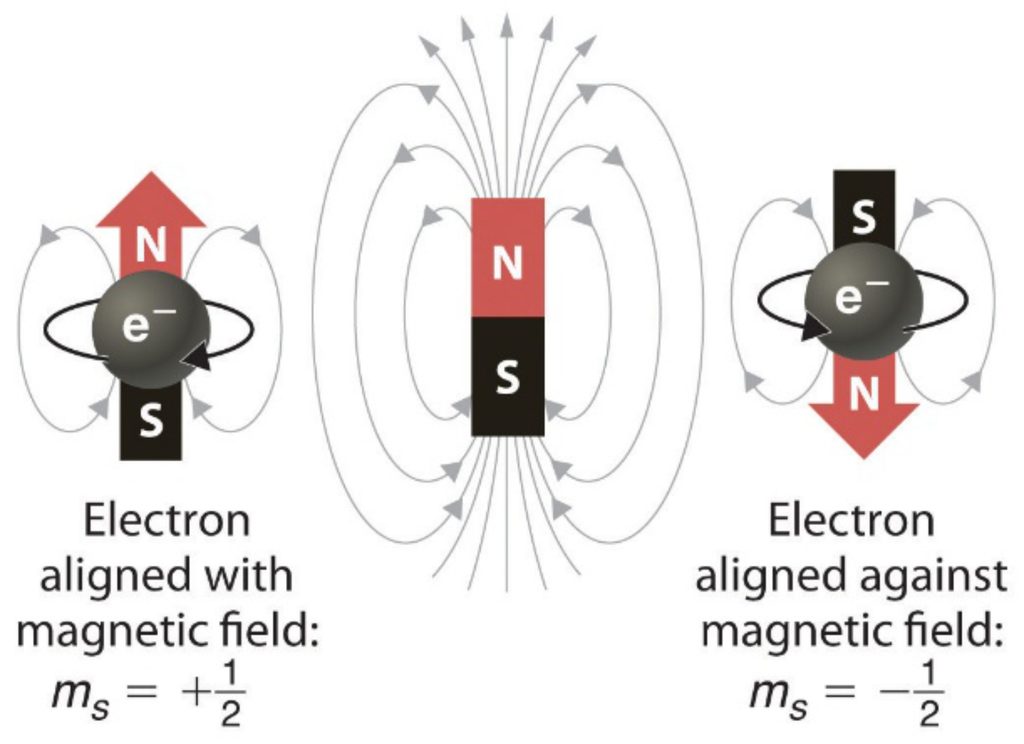
The electron can spin in two directions:
- Spin up
- Spin down
The spin up and spin down directions correspond to the spinning in the “+z” or “-z” direction. These spins (spin up and spin down) are the particles that have spin “s” equal to 1/2, i.e. for electrons.
As far as quantum theory is concerned, the electron acts like a small magnet and its spin refers to the northern pole of a small magnet. In case of proximate electrons that have the same spinning direction, they reinforce one another to form a powerful magnetic field. However, when the proximate electrons have the opposite spinning directions, the magnetic field formed by them nullifies one another. Therefore, no magnetic field exists in this situation.
What is Spintronics?
Spintronics, which is sometimes referred to as Spin Electronics, utilizes both the charge and spin of electrons in order to develop devices that are highly functional.
Unlike CMOS-based transistors, which continuously dissipate leakage energy, spintronic devices are usually:
- Nonvolatile
- Radiation-resistant
- Highly Scalable
- Switch rapidly
- Energy-efficient
Spintronic devices can be used for both computation and memory storage at the same time.
Key Physical Effects
Several quantum phenomena make spintronics possible.
1. Giant Magnetoresistance (GMR)
Discovered in 1988, GMR occurs when alternating magnetic layers change electrical resistance depending on their magnetic alignment.
Applications include:
- Hard disk read heads
- Magnetic sensors
- Automotive sensing
- Industrial position detection
The discovery of GMR revolutionized data storage and earned the 2007 Nobel Prize in Physics.
2. Tunnel Magnetoresistance (TMR)
TMR improves upon GMR by separating magnetic layers using an ultra-thin insulating barrier.
Electrons quantum tunnel through this barrier.
Resistance depends on magnetic orientation, enabling:
- MRAM
- Magnetic sensors
- Secure storage
TMR ratios exceeding 600% are now being demonstrated in advanced research.
3. Spin Transfer Torque (STT)
Instead of external magnetic fields, spin-polarized current directly switches magnetic orientation.
Benefits include:
- Lower power
- Faster writing
- Smaller cells
- Better endurance
STT is widely adopted in commercial Magnetic RAM.
4. Spin-Orbit Torque (SOT)
Spin-orbit interaction generates spin currents without directly passing current through magnetic layers.
Advantages include:
- Picosecond switching
- Reduced write energy
- AI accelerator compatibility
SOT-MRAM is considered one of the strongest candidates for embedded non-volatile memory.
Magnetic Random Access Memory (MRAM)
MRAM represents one of the first large-scale commercial successes of spintronics.
Unlike Flash memory:
- No erase cycles
- Extremely high endurance
- Nanosecond access time
- Unlimited write cycles
- Instant-on capability
MRAM combines the speed of SRAM with the persistence of Flash.
Applications include:
- Automotive ECUs
- Aerospace
- Medical devices
- Industrial automation
- AI edge processors
Several semiconductor manufacturers are actively commercializing embedded MRAM technologies for advanced process nodes.
Enter Skyrmions: Tiny Magnetic Whirlpools
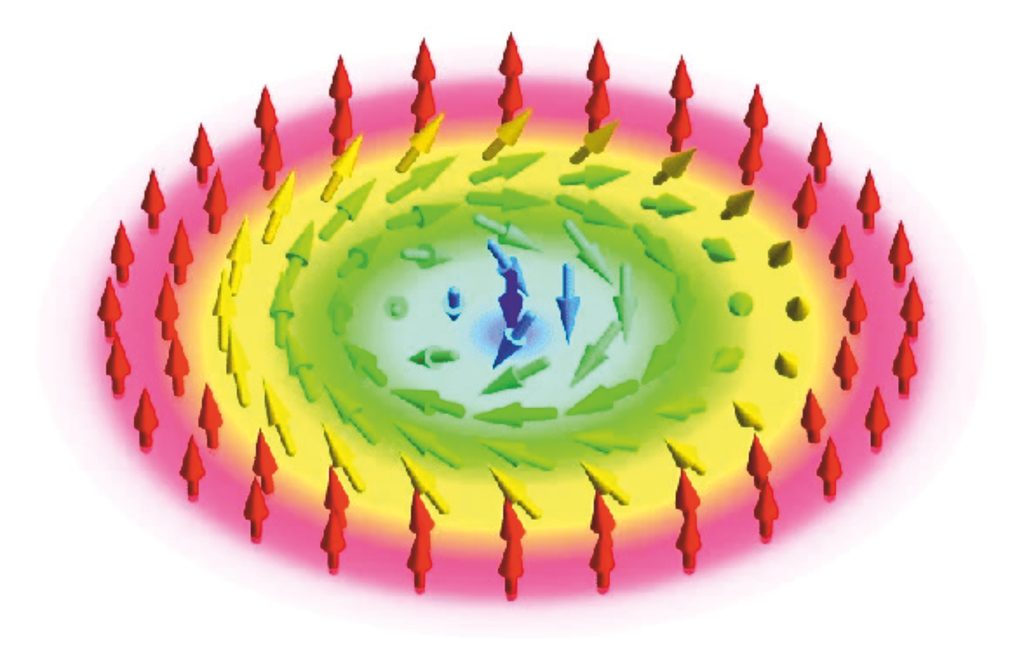
One of the most interesting discoveries of recent times in magnetism is that of the magnetic skyrmion.
In certain magnetic materials, the orientation of the magnetization forms a vortex-like structure called a skyrmion. Such stable magnetic structures occur at room temperature and are capable of being controlled with low energy, making them suitable as computer memory and logic devices. The movement of electrons through a material causes interaction with skyrmions and leads to emergent electrodynamic phenomena that allow these magnetic textures to be detected and can result in new ways of using such textures. A skyrmion is an exceptionally tiny magnetic particle-like structure.Typical diameter:
1-100 nanometers
This is nearly 100 times smaller than many current magnetic memory bits.
Unlike conventional magnetic domains, skyrmions are:
- Extremely stable
- Topologically protected
- Easy to move
- Very energy efficient
Because of their stability, skyrmions can survive defects, impurities, and thermal fluctuations.
Why Are Skyrmions Important?
Magnetic skyrmions are regarded as one of the most promising elements for the development of future electronics owing to their superior stability along with ultralow energy consumption. As these have a topology protected magnetic configuration, they are able to maintain their stability even under the effect of material defects and thermal fluctuations, which makes them highly suitable for the fabrication of nanoscale devices. They can be generated, controlled and transported using very low electrical currents, which leads to the consumption of an extremely low amount of energy when compared with conventional magnetic domains. Being very small in size, they offer ultrahigh memory density while their fast motion facilitates high-speed processing of information.Skyrmions possess the following advantages over conventional magnetic domain walls:
- 100-1000 × lower energy
- Higher density
- Faster motion
- Better scalability
This makes them ideal for future ultra-low-power memory.
Researchers envision storage densities exceeding several terabits per square inch.
Skyrmion Racetrack Memory
It is One of the most promising concepts is racetrack memory.
Skyrmion Racetrack Memory (SRM) is one of the emerging non-volatile memories storing information in the form of nanometer-sized magnetic skyrmions that propagate through very thin magnetic nanowires. Manipulated by electric current, skyrmions are moved past immobile read/write heads offering extremely high memory densities, high endurance, fast data rates, and reduced energy consumption compared to other memory technologies.
A Skyrmion Racetrack Memory can be acquired through four possible ways (A), (B), (C) and (D) based on the combination between skyrmion type (Bloch13 (azimuthal magnetization at the skyrmion boundary) or Néel20 (radial magnetization at the skyrmion boundary)) and the mechanism of skyrmion motion driven by STT or SHE. These four possible situations are shown in Fig. 1. The insets demonstrate skyrmion types for each scenario. For scenarios A, C and D the magnetic strip size is 1000 × 100 × 1 nm3 while for B 100 × 1000 × 1 nm3. Also a Cartesian coordinate system is introduced. The current flows in the positive x-direction.
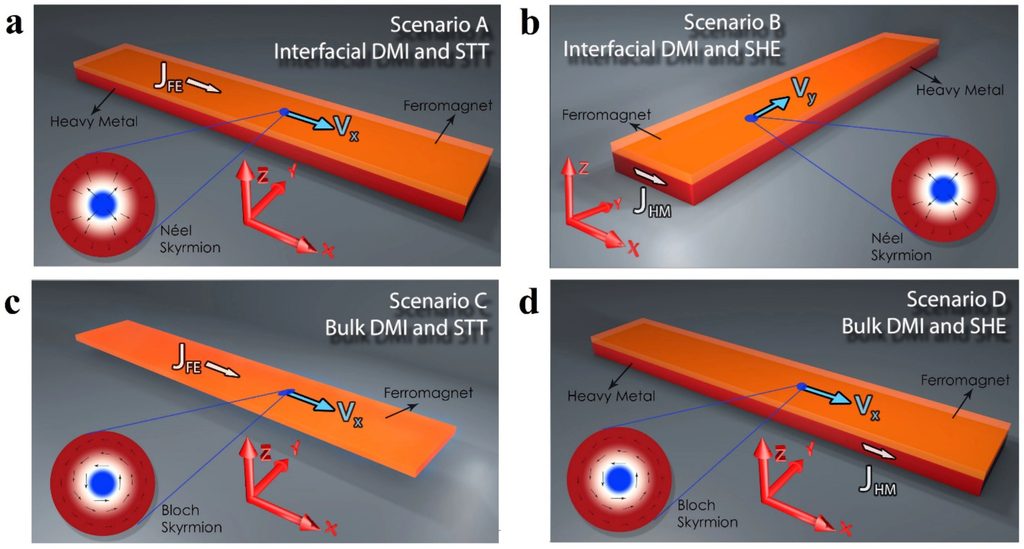
Four different scenarios for the design of a skyrmion racetrack memory.
(a), Néel skyrmion motion via the STT effect.
(b), Néel skyrmion motion via the SHE effect.
(c), Bloch skyrmion motion via the STT effect.
(d), Bloch skyrmion motion via the SHE effect.
Four inset figures demonstrate the spatial pattern of the Néel and Bloch skyrmion, where the color background denotes the z-component of the magnetization (blue negative, red positive), while the arrows are associated with the in-plane components of the magnetization. The electric current is applied along the x-axis. Skyrmion propagates along the x-axis in the cases A, C and D and along the y-axis in the case B.
Skyrmions are not stored at definite points but rather move along nanowires.
The read/write heads stay put while skyrmions move via pulses of current.
Eventually, Racetrack memory will substitute SSDs and DRAM in specific applications.
Logic Using Skyrmions
Researchers are developing:
- Skyrmion transistors
- Logic gates
- Majority gates
- Neuromorphic computing elements
Instead of voltage switching, information propagates through magnetic textures.
Potential benefits include:
- Minimal heat generation
- Ultra-high integration
- In-memory computing
- AI acceleration
Topological Electronics
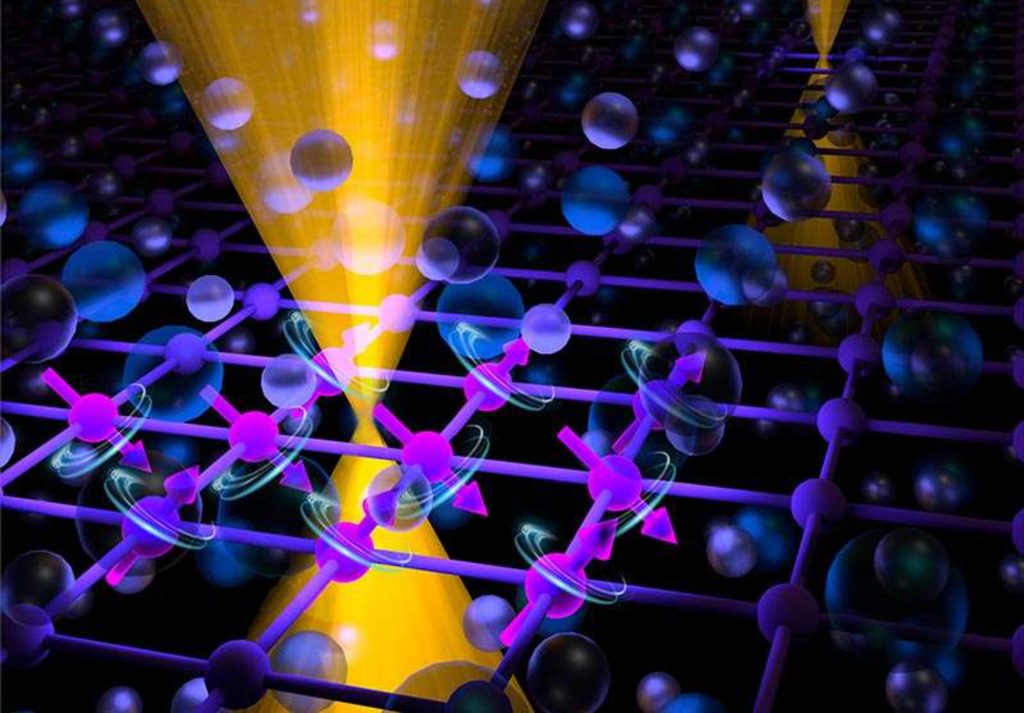
Topological materials have recently been considered as quantum materials and their properties are emphasized by topology. Topology can be defined as a sub-field of mathematics which deals with the study of properties of objects that remain invariant under smooth deformations. The materials whose properties remain unchanged under topological transformation are known as topological materials. The topological insulators (TIs) have insulating bulk but conducting surfaces. In another type of topological materials, the bulk of the material acts as a semimetal and its valence and conduction bands cross each other at Fermi energy level. On the basis of nondegeneracy or doubly degeneracy of the bands, topological materials are termed as topological Weyl semimetal or topological Dirac semimetal respectively. The properties of topological materials show the presence of Majorana, Weyl and Dirac fermions. Many of the materials having chalchogens and pnictogens have shown exotic behaviors such as high temperature superconductors, topological insulators, Weyl and Dirac semimetals, graphene analogues (transition metals chalcogenides) etc.
Topological Insulators
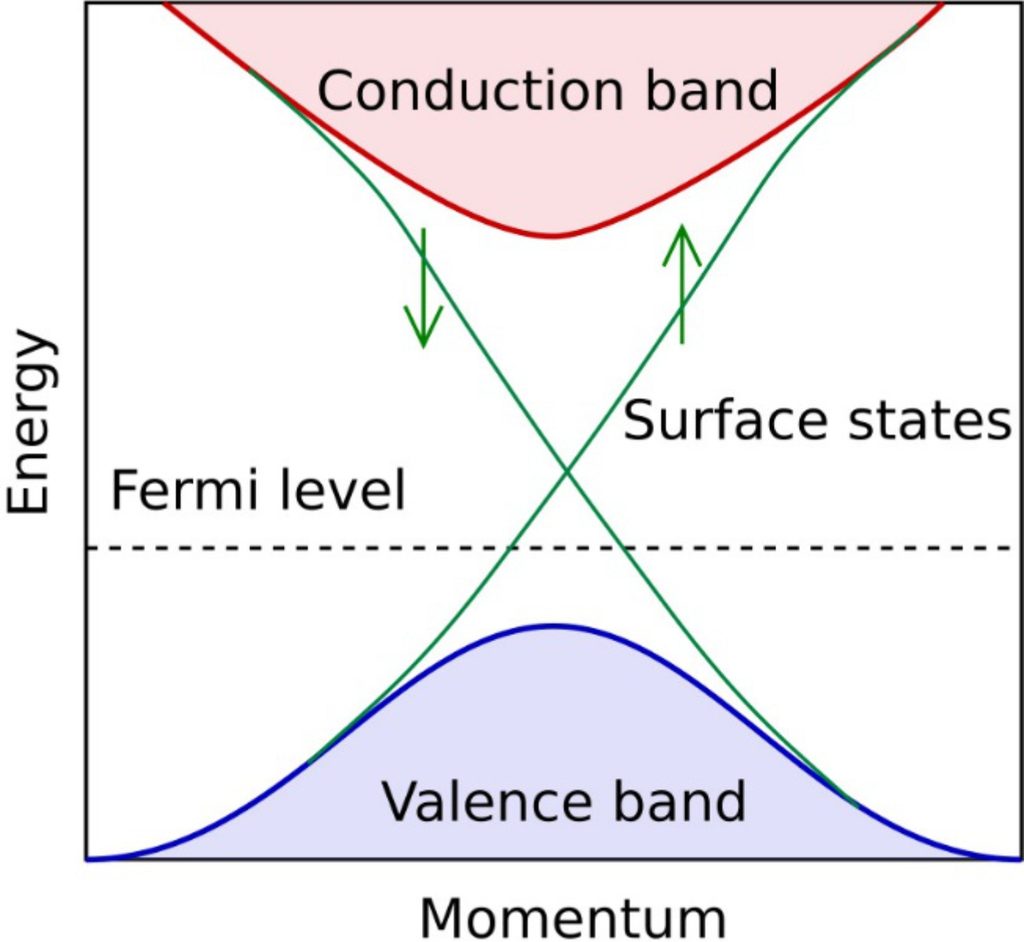
A topological insulator is a type of material that has its interior behave like an insulator, but the exterior acts as a conductor to allow movement of electrons on the surface.
Band structure of a 3D time reversal invariant topological insulator. The Fermi level lies inside the bulk gap, which has been spanned by the topological surface states that carry a spin texture.
This opens up tremendous possibilities for spintronics applications.
Spin-Momentum Locking
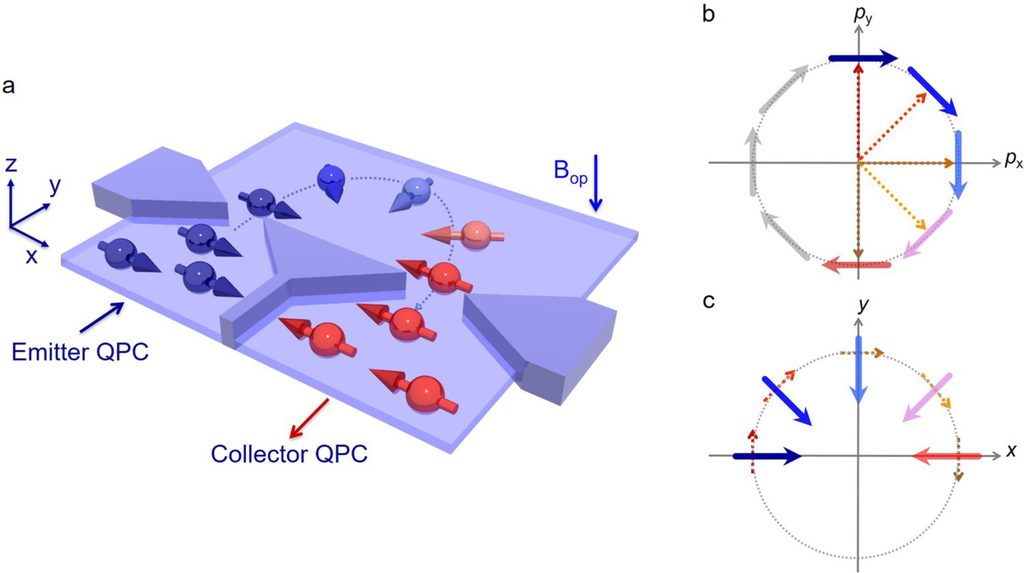
Spin-momentum locking-induced spin manipulation by transverse magnetic focusing.
(a) The InGaAs-based two-dimensional electron gas system has been processed into lateral quantum point contact (QPCs). This process makes it possible to polarize and measure the electron spins via these QPCs due to the spatial gradient of the spin-orbit (SO) field. In the presence of the weak out-of-plane magnetic field Bop, the generated spin-polarized electrons from the emitter QPC are focused into the collector QPC by the Lorentz force. During the orbital motion, the electron spin direction is locked perpendicular to the momentum direction via spin-momentum locking induced by the SO field. Spin orientation in the orbit is opposite to that of the spins generated in the emitter QPC.
(b) Spin orientation in momentum space as defined by equation (1). As the momentum direction changes from +py to -py in the clockwise manner, so does the spin orientation. (c) Orbits (dashed arrows) and spin orientations (solid arrows) in real space according to (b).
Advantages include:
- Efficient spin current generation
- Lower energy loss
- Reduced heat
- Faster switching
Spin-momentum locking may eliminate several inefficiencies found in conventional spin injection methods.
Topological Electronics for Future Chips
Topological electronics uses quantum materials that have protected surface states and enables the transport of electrons with less loss, better spin manipulation, and increased efficiency. Topological materials integrated with CMOS and spintronic circuits will ensure future computer chips are more efficient in computation, use less power, and are reliable and scalable for AI, HPC, and quantum technology applications.
Neuromorphic Computing
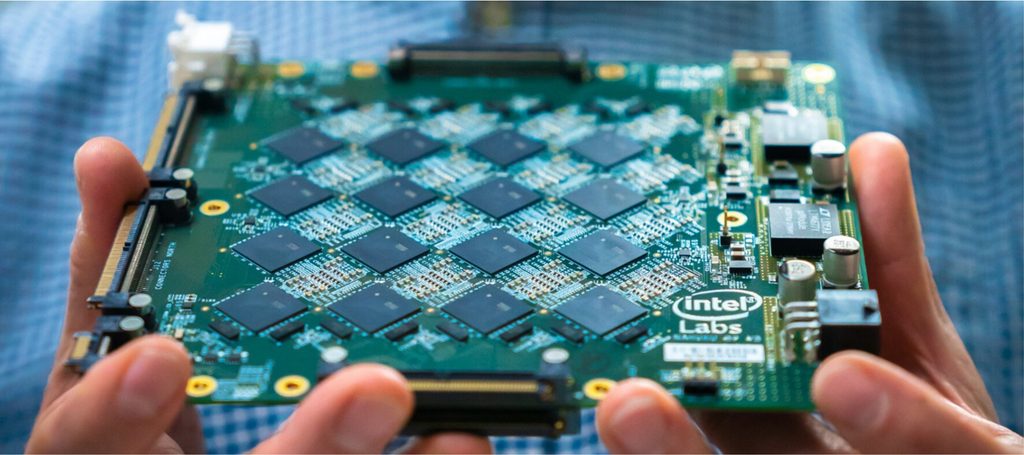
One of Intel’s Nahuku boards, each of which contains eight to 32 Intel Loihi neuromorphic chips. Credit: Tim Herman/Intel Corporation. AI needs hardware that can mimic biological neural networks.
Spintronic devices are naturally designed to mimic the following features of neuromorphic systems:
- Non-volatility
- Analog switching
- Stochastic dynamics
- Synaptic plasticity
Magnetic tunnel junctions can mimic artificial neurons.
Skyrmions can act as dynamic synapses.
Both together provide extremely energy-efficient neural hardware.
Quantum Computing Connections
Quantum computation using topological materials is another area of focus that is gaining interest.
Among these could be: Majorana zero modes
These unique quasi-particles can offer naturally occurring quantum bits that have high resistance to errors.
Though still being researched, topological quantum computation is regarded as one of the most feasible methods of achieving fault-tolerant quantum computing in the future.
Applications across Industries
- Artificial Intelligence
- Automotive Electronics
- Industrial Automation
- Consumer Electronics
- Aerospace & Defence
- Healthcare
Manufacturing Challenges
Even with rapid advances, there remain many hurdles to overcome in terms of commercialization.
• Material Engineering
Creating defect-free magnetic multilayers is tough.
• CMOS Integration
Spintronic devices have to be integrated into current semiconductor production lines.
• Skyrmion Uniformity
Making identical skyrmions in billions of devices takes tremendous engineering accuracy.
• Read-Write Reliability
Conserving deterministic switching while minimizing energy consumption is being researched extensively.
• Fabrication Costs
The use of novel materials and novel deposition methods makes manufacturing more complex than regular CMOS fabrication.
India’s Growing Opportunity
Semiconductor mission of India gives an opportunity to be part of the next generation spintronics technology.
Possible areas could be:
- Studies of magnetic materials
- Device modeling
- Highly advanced MEMS and sensors
Institutions like IISc, IITs, DRDO labs, CSIR labs, and a number of semiconductor startups are already engaged in spintronics, magnetic materials and quantum devices. With expansion of the Indian semiconductor sector on account of design linked incentive scheme, advanced packaging scheme and fabrications, academia and industry collaboration could promote indigenous innovation in spintronics.
Conclusion
Spintronics, skyrmions, and topological electronics constitute the most promising frontiers of modern electronics. These technologies utilize quantum mechanical properties rather than charge-based mechanisms to bring about major leaps in energy consumption, speed, memory density, and resilience.
Their applications are likely to range from non-volatile AI hardware and super-fast memory systems to neuromorphic computers and quantum computers with fault tolerance, affecting all segments of the electronics industry. With growing investments and development of the Indian semiconductor industry, there is every chance that these technologies will move from laboratory to industrial production in the next decade. For the electronics fraternity, it has become imperative to know about them to make future smart and sustainable computing systems.