


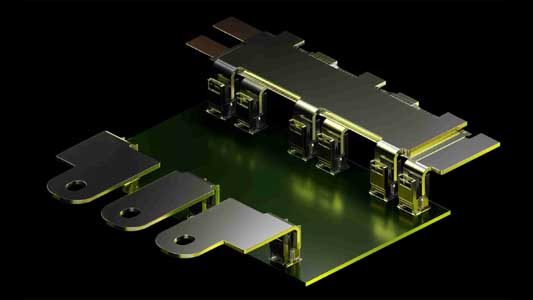
Industry 4.0 systems rely on distributed sensing, real-time control, and autonomous operation across factory floors, warehouses, and industrial machinery. The digital layers of these systems, like networks, control algorithms, and analytics, depend on the integrity of the physical electrical interfaces that carry power and signals. Mechanical vibration, temperature changes, high currents, and compact form factors all stress connectors and interconnects. Failures at the physical layer, such as intermittent contacts, cracked solder joints, or inefficient power paths, undermine uptime, increase maintenance costs, and negatively impact performance.
Engineering robust physical connectivity means choosing technologies that sustain electrical performance and mechanical integrity over long lifecycles, support manufacturability, and fit into modern automated assembly workflows. Drawing on proven automotive-grade experience, this article outlines how ENNOVI’s mature hardware connectivity solutions can help designers unlock the full potential of smart, connected industrial systems by improving reliability, manufacturability, or lifecycle cost.
Soldered Connections and Their Limitations
Soldering has been the dominant method for attaching components onto PCBs and forming electrical connections for decades, and it remains effective in many controlled applications. However, solder joints have limitations when exposed to frequent thermal or mechanical stress.
Thermal cycling is the most common stressor. Mismatches in the coefficient of thermal expansion (CTE) between the component, the solder, and the printed circuit board (PCB) cause them to expand and contract at different rates. This differential movement may create shear stresses within the solder joint, leading to thermal fatigue, micro-cracking, and eventual fracture. Mechanical vibration and shock can intensify joint degradation, accelerating time to failure.

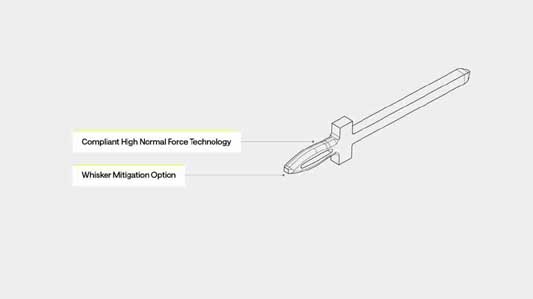
An alternative is solder-free mechanical interconnects, such as press-fit technology, which, according to independent industry comparisons, can deliver significantly higher reliability in harsh environments and reduce common reliability concerns tied to solder joints. Press-fit connectors create reliable connections by mechanically pressing the compliant pins into a plated through-hole (PTH) on a PCB.
Modern compliant press-fit designs generate a high normal contact force, providing a stable electrical path over long service lives, even under heavy vibration. This mechanical retention mechanism also accommodates CTE mismatches, maintaining consistent contact as systems heat up and cool down. Because solder-free press-fit interconnects avoid a thermal process and rely instead on controlled mechanical deformation, they can also support automation-friendly assembly processes and help simplify production lines by eliminating secondary soldering steps.
Limitations to Power Distribution Wiring
Power distribution presents another set of physical connectivity challenges in Industry 4.0 systems. Many industrial modules, such as motor drives, inverters, battery systems, and power converters, demand high current delivery with low resistive loss and minimal heat generation. Traditional wiring harnesses, while flexible and familiar, can become bulky, introduce additional resistance due to multiple connections, and complicate assembly and service.
Engineered busbar systems offer an effective alternative for managing high current distribution. A busbar typically comprises a solid metallic strip that conducts and distributes power efficiently within a module or assembly. Compared to point-to-point wiring, a busbar can reduce overall resistance and inductance, thereby improving power efficiency and reducing heat generation. Its larger cross-section also promotes better thermal spread and dissipation, mitigating hotspots that could otherwise accelerate ageing in adjacent components. Because busbars are centralised conductors, they simplify layouts and reduce potential points of failure introduced by numerous discrete cables and terminations.
Busbar architectures are increasingly used in automotive and high-power electronics to optimise current delivery and thermal behaviour, and many of the lessons from those domains are directly relevant to industrial power systems. In many cases, busbars can be integrated with custom connectors that manage assembly tolerances and mechanical stresses, further enhancing reliability and manufacturability.
Industry 4.0 Example: Autonomous Mobile Robots (AMRs)
Autonomous mobile robots (AMRs) illustrate why physical connectivity choices matter in Industry 4.0 hardware. These systems frequently navigate large facilities while carrying payloads, performing lifts, or interacting with conveyor systems. Their designs include distributed sensor networks, real-time control electronics, drive systems, and compact, high-density power sources.
In AMRs, lithium-ion batteries are often chosen for their high-energy density and long cycle life, creating compact power systems capable of continuous operation. However, delivering high currents efficiently within constrained spaces introduces design trade-offs between mechanical robustness, heat generation, and manufacturability. Busbar-centric power distribution can help reduce wiring complexity and improve thermal behaviour, while solder-free press-fit interconnects can provide reliable connections that tolerate vibration and temperature variation without solder-induced failure modes.
These hardware strategies are not limited to AMRs; they are equally relevant in other industrial contexts such as distributed inverters, motor drives, and edge control modules, where consistent electrical performance supports the digital and control systems that define smart manufacturing.
Conclusion
In Industry 4.0 ecosystems, digital intelligence may capture attention, but hardware reliability at the physical interface layer determines whether advanced capabilities can be sustained in the field. ENNOVI’s press-fit interconnects and advanced busbar solutions provide engineered approaches to address common industrial electronics challenges: eliminating solder fatigue, supporting high current densities in compact layouts, simplifying assembly for automated production, and enabling signal integrity in distributed systems.
With quantified mechanical metrics, automotive-grade validation, and high-volume deployment history, ENNOVI’s interconnect technologies offer electronics engineers a dependable foundation upon which Industry 4.0 systems can be built with confidence.