

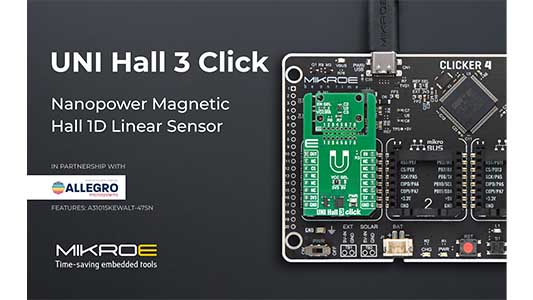
UNI Hall 3 Click from MIKROE, the embedded solutions company that dramatically cuts development time by providing innovative hardware and software products based on proven standards, is a compact add-on Click board™ designed for contactless magnetic sensing applications. This board is based on the A31015KEWALT-47SN, a nanopower, ratiometric 1D linear Hall-effect sensor from Allegro MicroSystems, configured for high-reliability south-pole sensing. It is ideal for high-precision, power-constrained applications such as position sensing, proximity detection, contactless switching, human-machine interfaces (HMIs), industrial automation and smart home devices.
“UNI Hall 3 Click brings exceptional flexibility and precision to magnetic position detection,” says Nebojsa Matic, CEO of MIKROE. “By combining Allegro’s high-performance Hall-effect sensor with our Click Snap modularity and ClickID automatic board recognition, developers can accelerate prototyping across industrial and smart home applications.”
UNI Hall 3 Click is fully compatible with the mikroBUS™ socket and can be used on any host system supporting the mikroBUS™ standard, ensuring seamless integration across a wide range of development hardware. Featuring a 15kHz typical bandwidth, the sensor accurately tracks rapidly changing magnetic fields across an operating range of approximately -2.8mT to 58.9mT. When operating at 3.3V, the sensor delivers a typical sensitivity of 4.7mV/G, while an onboard VCC SEL jumper enables 5V supply operation to achieve 7.1mV/G sensitivity.
To minimise energy consumption in applications that take periodic readings, the board incorporates GPIO-controlled enable and sleep modes. In active mode at 3.3V, the IC draws 1.9mA, while sleep mode reduces current draw to an ultra-low 65pA with a fast enable time of typically 10µs, making it suitable for low-power embedded designs. The sensor supports an operating temperature range from -40°C to +125°C, while magnet polarity and orientation determine the magnetic field applied along its sensitive axis.

MIKROE’s innovative Click Snap technology, which allows the main sensor section to be detached along predefined PCB lines, allows the sensor section to be detached from the mikroBUS™ base for installation closer to the magnet or within a compact assembly, using paired footprint pins for reconnecting signals. Additionally, onboard ClickID identification circuitry enables automatic board detection when connected to supported host systems.
UNI Hall 3 Click demo application is developed using the NECTO Studio, ensuring compatibility with mikroSDK’s open-source libraries and tools. Designed for plug-and-play implementation and testing, the demo is fully compatible with all development, starter and mikromedia boards featuring a mikroBUS™ socket. The mikroBUS™-enabled Click board family now numbers over 2000 compact add-on development boards that save design time and cost. Hundreds of ready-to-use embedded projects using the UNI Hall 3 Click board are available on EmbeddedWiki.