


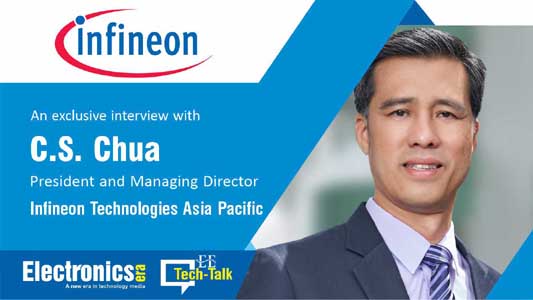
Electronics Era: How does Infineon view India’s role within its broader APAC growth and innovation strategy, particularly in semiconductors and power electronics?

C.S. Chua: India is positioned as a truly strategic market and an innovation hub for Infineon, and it plays a key role in our broader APAC growth agenda. We’ve been driving R&D and innovation in India for over 25 years now, so it’s not a new story for us – India has a sustained and important role in our global innovation footprint. Recently, we announced our new Global Capability Center in Ahmedabad, which is a clear signal that we see India as central to our innovation strategy. This center will focus on advanced chip design, product software, IT, supply chain management, and systems and application engineering. As a global leader in power systems and IoT, India’s capabilities are directly relevant to the power electronics and energy-efficient applications that drive our business.
Electronics Era: Startups are increasingly driving semiconductor-led innovation— how is Infineon engaging with Indian startups across design, validation, and deployment?
C.S. Chua: We see tremendous growth opportunities with startups and small and medium-sized businesses in India – they’re increasingly driving innovation in areas like electric mobility, renewable energy, and IoT.
We’re engaging with the startup ecosystem in several ways. Our partnership with Startup India is a great example – we’re jointly organizing engineering contests. This gives young innovators direct exposure to our technologies and expertise.
We’re also committed to strengthening the local ecosystem by partnering with startup incubators and government agencies. We also work closely with these companies to help them succeed.
Electronics Era: Infineon recently signed a MoU with NIELIT—what are the key objectives behind this collaboration?
C.S. Chua: Our partnership with NIELIT, has a clear objective: to help build the talent pipeline India needs for its semiconductor future. We’re aiming to skill 10,000 students through this collaboration.
The core objectives include enriching NIELIT’s curriculum – specifically integrating Infineon’s microcontroller expertise into their Masters of Technology in IoT and Sensor Systems program. We’re conducting guest lectures, providing product training to educators, supporting student projects with product samples, and hosting joint hackathons. Essentially, we want to bring real-world, industry-relevant semiconductor knowledge into the classroom.
Electronics Era: What kind of curriculum, training, or hands-on exposure can students and professionals expect through this initiative?
C.S. Chua: Students and professionals can expect practical, industry-relevant exposure across several dimensions.
On curriculum, we’re adding teaching materials from Infineon Academy and working closely with NIELIT to integrate our microcontroller knowledge into their programs. Our engineers conduct guest lectures sharing the latest trends and technologies in the semiconductor industry.
For hands-on experience, we’ve already completed our first Train-the-Trainers workshop in Singapore in December 2025, where NIELIT lecturers received hands-on training with Infineon development kits. These lecturers can now adapt the content and train their students directly. We provide product samples and kits for student projects, and we’ll also be sharing internship opportunities, scholarship programs, and full-time career opportunities with NIELIT students.
Electronics Era: Sustainability is at the core of Infineon’s brand—how does this translate into product innovation and manufacturing practices?
C.S. Chua: Decarbonization and digitalization are at the heart of everything we do at Infineon. Our investments and technology roadmap are fundamentally oriented around enabling a more sustainable world.
On the product side, we develop advanced chip technologies and energy-efficient semiconductors. In our last fiscal year, our products helped avoid 53 times the CO₂ that was emitted during their production – that’s the kind of impact we’re talking about.
On manufacturing, we’re expanding global capacity for energy-efficient power semiconductors. For example, our Kulim expansion in Malaysia focuses on silicon carbide power semiconductors, which are directly aligned with decarbonization-driven demand. We’re committed to carbon neutrality by 2030 and are on track – we’ve already reduced emissions by over 80 percent versus 2019.
Electronics Era: In what ways can collaboration with startups and academic institutions accelerate sustainable electronics development?
C.S. Chua: Collaboration is an accelerator for innovation in sustainability. When you bring together academic research, startup agility, and industrial scale, you can move faster and with greater impact.
We partner with academic institutions and startup incubators specifically to strengthen the local ecosystem. This creates co-development opportunities in areas like energy efficiency and sustainable applications. Our India R&D footprint – covering advanced chip design and systems/application engineering – provides a base for such collaborations.
A great example is our Center of Competence for electric two- and three-wheelers in Pune, partnered with ARAI. India has a large number of two- and three-wheelers. Transitioning these from petrol to electric is key to India’s sustainability agenda, and by collaborating with research organizations and startups, we can accelerate solutions to market faster.