


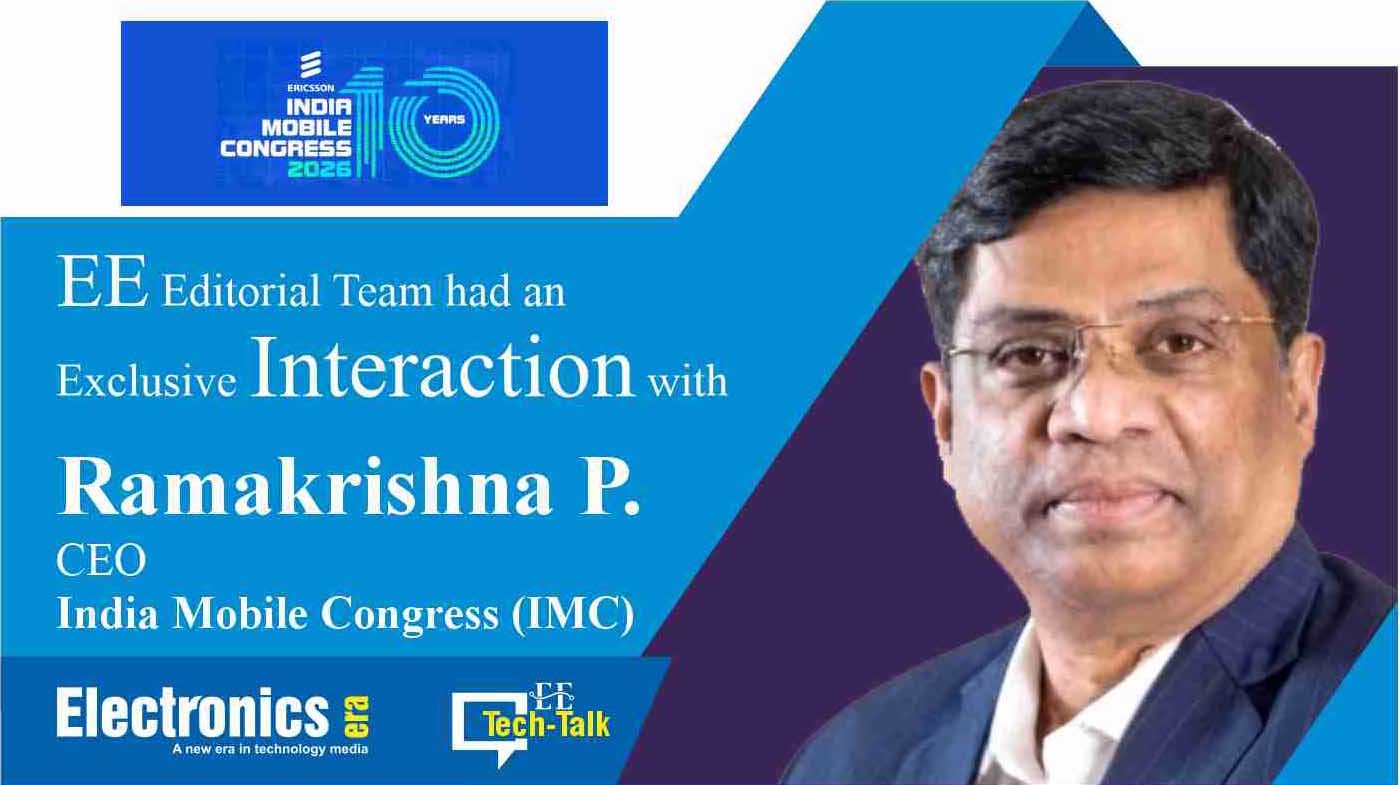
Electronics Era: IMC is entering its landmark 10th edition. Looking back to its journey since 2017, how has the platform evolved, and what does this evolution tell us about the transformation of India’s telecom and digital technology ecosystem?
Ramakrishna: IMC began in 2017 with 32,000 visitors, around 100 exhibitors and one simple objective: to bring the mobile and technology ecosystem together and help connect the next billion. This year, we expect over 1.5 lakh attendees, 300-plus exhibitors and partners from over 100 countries, and 1,500-plus technology use cases. That trajectory is not just IMC’s growth story, it is India’s digital growth story told through one platform.

Each edition has mirrored where India stood at that moment. The early years were about access, the middle years about 5G leadership, with the Hon’ble Prime Minister launching 5G services live at IMC 2022, and this decade is about AI, 6G, semiconductors and quantum. Hosting the ITU’s WTSA-24 in 2024, a first for South Asia, showed how far that journey had come. India has moved from adopting technology to building it, and IMC has moved from showcasing India’s progress to the world to shaping conversations with it.
Electronics Era: The theme of IMC 2026 is “Scale without Boundaries”. How would you interpret this theme, and how would you envision its implementation in real life in the tech industry?
Ramakrishna: The message is straightforward: innovation should no longer be constrained by geography, industry or technology. India has already shown how digital infrastructure can transform a nation at population scale, through Digital Public Infrastructure, 5G and fintech. The next chapter is sharing that capability with the world, through ecosystems that are interoperable, secure and inclusive.
In real life, it looks like a payments model built for India being adopted abroad, an indigenous telecom stack finding export markets, or a startup that solves a rural connectivity problem here taking the same solution to other markets. The measure of scale is no longer national adoption alone, but how quickly a solution can be replicated across markets.
The theme is anchored in four pillars: Srishti, building the future through frontier innovation; Samvardhan, fuelling growth at deployable scale; Sashakt, expanding opportunity to every enterprise and citizen; and Suraksha, strengthening trust, because nothing scales without security at its core.
Electronics Era: AI is rapidly transforming telecom networks, customer experiences and enterprise applications. What role will AI-native networks and intelligent infrastructure play in the next phase of India’s digital growth?
Ramakrishna: AI is no longer just an application riding on the network. It is moving into the network itself. Early AI-RAN deployments are already embedding intelligence into radio infrastructure, with lightweight models at the radio, more capable models at the edge and large models in the core.
With over 1.2 billion people connected and data consumption still rising, India must move beyond solving the complexities manually. AI-native networks will make 5G-Advanced capabilities like network slicing and massive IoT efficient, lay the foundation for 6G, and turn the network into a platform for enterprises.
But intelligence at this scale has to be trusted. That is why AI governance sits under our Suraksha pillar. The question is not only what AI can do for networks, but how India builds AI-powered infrastructure the world can rely on.
Electronics Era: 6G is moving from research and standards discussions towards future deployment architectures. How will IMC 2026 showcase India’s contribution to the global 6G ecosystem?
Ramakrishna: India’s 6G ambition is backed by structure. Through the Bharat 6G Alliance, the country aims to contribute at least 10% of global 6G patents. Having built its own indigenous 4G stack, India enters the 6G era as a builder of networks, not just a user.
At IMC 2026, the 3rd edition of the International 6G Symposium will bring global researchers, standards experts, operators and vendors together on what 6G will actually be built on: AI-native design, new spectrum bands and the convergence of terrestrial and satellite networks. Indigenous 6G research is also central to our Srishti pillar, so India’s contribution will be visible on the floor through academic institutions, startups and technology companies, not just in sessions. Our role is to make sure Indian contributions are seen where global standards and partnerships are decided.
Electronics Era: Satellite communications, NTN and direct-to-device connectivity are opening new possibilities for ubiquitous connectivity. Where do you see the biggest opportunities for India in the convergence of terrestrial and satellite networks?
Ramakrishna: Non-terrestrial networks are now a practical layer of the connectivity stack, with multi-orbit constellations integrating with terrestrial 5G. I see three big openings.
First, last-mile inclusion, taking broadband where fibre and towers are hard to justify, complementing efforts like BharatNet. Second, resilience, with satellite backing up critical communications, disaster response, defence and maritime operations. Third, new markets, as direct-to-device connectivity reaches mobility, logistics, agriculture and IoT beyond terrestrial coverage.
India’s satcom market, estimated at close to $4 billion, is projected to reach almost $15 billion by 2033. The opportunity is to build across the value chain, from ground segment to services. The dedicated SatCom Summit at IMC 2026 will bring operators, satellite providers and policymakers together to shape that convergence.
Electronics Era: IMC has grown into a platform with participation from more than 100 countries and a projected 1.5 lakh-plus attendees. What is your strategy for taking IMC from an Indian-led technology event to a truly global technology platform?
Ramakrishna: Scale by itself isn’t the goal, global relevance is. The world is already coming to IMC. The strategy now is to ensure every international participant leaves with partnerships and outcomes, not just exposure.
A major step this year is our deeper collaboration with the GSMA. We signed an MoU at MWC Barcelona to strengthen international participation and align policy and technology dialogues with global telecom priorities, and the GSMA will hold its Board Meeting alongside IMC 2026, bringing global operator leadership to New Delhi.
We are also building structured pathways for international delegations, including CEO and CTO roundtables and the Global Best Practice Series, where leaders share real deployment models and operational learnings. The shift is from global presence to structured global collaboration.
Electronics Era: What are the biggest new additions or experiences that visitors can expect at IMC 2026, and how will this 10th edition be different from previous editions?
Ramakrishna: This edition is our broadest yet in scope. Alongside the core conversations on connectivity, AI, semiconductors, cybersecurity and satellite communications, we are opening platforms for new-generation verticals such as Industrial Automation, Smart Mobility, etc. Each reflects the same shift: digital infrastructure is no longer a sector of its own, but the foundation that every other sector now runs on, from factories and logistics to transport and sports.
We are also launching Viksit Tech 47, a platform to identify and promote India’s most promising technology brands, leaders and enablers, culminating in a flagship report on where India stands in the global technology value chain, based on a study of over 200 Indian tech companies.
What really sets this edition apart is its design: clearer participation pathways, stronger buyer-seller engagement, deeper enterprise and operator connect, and a tighter focus on deployment-ready technologies. And being our 10th year, visitors will also see a retrospective on how the platform, and Indian technology with it, has scaled since 2017.
Electronics Era: India has a growing deep-tech and telecom startup ecosystem. What gaps still need to be addressed to help these startups scale globally, and what role can IMC play in closing those gaps?
Ramakrishna: India has no shortage of talent or ambition. What many deep-tech startups lack is the bridge from prototype to paying customer, and from domestic customer to global one. The gaps are patient capital for longer development cycles, first adoption by large buyers who want proof at scale, global readiness through certifications and partnerships, and brand building.
Through ASPIRE, IMC puts startups directly in front of the enterprises, operators, investors and public-sector stakeholders who drive adoption. This year, we expect over 400 startups and DPIIT-recognised MSMEs, more than 300 investors, incubators and accelerators, and 700-plus curated one-on-one investor meetings, alongside mentorship workshops, live pitches and reverse pitches.
Viksit Tech 47 adds the brand dimension, and its Dr. Zarabi Indigenisation Award recognises startups building hardware India once imported. Startups should leave IMC with pilots, partners and capital, not just visibility.
Electronics Era: As IMC completes its first decade, what is your vision for the next 10 years? What should IMC become by its 20th edition?
Ramakrishna: The first decade was about proving scale. The next must be about consistency and follow-through across editions. In the coming decade, I want IMC to be a platform where Indian innovation engages with global markets as a matter of course, not as an exception.
That means three things. IMC should be where technologies are launched and adopted, with partnerships formed here showing up in real deployments. It should be where global conversations on 6G, AI governance and digital trust are shaped with India at the centre. And it should be the launchpad through which Indian companies, including today’s ASPIRE startups, grow into global brands.
If the last decade was about Digital India, the next is about Intelligent India, and IMC should mirror that journey as closely as it has mirrored the last one.