


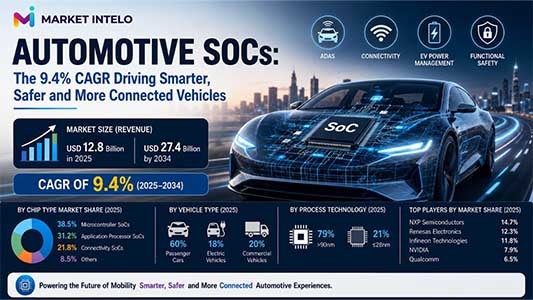
Every car coming out of a production line now is endowed with more silicon smarts than fighter jets from decades past, and the chip behind all that processing power is becoming more often than not a single, highly-integrated SoC. A recent report from Market Intelo estimates the global market for Automotive System on Chip (SoC) at $12.8 billion in 2025, rising to $27.4 billion by 2034 at a CAGR of 9.4%. For executives throughout the automotive industry as well as those in semiconductor manufacturing, this figure represents more of a signpost than a mere statistic – the automobile is now a computer first, and a car second.
The Inside Story: Shifts in Segments and Types of Vehicles
The report’s breakdown by chip type is where the forecast turns into a planning tool. Microcontroller SoCs, the workhorses of body electronics and basic control functions, remain the largest category at 38.5% share, but their growth trails the market average. Application processor SoCs, the chips powering ADAS and infotainment, hold 31.2% share and are expanding at 11.2% CAGR, comfortably outpacing overall market growth. Connectivity SoCs, covering cellular, Wi-Fi, and V2X functions, sit at 21.8% share but are growing fastest of all at 12.3% CAGR as regulatory mandates push cellular V2X into new vehicles.
Passenger cars continue to make up 60% of the market share in terms of revenue, while electric vehicles are the exception: although making up only 18% of the vehicles manufactured globally in 2025, the EVs already make up 20% of the market value in SoCs due to their higher silicon content and have been growing by 12.1% CAGR. Commercial vehicles, at 20% share, are close behind at 10.8% CAGR as fleet telematics and autonomous trucking development accelerate. On process technology, legacy nodes above 90nm still dominate with 79% share thanks to the automotive industry’s cost sensitivity and long qualification cycles, while advanced nodes at 28nm and below, though only 21% of the market today, are growing at 12.4% CAGR as autonomous and AI-heavy workloads demand more computing muscle.
Recent Developments Setting the Pace
Activities of the suppliers in the automotive semiconductor ecosystem correlate perfectly with the areas of market growth as indicated by the forecast. The top spot in the overall market belongs to NXP Semiconductors with a market share of 14.7%, attributable to its extensive range of microcontrollers and established OEM partnerships, followed by Renesas Electronics and Infineon Technologies with respective shares of 12.3% and 11.8%, the latter being highly focused on EV battery management and high-power semiconductors.
The more disruptive movement is coming from computing-first entrants. NVIDIA has built substantial share through its DRIVE platform for autonomous and ADAS applications, while Qualcomm has extended its Snapdragon architecture into infotainment, connectivity, and ADAS processors. Mobileye, now under Intel, has carved out roughly a third of the global ADAS SoC segment through its vision-processing platforms. On the other hand, OEMs have taken up the silicon discussion themselves. The Dojo chip initiative by Tesla and NIO’s collaborations with semiconductor firms are indicative of chip design becoming an area of competition for automakers instead of an outsourcing one – much like how software has become an in-house affair for some luxury brands.
What’s Actually Driving the Industry
Three forces are doing most of the work behind the 9.4% CAGR. The first one is electrification. Electric car sales amounted to around 14 million vehicles in 2025, constituting about 18% of the world vehicle market, each of which requires a battery management system on chip for measuring cell voltages, thermal management, and battery charging process, something without any equivalents in conventional cars. The transition in the battery industry from 400-volt battery architecture to 800 volts battery architecture that is set to accelerate between 2028-2030 would require the redesign of power management silicon devices to deal with greater levels of insulation and switching, and the market for BMS chips is likely to almost double from $4.2 billion in 2025 to $8.9 billion by 2034.
The second force is autonomy. The current penetration rate for Level 2 autonomous driving is approximately 31%, with each one needing an application processor that can combine the signals from cameras, radars, and ultrasonic sensors in real-time. With the approach of Level 3 and Level 4 autonomous driving applications designed for the period between 2028 and 2030, the demand for functional safety will only increase, leading toward ASIL D certification, redundancy of computation paths, and the need for AI accelerators. In the case of ADAS SoCs, it will grow almost threefold, from $2.89 billion in 2025 to $6.23 billion in 2034.

The third factor, which is less obvious but may well be just as structural, is the transition to software-defined vehicles. Instead of having 70 to 100+ distinct ECUs, the new architecture will have 8 to 12 domain controllers with software stacks that can be updated over the air. While this does reduce overall chip usage, it increases the complexity and cost of the remaining chips, since every domain controller will require hardware-accelerated cryptography and secure boot capabilities to allow field updating of its software stack.
Regional Outlook and Regulatory Developments
APAC region has 42.8% share in the value terms owing to a combination of mass production capabilities of China, Japan, South Korea, and India along with the penetration rate of Chinese electric vehicles having crossed 35%. North America and Europe have 35% share each wherein North America share is attributed to the efforts of Tesla, Ford, and GM towards electrification along with autonomy innovation through Qualcomm and NVIDIA whereas Europe’s share is due to decarbonization strategy along with high-end vehicle manufacturers such as BMW, Mercedes-Benz, and Audi working on their software and hardware solutions. Latin America and Middle East & Africa regions have share of 9% and 8% each, though these regions are growing at higher pace compared to others.
Regulation is a genuine demand driver here, not a background variable. The push by the European Union to mandate automatic emergency braking for new cars from 2024, along with V2X cell requirements set to come in for Europe and North America by 2026-2027, is dragging silicon for connectivity and safety into mass-market vehicles which otherwise ignored such systems. Geopolitics on the supply side brings another level of worry: Taiwan represents about 92% of worldwide sub-5 nm wafer capacity, a share which is hard to avoid for self-driving chips designers in the short run and a reason for vertical integrations at BMW, Mercedes-Benz, and Tesla.
Implications for Decision-Makers
Chip and systems architects have the warning that the consolidation of domains and increased ASIL levels mean that the average silicon value will continue to rise even as the unit number of chips falls. Also, the choice of process node and safety architecture done today will determine the costs and time to market years down the line, given how constrained advanced node capacity is. The focus on manufacture and future demand increase in Asia Pacific and the advanced node production being done in Taiwan means procurement and supply chain executives need to qualify suppliers early enough and have true dual-sourcing in place. On the other hand, those tracking budget spend on automotive engagement must know that the segments which have outpaced the 9.4% blended CAGR, ADAS, connectivity, and EV power management segments are the best indication of where the conversation with OEMs and Tiers-1 will be through 2034.
Reference: https://marketintelo.com/report/automotive-system-on-chip-market
Raksha Sharma is an industry research and business insights professional associated with Marketintelo. She focuses on researching emerging industries, market trends, technological developments, and evolving business landscapes. Through data-driven content and industry analysis, Raksha brings practical perspectives on key developments shaping global markets and helps readers understand complex industry trends through clear, accessible insights.