



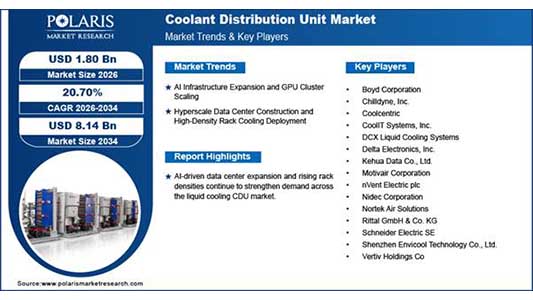
The global coolant distribution unit market is entering a transformative growth phase as hyperscale data centers, artificial intelligence workloads, and high-performance computing environments rapidly increase demand for advanced liquid cooling technologies. Industry analysts indicate that the market, valued at USD 1.50 billion in 2025, is projected to reach USD 8.14 billion by 2034, registering a remarkable CAGR of 20.70% during the forecast period. The transition from conventional air-based cooling systems toward efficient liquid cooling architectures is becoming a strategic necessity for next-generation digital infrastructure.
Modern AI infrastructure is generating unprecedented thermal density across server racks, forcing enterprises and cloud providers to rethink cooling strategies. Large language models, generative AI applications, and machine learning clusters require continuous high-performance processing, which significantly increases heat generation. Traditional cooling systems are increasingly unable to handle rack densities exceeding 30kW to 100kW, creating substantial opportunities for coolant distribution units (CDUs) across hyperscale facilities, colocation centers, and enterprise environments.
According to industry insights, the rapid expansion of hyperscale data center construction worldwide remains one of the primary growth drivers for the coolant distribution unit industry. Technology companies are investing heavily in AI-ready infrastructure capable of supporting GPU-intensive computing workloads. CDU systems are emerging as critical infrastructure components because they regulate coolant temperature, pressure, and flow across liquid-cooled server environments, ensuring optimal operational stability and energy efficiency.
The increasing adoption of direct-to-chip cooling and immersion cooling technologies is further accelerating market demand. Data center operators are prioritizing sustainable cooling systems that can minimize power consumption while maintaining superior thermal performance. Liquid cooling architectures supported by advanced CDU systems help organizations improve Power Usage Effectiveness (PUE), reduce operational expenses, and align with global sustainability initiatives. As governments and enterprises intensify their focus on carbon reduction and energy-efficient digital infrastructure, CDU deployment is expected to rise sharply across developed and emerging economies.
North America currently dominates the global coolant distribution unit market due to rapid AI deployment, strong hyperscale investments, and widespread adoption of advanced thermal management technologies. The United States remains the primary innovation hub, supported by aggressive investments from major cloud computing providers and semiconductor companies. Large-scale GPU clusters used for AI model training and inference are significantly boosting the need for scalable liquid cooling systems throughout the region.
Meanwhile, Asia Pacific is emerging as one of the fastest-growing regions in the market. Countries such as China, India, Japan, Singapore, and South Korea are witnessing extensive data center construction activities fueled by digital transformation initiatives, increasing internet penetration, and expanding cloud infrastructure. Governments across the region are also promoting smart manufacturing, AI innovation, and digital economy development, creating a favorable environment for coolant distribution unit manufacturers and solution providers.
Europe is also witnessing increasing adoption of CDU technologies as environmental regulations become stricter and energy-efficient cooling infrastructure gains priority among enterprise operators. The region’s focus on sustainable data center operations is encouraging the deployment of liquid cooling systems capable of reducing water usage and electricity consumption. Enterprises are increasingly adopting modular CDU solutions that offer scalability, flexibility, and reduced maintenance complexity.

Technological innovation remains a defining factor shaping the competitive landscape of the coolant distribution unit market. Leading manufacturers are developing intelligent CDU systems integrated with AI-driven monitoring capabilities, predictive maintenance features, and real-time analytics. Smart cooling management platforms are helping data center operators optimize thermal performance while minimizing downtime risks. Advanced automation technologies are also enabling improved coolant flow regulation and dynamic temperature control, enhancing operational reliability in high-density computing environments.
For more information, visit @ https://www.polarismarketresearch.com/industry-analysis/coolant-distribution-unit-market
Several industry participants are actively expanding their product portfolios and strengthening strategic collaborations to capitalize on growing market opportunities. Major companies operating in the market include Boyd Corporation, CoolIT Systems, Delta Electronics, Schneider Electric, Vertiv Holdings, Rittal GmbH, Chilldyne, and nVent Electric. These organizations are investing heavily in research and development activities to introduce scalable, high-capacity cooling solutions tailored for AI-driven data centers and next-generation computing applications.
The market is also benefiting from increasing investments in edge computing infrastructure. As businesses demand faster processing speeds and reduced latency, edge data centers are becoming more common across industries such as healthcare, telecommunications, automotive, manufacturing, and financial services. Compact CDU systems designed for decentralized computing environments are gaining popularity due to their ability to deliver efficient cooling in space-constrained deployments.
Another major trend influencing the market is the growing integration of modular and prefabricated data centers. These facilities require highly efficient and flexible thermal management systems that can be rapidly deployed and easily scaled. Coolant distribution units play a vital role in supporting these modular architectures by enabling consistent temperature control across diverse computing environments.
Despite strong growth potential, the coolant distribution unit market faces challenges related to high upfront installation costs and infrastructure complexity. Transitioning from air-based cooling systems to liquid cooling technologies often requires significant capital investment and specialized expertise. However, long-term operational savings, improved energy efficiency, and enhanced computing performance continue to outweigh initial deployment concerns for many organizations.
As AI adoption accelerates globally and data center operators seek sustainable, high-density thermal management solutions, the coolant distribution unit market is expected to remain a critical component of the evolving digital infrastructure ecosystem. The convergence of artificial intelligence, cloud computing, edge technologies, and energy-efficient cooling innovations will continue shaping the future of the industry over the coming decade. Businesses investing early in advanced CDU technologies are likely to gain a competitive advantage in managing the next generation of high-performance digital workloads.
Read More @ https://www.polarismarketresearch.com