


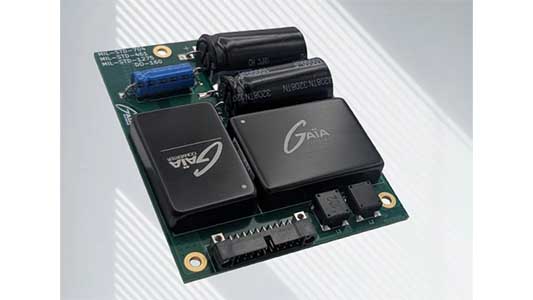
Reliability and performance are absolute requirements in electronic systems for defence applications. Engineers in the sector have traditionally met these needs by using highly customized designs assembled from discrete, military-specification components, resulting in bespoke power supplies through a lengthy and expensive process.
However, governments in places like Europe and the US have encouraged military users to prioritize cost-effectiveness in procurement and, to that end, to utilize commercial off-the-shelf (COTS) products whenever possible.
In the case of DC/DC converters for military or avionics applications, the COTS path offers numerous end-user benefits, primarily because it provides standard, ready-to-use, multiple applications-oriented products. The use of mass-produced COTS parts is cost-effective, offering versatile components that can be configured in distributed or centralized power supply formats. They can be used and qualified in a broad range of different applications, drastically shortening development times compared to the custom approach.
However, simply dropping into COTS converters for avionics and military power supplies requires careful analysis, as there are specific barriers and requirements to meet.
COTS issues
So let’s take a look at the special requirements for high-reliability military COTS. The issues fall into four major categories: input and efficiency requirements; electromagnetic compatibility; environmental performance; and the specific needs of military and avionics systems. These problems can be overcome by employing a modular-design approach, such as that adopted by GAIA Converter. This allows the use of COTS technologies where they offer the best performance. It also provides the ability to use additional components and subsystems to meet the specific requirements of military-grade systems.
Input requirements
Power inputs for military electronics can come from a variety of sources during operation because of the need to provide backup power from batteries if onboard generators cannot supply enough energy. The resulting changeovers in running systems can lead to large swings in input voltage combined with short-lived transients. A secondary effect of these changes is a drop in efficiency if the converter was not designed from the beginning to handle input voltages well above or below nominal.
It is a challenge to design a power supply subsystem that can handle voltage changes from 9 to 80V, for example, and still provide stable or constant conversion efficiency that is compatible with military needs. Many COTS converters are designed to work at their highest efficiency at nominal voltage. These products sometimes used variable-frequency topologies in order to support zero-voltage switching across the input-voltage range.
Whilst variable frequency switching can render the noise less predictable and thus more challenging to mitigate, the implementation of Zero-Voltage Switching (ZVS) can significantly reduce the level of noise, often to the extent that it becomes less intrusive to sensitive systems such as radar and radio receivers. However, it is worth noting that variable frequency may also introduce stability issues, particularly when the load is subject to variations such as Pulse Width Modulation (PWM) or pulsed loads.
Moreover, the efficacy of tuning out conducted Electromagnetic Interference (EMI) is contingent upon the DC/DC converter featuring a synchronisation function, which allows for a slight adjustment of the noise frequency to avoid interference with the bandwidths of radar or radio systems. This feature is common in many of GAIA Converter’s products. Regarding high-frequency soft-switching, it should be clarified that while it can improve efficiency, it does not categorically eliminate the need to manage efficiency across the entire input voltage range.
Transient and EMI protection
A broad input range can obviate the necessity for front-end voltage transient limiters designed to manage transients, which can otherwise diminish overall conversion efficiency compared to a conversion topology that inherently accommodates transients. In military applications, significant transients may arise from scenarios such as engine cranking or during the transition between disparate energy sources. According to the Mil-Std-1275 standard, a cranking level at 12V is stipulated, which the GAIA Converter MGDD series can comfortably support, given that they commence operation at a threshold of 9V, thus providing a considerable margin. Additionally, at the higher end of the input range, the MGDD series can easily handle the 80V/100ms surge imposed by the DO-160 standard, thanks to its capability to operate across a 9 to 80V input range.
A related problem lies in undervoltage and brownouts that can occur when energy sources change over or because of intermittent faults. The interruption could last from 10ms to as long as 1 second. Military standards test for the ability to withstand these outages. COTS supplies designed for mainstream markets are unlikely to have the required resilience. But it is possible to design this into supplies with a combination of an appropriate power-conversion topology and additional modules. For example, a common technique for increasing hold-up time is to place a large capacitor in the circuit to deliver a charge large enough to sustain the rest of the system temporarily. However, a simple COTS design using this approach risks creating large inrush currents when the energy source is restored. A technique pioneered by GAIA uses a boost voltage across the capacitor. This provides a larger amount of energy storage for a given capacitance. This maximises hold-up time while reducing inrush-current problems.
Modular design techniques, such as those used by GAIA’s power architectures, provide the mechanism to deal with larger transients. They provide the ability to combine specialist military circuit design with the advanced technologies that can be found in COTS implementations. There are many military standards from organisations around the world that enforce stringent controls on transients and EMI.
An example is DefStan-461 from the UK, which stipulates that ground-based equipment with a nominal supply voltage of 28V must be capable of withstanding a surge of up to 202V (28V nominal plus a 176V surge) for 300ms. This presents a challenge to any circuit topology. But the use of specialised front-end filters provides the means to clamp this voltage to an acceptable value and handle this energy and protect the rest of the system.
A combination of defence-focused designs in the core circuitry and the use of modular front-end filters provides the ability to meet the demands of relevant standards. Most radiation usually emanates from the input cabling or load circuitry and that is where careful system design is essential, taking into account the circuit topology and grounding strategy, as well as shielding and cabling.
By employing high-frequency fixed switching in the core design, power-converter designers are able to ensure a predictable frequency that simplifies the task of filtering out low-frequency conducted emissions, thereby facilitating compliance with stringent emission standards.
GAIA’s approach encapsulates the circuitry with metal on five sides. The system designers then have the option to complete the shield on the sixth side using a PCB ground shield under the converter.
Environmental performance
The packaging design is as crucial to the environmental performance of a military power converter. Where many COTS power supplies can use an open-frame design, these will often perform poorly in a defence application because of shock and vibration stresses. Another technique not widely used in COTS designs is the use of potting to encapsulate individual components within the package. To guarantee high reliability in vibration-prone environments, power converters designed for the defence sector make extensive use of potting. Such potting compounds, if chosen for their ability to conduct heat as well as insulate against vibration, can also enhance internal thermal conduction. In the case of GAIA’s modules, the technique simplifies design, because the case-to-ambient thermal resistance can be specified for an entire brick within a modular power supply.
Keeping pace with technology
As with environmental factors, longevity and long-term reliability are requirements of military components that are not best served by mainstream COTS products. Though the reliability of the components used plays an important role, an associated issue is that of design longevity. Mainstream COTS products often have much shorter production lifetimes than the length of defence contracts and their equipment. As a supplier to the defence sector, GAIA has maintained continuity for even its first DC/DC converter, a product introduced to the market in 1993.

While mainstream COTS hardware may have limitations in defence applications, these can be mitigated through modular design approaches, such as those employed by GAIA-Converter, which also facilitate the integration of emerging technologies. Wide-bandgap semiconductors like silicon carbide (SiC) and gallium nitride (GaN) have gained traction in sectors such as automotive and renewable energy due to their low switching losses and high conductivity when active. SiC, in particular, offers high robustness and reliable operation at elevated temperatures. These attributes allow for increased operational frequencies, leading to the creation of high-density, high-power modules.
However, GAIA Converter currently does not utilise SiC or GaN technologies for their products designed for relatively low voltage (28V nominal) and low power (less than 500W), as these wide-bandgap semiconductors are not yet technically competitive with the best MOSFETs for such applications. Nonetheless, it is anticipated that as these technologies continue to proliferate in the high-voltage automotive sector, they will eventually become more prevalent in low-voltage and low-power domains, a trend GAIA Converter is monitoring closely for future designs.
Conclusion
As we have seen, the trend towards the use of COTS components and subsystems in the defence sector has challenges. But by engaging with suppliers who recognise the limitations of these products together with a fundamental understanding of the needs of military projects, it is possible to leverage the technology advances and the learning curve that accompanies mass production. This combination brings innovation and forward-thinking to applications that need high reliability and longevity. Suppliers such as GAIA-CONVERTER play a key role in using these ideas to shape the future of military and avionics power systems.