


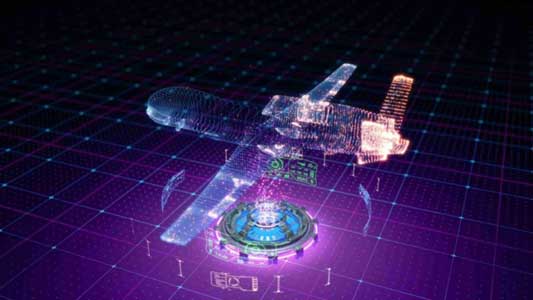
Modern defense platforms are no longer defined only by steel, composite, and propulsion. They are increasingly software-defined, sensor-saturated, networked systems-of-systems operating under rapidly evolving threats. In this environment, “build-test-fix” cycles and document-centric engineering struggle to keep pace with capability needs, upgrade tempo, and sustainment costs. This is the gap that digital engineering and digital twins are intended to close—by shifting the center of gravity from static documentation to living models, connected data, and continuous verification across the life cycle.
A digital twin in defense is not a single 3D model or a dashboard. In practice it is a configuration-controlled, purpose-built digital representation—connected through a digital thread—that enables engineers, testers, and operators to predict performance, evaluate changes, and plan sustainment with greater confidence and speed. Defense organisations are now formalizing this shift: U.S. DoD policy explicitly defines digital engineering as using and integrating digital models and data to support development, test & evaluation, and sustainment, with models becoming the primary means of communicating system information rather than documents.
1. What a “Digital Twin” means in defence engineering (not marketing)
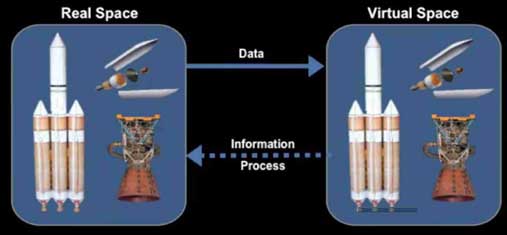
Defence engineering frequently uses terms like model, simulation, digital model, digital thread, and digital twin interchangeably—until an acquisition milestone or operational incident forces clarity. DoDI 5000.97 provides that clarity at policy level: it defines digital engineering as integrating digital models and underlying data across the life cycle; it also defines a digital twin as a virtual representation using the best available models plus sensor information and real-world data to mirror and predict system performance across the physical twin’s life, and to inform design changes over time. Importantly, the policy notes that there may be multiple digital twins of the same system, with differing fidelity based on use case—so long as they are grounded in authoritative sources of truth and have clearly defined scope.
2. Digital twin vs digital model: the practical difference
A digital model can be static—useful for design, analysis, and communication. A digital twin becomes distinctive when it is (a) operationally connected to the physical asset, (b) continuously updated with relevant real-world data, and (c) used to predict and inform decisions (maintenance intervals, mission envelopes, configuration updates). DoDI 5000.97 also stresses configuration control and traceability of models and data from operational capabilities through requirements, design, production, test, training, and sustainment.
3. Digital Twins in Defence System Design
Defence engineering frequently uses terms like model, simulation, digital model, digital thread, and digital twin interchangeably—until an acquisition milestone or operational incident forces clarity. DoDI 5000.97 provides that clarity at policy level: it defines digital engineering as integrating digital models and underlying data across the life cycle; it also defines a digital twin as a virtual representation using the best available models plus sensor information and real-world data to mirror and predict system performance across the physical twin’s life, and to inform design changes over time. Importantly, the policy notes that there may be multiple digital twins of the same system, with differing fidelity based on use case—so long as they are grounded in authoritative sources of truth and have clearly defined scope.
3.1 Model-Based Systems Engineering (MBSE)
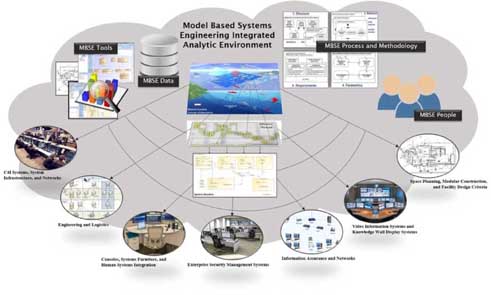
Modern defense systems are highly complex, often comprising millions of lines of code and tightly integrated hardware components. Traditional document-based design approaches are insufficient for managing such complexity.
Digital twins leverage Model-Based Systems Engineering (MBSE) frameworks to:
- Define system requirements in executable models
- Simulate system interactions before physical prototyping
- Identify design flaws early in the lifecycle
- Optimize performance under mission-specific constraints
- This approach reduces costly late-stage redesigns and shortens development cycles.
3.2. Multi-Physics Simulation
Defense platforms operate under extreme conditions — high acceleration, temperature gradients, shock loads, EMI/EMC exposure, and electronic warfare interference.
Digital twin environments incorporate:
- Structural simulations for vibration and fatigue
- Thermal simulations for electronics cooling
- Electromagnetic modeling for radar and communication systems
- Power electronics simulations for energy resilience
By integrating multi-domain simulations into a unified digital model, engineers can validate cross-system dependencies long before hardware is built.
4. The defence digital twin stack: Ecosystem ® Models ® Thread ® Artifacts
DoDI 5000.97 describes digital engineering as an integrated capability composed of four major elements:
4.1 The digital engineering ecosystem
The ecosystem is the enabling environment—hardware, software, networks (including cloud), tools, and workforce—combined with the processes and practices that allow stakeholders to collaborate, execute simulations, and analyse results. It explicitly acknowledges government-to-government, contractor-to-government, and contractor-to-supplier collaboration, and calls out the security risks that come with aggregating sensitive information in a shared environment. Source
The U.S. DoD’s Digital Engineering, Modeling and Simulation office (DEM&S) emphasises that digital engineering and modelling & simulation are mechanisms to automate design, development, and integration via collaborative environments—supporting earlier defect discovery and improved quality relative to traditional acquisition workflows.
4.2 Digital models (including digital twins)
Defence programmes need multiple model types: requirements, architecture, physics-based models, threat models, human performance models, and life-cycle models. DoDI 5000.97 describes modelling and simulation as essential for understanding complex interdependencies and enabling informed decisions—especially when simulation integrates relevant real-world data to underpin an authoritative source of truth.
4.3 Digital thread
The digital thread is the “connective tissue”: an extensible analytical framework that orchestrates data, software, information, and knowledge across life-cycle activities. It supports feedback loops, enabling different audiences (engineering, test, training, and sustainment) to extract consistent views and perform their activities with shared traceability.
4.4 Digital artifacts
Artifacts are dynamically generated outputs from models—drawings, interface docs, bills of material, test cases, analytical resultWQs, production instructions. The point is not “more documents,” but consistent, model-derived outputs that reduce divergence and rework.
5. Digital Twin Architecture in Defence]
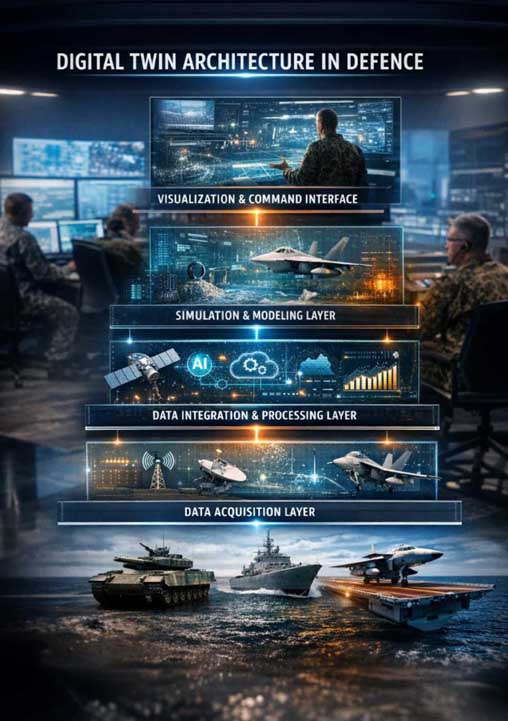
A robust defence-grade digital twin architecture comprises five core layers:
1. Physical Asset Layer
The actual hardware — aircraft, missile, radar, vehicle, or electronic subsystem.
2. Data Acquisition Layer
Embedded sensors, FPGA-based telemetry systems, RF modules, and secure communication links collect performance data in real time.
3. Data Integration and Processing Layer
AI-enabled analytics engines process streaming data to detect anomalies, trends, and degradation patterns.
4. Simulation and Modeling Layer
High-fidelity simulation engines perform predictive modeling using physics-based and AI-driven algorithms.
5. Visualization and Command Interface
Secure dashboards provide actionable insights to engineers, commanders, and maintenance teams.
This layered architecture ensures seamless synchronization between the physical and digital domains.
6. Simulation and Test: The Twin Becomes a Force Multiplier
6.1 Shifting left—verification and validation earlier
One of the biggest payoffs is using digital twins to verify and validate requirements early, before expensive hardware and range time is committed. The defence industry’s push toward faster acquisition timelines is repeatedly linked to digital engineering adoption, with simulation-enabled twins supporting early insight into performance envelopes and operating ranges.
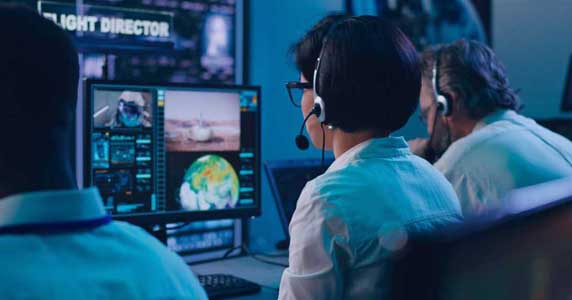
6.2 Digital test infrastructure + DevSecOps: continuous assurance, not annual events
DoDI 5000.97 explicitly calls for digital engineering capability elements that include DevSecOps and test infrastructure to automate testing, analysis, and software distribution across the life cycle—supporting both developmental and operational testing, plus security testing such as vulnerability scanning and penetration testing. Source
It also points programmes toward DoD investments such as the National Cyber Range Complex (NCRC) for high-fidelity cyber activities during all phases of the system life cycle. In digital twin terms, this means the “twin” is not purely mechanical or performance-centric; it can also be used to evaluate cyber-physical behaviour and resilience under threat-representative conditions.
7. Field Deployment: Closing the Loop from Sensors to Decisions
A defence digital twin becomes operationally meaningful when it is deployed as a decision-support instrument—not just an engineering tool.
7.1 Readiness and sustainment: predicting failures and scheduling maintenance when it matters

NAVSEA’s coverage of digital twin work for fleet resilience provides a concrete readiness framing: even a small percentage increase in operational availability can have fleet-level impact, and digital twins can help spot degradation early, predict failures, and support smarter maintenance decisions over the ship life cycle. It describes digital twins as combining real-time sensor data with physics-based modelling and machine learning to provide a dynamic picture of vessel performance.
The NAVSEA article also surfaces a key human factor reality: predictive recommendations require trust. It notes discomfort with predictive models and AI as a barrier and emphasises keeping subject matter experts “in the loop,” framing the digital twin as augmenting—not replacing—human judgement.
7.2 Deployment realities: bandwidth, edge compute, and “twin drift”
Fielded twins must contend with:
- Intermittent Connectivity (Contested Spectrum, Mission Radio Silence, Denied Environments)
- Sensor Calibration And Drift
- Configuration Changes In Theatre (Repairs, Substitutions, Software Patches)
- Adversarial Manipulation Risks (Data Poisoning, Spoofing)
Policy guidance anticipates this by stressing that ecosystems must maintain confidentiality, integrity, and availability, and that advanced data security methods such as Zero Trust should be used to secure digital engineering environments—especially given aggregation risk. Source
8. Cybersecurity Considerations
Defence digital twins must operate within highly secure environments. Key challenges include:
- Secure data pipelines from battlefield assets
- Protection against spoofed telemetry
- Encryption of digital models
- Isolation from adversarial cyber intrusion
A compromised digital twin could expose operational vulnerabilities. Therefore, zero-trust architectures and encrypted communication protocols are essential.
9. Integration with AI and Edge Computing
Digital twins become exponentially more powerful when integrated with AI.
AI-Driven Predictive Models
Machine learning algorithms analyze historical performance data to:
- Detect subtle degradation patterns
- Improve anomaly detection accuracy
- Optimize mission parameters
- Edge-Based Digital Twins
In contested environments with limited connectivity, partial digital twin functionality can operate at the edge:
- Embedded processors analyze local sensor data
- Critical decisions are made autonomously
- Only essential data is transmitted back to command centers
This hybrid architecture ensures resilience in electronic warfare conditions.
10. Indian Perspective: Opportunities and Strategic Importance
India’s defence modernization initiatives emphasize indigenous development under Make-in-India and Atmanirbhar Bharat programs. Organizations such as Defence Research and Development Organisation are increasingly leveraging simulation-driven design methodologies.
Digital twin technology offers India:
- Reduced dependency on foreign test infrastructure
- Faster prototyping cycles
- Improved reliability of indigenous systems
- Enhanced lifecycle management of legacy assets
As India expands its aerospace and naval capabilities, digital twins can play a pivotal role in accelerating modernization.
11. Future Trends in Defense Digital Twins
1. Cognitive Digital Twins
Future twins may autonomously adapt based on AI-driven reasoning models.
2. Swarm-Level Digital Twins
Modeling coordinated drone swarms in real time will require distributed digital twin architectures.
3. Quantum-Enhanced Simulation
Emerging quantum-computing platforms may enable ultra-high-fidelity battlefield simulations.
4. Secure Military Cloud Integration
Dedicated defense cloud ecosystems will host large-scale digital twin simulations with classified security layers.
Conclusion
Digital twin technology is redefining defence system engineering — from conceptual design to field deployment and lifecycle sustainment. By enabling high-fidelity simulation, predictive maintenance, AI-driven analytics, and mission-level modeling, digital twins provide armed forces with a decisive technological edge.
As defence platforms become increasingly software-defined and electronically complex, digital twins will shift from being a design enhancement to a strategic necessity. Nations that effectively integrate digital twin ecosystems into their defence modernization roadmap will benefit from accelerated innovation, reduced lifecycle costs, and enhanced operational readiness.
For the defence electronics industry, digital twins represent not merely a tool — but a foundational pillar of next-generation military capability.