


Louvain-la-Neuve, Belgium – e‑peas, a pioneer in ultra-low-power energy harvesting and power management solutions, today announced a series of PMICs to improve design flexibility for OEMs seeking to eliminate disposable batteries from remote controls, keyboards, mice and other consumer, IoT sensors and smart home devices.
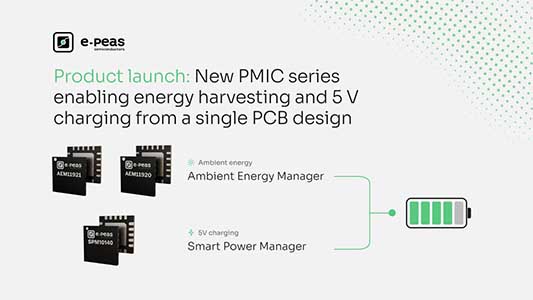
Three power management ICs that share a common pinout have been launched. These enable OEMs to use the same PCB design to easily create device variants with two charging options: energy harvesting, for example from an embedded PV cell, with 5 V charging also available, and 5 V charging only. As a single PCB layout accepts any of three PMICs, OEMs can switch between configurations by simply changing the PMIC and making minimal component changes, such as adding the energy harvester and adapting the housing.
The series includes devices with e-peas Average Power Monitoring (APM) functionality, which estimates the energy harvested and the energy delivered to the application (AEM11921), or the energy delivered to the application (SPM10140), and gives the application a regular view of its energy budget. OEMs can use it to build devices that adapt their behavior to the available energy.
The AEM11920 and AEM11921 (with APM) are ultra-efficient ambient energy management PMICs with boost converter, buck output and 5 V charger. They enable harvesting from inputs between 0.40 V and 2.24 V. They optimize using maximum power point tracking (MPPT) or constant voltage source regulation and are able to cold-start from just 2.4 µW.
The SPM10140 is the first e-peas PMIC designed specifically for 5 V charging only. It includes the APM function and is able to deliver 50 to 400 mA to the battery from a 5 V charger with a constant current / constant voltage (CC/CV) method, and up to 50 mA to the application circuit via its integrated buck converter.
The SPM10140 is the first member of the Smart Power Manager (SPM) family, a new e-peas product line of 5 V battery chargers. Sharing a common pinout with the AEM11920 and AEM11921, it gives OEMs a direct path to an energy harvesting version on the same PCB layout.
All devices come in a 3 x 3 mm QFN20 package and have a buck efficiency of up to 96%. They can be configured by GPIO or I2C, started even with a battery voltage below 2.00 V and implement battery protections from 2.30 V to 4.60 V when used with Li-ion, Li-ion capacitors, LiPo, LiFePO4 and NiMH energy stores.
The environmental impact, cost and time taken to replace batteries is driving organizations and consumers to seek rechargeable devices and energy harvesting alternatives. For example, Nielsen’s Consumer Tech Trends 2027 states two fifths (41%) of respondents would pay a premium of up to 10% for products that are environmentally friendly.
EU figures state that 231,000 metric tons of portable batteries were sold in 2023 in the region, but just half this amount (117,000 metric tons, 49%) was collected for recycling during the same year. Batteries in landfill leach corrosive electrolytes, heavy metals, and toxic organic compounds.
e-peas CMO, Christian Ferrier, said: “We speak with a lot of customers that want to reduce their environmental impact by eliminating disposable batteries and seek to offer both premium, energy-harvesting peripherals that never need a battery replacement, and a lower-cost option charged from 5 V. Having two devices with two PCBs is costly. But the launch of this new series of products enables one design, one PCB, and both charging configurations.”
Samples and evaluation boards will be available in December, following their public debut at electronica 2026, which is held from November 10 to 13 in Munich.
For further information on the AEM11920, AEM11921 and SPM10140 please visit e-peas.com.
To arrange a meeting at the e-peas electronica stand (C4.178), please contact e-peas directly.