


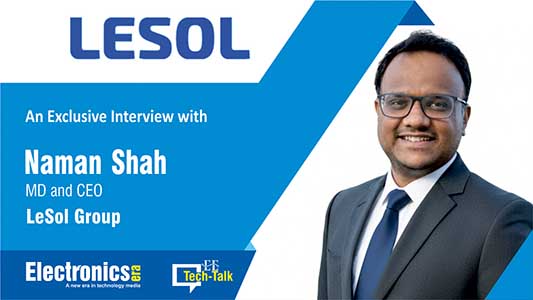
Electronics Era: LeSol Group has established itself as a technology-driven industrial solutions provider. Could you share the company’s journey and the key milestones that have shaped its growth?
Naman Shah: LeSol Group’s journey has basically been defined by a clear focus on innovation, strategic expansion, and building future-ready manufacturing capabilities. We began our journey in 2017, with this vision of making a globally competitive electronics manufacturing company. In the early years, we strengthened our R&D capabilities, made strategic alliances with key suppliers, and set the groundwork for more advanced manufacturing facilities too.
A big turning point happened in 2022, when LeSol acquired the BAG India business from Trilux AG, Germany, and shifted everything forward. This significantly strengthened the product portfolio and accelerated our development of energy-efficient technologies while expanding presence across key markets.
In 2023, we further enhanced our capabilities by acquiring the global rights to the Renesola brand, followed by the acquisition of the USHA Shriram brand rights in 2024, while also initiating the IATF certification process to strengthen automotive manufacturing credentials.
Recently, our strategic partnership with Hefei Pengpai Energy marked another significant milestone. This collaboration combines our advanced manufacturing expertise with Pengpai’s global leadership in Battery Management Systems (BMS), enabling us to strengthen India’s EV and energy storage ecosystem. Alongside this partnership, we have expanded our manufacturing capacity threefold and achieved IATF certification, positioning LeSol Group as a technology-driven industrial solutions provider ready to serve both domestic and global markets.
Electronics Era: India’s electronics manufacturing industry is witnessing unprecedented expansion. How do you see this transformation creating new opportunities for solution providers like LeSol Group?
Naman Shah: India’s electronics manufacturing sector is entering a defining phase. While production volumes are rising due to policy support, global supply chain diversification, and the China+1 strategy, the next growth wave will be driven by higher value addition, engineering, and indigenous design capabilities rather than assembly alone.
For solution providers like us, this presents a significant opportunity. Customers today seek manufacturing partners who can support the entire product lifecycle, from design validation, R&D, SMT, and precision manufacturing to system integration and testing. With our integrated EMS/OEM capabilities, we are well-positioned to help OEMs accelerate time-to-market while improving quality, localisation, and supply chain resilience. We also see strong demand emerging from sectors such as EVs, industrial automation, consumer electronics, and energy storage, where engineering expertise and manufacturing excellence will increasingly become key competitive differentiators rather than production capacity alone.
Electronics Era: Industry 4.0 is moving from concept to implementation. Which technologies — AI, IoT, digital twins, machine vision, robotics, or predictive analytics — do you believe will have the greatest impact over the next five years?
Naman Shah: Over the next five years, the biggest impact probably won’t come from one single technology, more like it will come from the convergence of AI, industrial IoT, machine vision, and predictive analytics, all blending. In this setup, IoT is going to act as the foundation, generating real-time shop floor data, while AI and predictive analytics will take that stream and turn it into actionable insights, optimizing production, helping improve equipment utilisation and cutting down unplanned downtime. Machine vision, meanwhile, will become indispensable for high-precision quality inspection, allowing faster and more consistent defect detection than manual processes ever could.

At the same time, digital twins will bridge the whole gap between design and manufacturing. They’ll make it possible to simulate products and production lines before anything goes physical, which should reduce errors and speed up time to market. Robotics will keep pushing automation for repetitive but also precision-driven work, especially in high-volume electronics manufacturing. At LeSol Group, we believe the real competitive advantage is less about buying a tool here and there and more about integrating these technologies into a connected, data-driven manufacturing ecosystem, not using them as standalone solutions only. That combination is really what will define smart factories.
Electronics Era: The semiconductor ecosystem is expanding rapidly in India. What role can manufacturing technology providers play in supporting semiconductor fabs, OSAT facilities, and electronics assembly plants?
Naman Shah: India’s semiconductor ambitions have moved beyond attracting individual investments to building a complete, self-reliant ecosystem. With initiatives like Semicon 2.0, the focus is now on strengthening the entire value chain from fabs and OSAT facilities to component manufacturing, testing, packaging, and electronics assembly.
Manufacturing technology providers are likely to take a big role in enabling this transition. Semiconductor facilities really need exceptional precision, process stability, traceability, and close to zero defect rates. In practice, this ends up with more advanced automation, AI-based quality inspection, machine vision, digital manufacturing platforms, predictive maintenance, and real-time production analytics so you can keep the yield steady and actually land operational excellence. Also, outside of the physical production line, technology providers can help with optimising material flow, improving energy efficiency, lifting equipment utilisation, and staying aligned with global quality standards end-to-end.
At LeSol, we think our core strength comes from mixing engineering know-how with advanced manufacturing capabilities. As India scales its semiconductor and electronics ecosystem, solution providers can’t just remain manufacturing partners; they must shift toward being technology partners. That means supporting customers from design validation and prototyping through precision manufacturing, system integration, testing, and even lifecycle support. This kind of collaborative approach will likely be crucial if India is serious about building globally competitive, resilient, and innovation-led semiconductor manufacturing capabilities that actually last.
Electronics Era: Sustainability has become a strategic priority for manufacturers worldwide. How can digital manufacturing technologies contribute to reducing energy consumption, waste, and carbon emissions?
Naman Shah: Sustainability is no longer only a compliance thing, as it’s become a business imperative. Digital manufacturing technologies are helping manufacturers, you know? The biggest edge is in data-driven decision-making. When manufacturers tap into AI, Industrial IoT, and live production insights, they can keep watch on machine behavior nonstop, spot inefficiencies faster, and fine-tune energy consumption across the production lines.
Predictive maintenance also matters a lot because it flags possible equipment failures before they actually happen. That means less pointless downtime, longer asset life, and fewer energy-heavy breakdowns. Then there are machine vision systems, which improve quality control by catching defects early in the production flow. This cuts down on material wastage and rework quite a bit. Digital twins help too, because they let manufacturers model products and production procedures virtually, so designs can be optimised, resource use reduced, and the need for multiple physical prototypes can be lowered. Overall, sustainable manufacturing is producing more, with fewer resources. By combining intelligent automation, data analytics, and precision engineering, manufacturers can drive down energy use, cut carbon emissions, minimise waste, and raise resource efficiency. So in the end, you get operations that are not only more sustainable but also more competitive and more cost-effective over the long run.
Electronics Era: Supply chain resilience has become a major focus after recent global disruptions. How can digital technologies improve supply chain visibility and manufacturing agility?
Naman Shah: The past few years have made it clear that supply chain resilience isn’t just about having multiple suppliers, it’s also about having real-time sight into what’s happening and being able to react fast when disruptions pop up. Digital tools like IoT, AI, cloud platforms, and advanced analytics help manufacturers watch inventory , production, transport, and even how suppliers perform, all inside one kind of shared digital ecosystem. In practice, this makes it possible to spot possible bottlenecks earlier, predict demand with more accuracy, and choose the next steps using data almost immediately. On the manufacturing side, things like digital twins, predictive analytics, and connected factory systems improve production agility since they let teams adjust schedules quickly, reduce downtime , and use resources in a smarter way. Automation keeps operational continuity more stable too, because it lowers reliance on manual tasks and supports better consistency. And since supply chains are getting more connected, more global , digital transformation helps manufacturers shift from reactive fixing to proactive risk management, which then builds operations that are more resilient, more flexible, and more focused on the customer , in a grounded kind of way.
Electronics Era: Innovation often requires strong industry collaboration. How does LeSol work with technology partners, OEMs, research institutions, and customers to drive innovation?
Naman Shah: At LeSol Group, we think meaningful innovation really happens when people collaborate across the whole manufacturing ecosystem, like from early planning all the way through. We work closely with technology partners, OEMs, suppliers, and customers to co-develop solutions that are market-ready and scalable and also in line with the way industry requirements keep changing.
One pretty clear example is our strategic partnership with Hefei Pengpai Energy, they’re a global leader in Battery Management Systems (BMS). By combining Pengpai’s advanced R&D abilities with LeSol’s integrated manufacturing know-how and localized supply chain setup, we’re bringing globally validated BMS solutions into India that help the country’s rising EV and energy storage setup grow, and at the same time we’re reinforcing the Make in India initiative.
Also, beyond the tech tie-ups, we team up with OEMs starting from the product design stage to tweak manufacturability, overall quality, total cost, and speed to market, and yes, it’s kind of continuous. We also stay in near-constant conversation with customers, whose feedback really matters for us, in tuning our offerings and the way we manufacture. From the inside, digital manufacturing platforms, advanced automation, and linked systems like ERP, MES, and PLM help engineering and production work together seamlessly, even when the work gets complex.
As we grow, we also spot strong prospects to partner with research institutions and deep-tech innovators to speed up the next wave of electronics, energy storage, and smart manufacturing solutions for both Indian and global markets.
Electronics Era: Looking ahead, what are LeSol Group’s strategic priorities over the next three to five years, and what new technologies or market opportunities excite you the most?
Naman Shah: Over the next three to five years, our strategic priority is to shift from being a top Electronics Manufacturing Services (EMS) provider to becoming a technology-led manufacturing and product company. We are expanding our manufacturing muscle, strengthening backward integration, and putting money into advanced automation plus digital manufacturing so we can boost quality, productivity, and operational resilience across everything we run. A key focus area will be building India’s capabilities in high-value electronics, especially around Battery Management Systems, or BMS, energy storage solutions, and things like that. Our partnership with Hefei Pengpai Energy is an important step in this direction, so we can blend global technology with localized manufacturing to serve the growing domestic market while also opening export opportunities. We are also quite excited about how AI-driven manufacturing, smart factories, industrial IoT, and data-led quality systems are growing. These technologies will help with predictive quality control, quicker product development, and more manufacturing agility, if you will. As India strengthens its position within the global electronics value chain, we see real prospects in automotive electronics, industrial electronics, consumer appliances, and clean energy technologies. Our long-term vision is to develop products that are globally competitive and that are designed, engineered, and manufactured in India, while positioning LeSol Group as a trusted innovation and manufacturing partner for customers worldwide.