

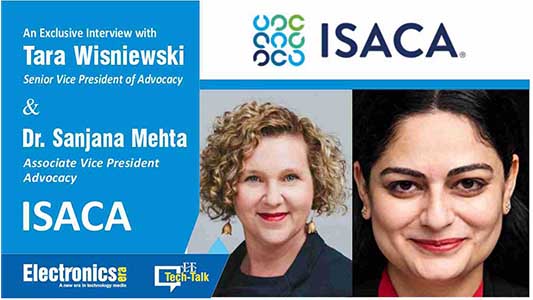
Electronics Era had an exclusive interaction with Tara Wisniewski, Senior Vice President of Advocacy, and Dr. Sanjana Mehta, Associate Vice President of Advocacy.
In this conversation, we explore the evolving landscape of technology advocacy, the importance of strengthening industry collaboration, and the role of policy, standards, and regulatory frameworks in driving innovation and responsible technology adoption. The discussion also focuses on emerging challenges and opportunities for the electronics and technology ecosystem, industry representation, and the need for greater engagement among businesses, policymakers, and technology stakeholders.
Through this interaction, Tara Wisniewski and Dr. Sanjana Mehta share their perspectives on key industry priorities, advocacy initiatives, and how collaborative efforts can help shape the future of the global technology ecosystem.
EE: As digital trust becomes increasingly important to businesses, what are the most significant skills gaps you currently see across the global technology workforce?
Tara: One of the biggest challenges for right now is keeping up with the speed of technology, and particularly with AI. What’s a real challenge, especially for cybersecurity professionals that are in that role, is the challenge of continuing to do their jobs day in, day out, but also being in a continuous learning loop, and understanding technology that they’re expected to magically know, but they actually have to do their own training around.
And I think that that’s a huge challenge for just that training pipeline.
EE: Which emerging skills—such as AI governance, privacy engineering, cyber risk management, digital identity and responsible AI—do you believe will be the most valuable over the next five years?
Dr. Sanjana: All areas of AI proficiency will be crucial, especially governance and risk management, as companies incorporate AI systems into their operations. The industry, academia, and professional organizations need to come together to find out how automation will affect entry-level jobs and prepare their graduates for such roles. India’s software industry is an example that shows how automation will change the nature of work and the way young professionals need to learn new skills and adapt. Engineers in India’s software industry no longer have to write code but validate the AI-written code.
EE: AI is transforming both the nature of technology jobs and the way organisations manage risk. How do you see AI reshaping cybersecurity career opportunities?
Tara: The chances that AI will completely take away the lower end positions in the field of cybersecurity are very low. However, it will increase the complexity involved in being a cybersecurity expert. Cybersecurity experts will have to have an understanding of the relationship between technology, risk management, audits and other systems. Even as multidisciplinary skills become more necessary, the knowledge of cybersecurity itself will remain very crucial in the evaluation of the AI systems and the discovery of the weaknesses.
EE: As AI automates certain technical tasks, will employers place greater value on human skills such as critical thinking, ethical reasoning, communication and risk assessment?
Dr. Sanjana: Increasingly, employers are recognizing the importance of soft skills within the field of cybersecurity. Certainly, technical skills are vital, but the field provides varied career paths that do not require knowledge of programming and mathematics. Reasoning, problem-solving, and critical thinking are skills needed by a great number of jobs in the cybersecurity realm. Good communication skills have become very important since it is necessary for professionals in the cybersecurity field to be able to articulate dangers and make cases for investments in cybersecurity projects to managers and boards. It is not enough to be technically proficient; it is necessary to explain cybersecurity issues within a business context.
EE: Cybersecurity careers traditionally focused on protecting networks, systems and data. How is the profession evolving toward broader digital trust and AI governance responsibilities?
Tara: The cybersecurity community is under a lot of pressure to get familiar with the topic of AI governance. The problem of the lack of consensus about the standards of AI governance is another reason why uncertainty is caused in the sphere. The conversation with Indian policy-makers and other stakeholders indicates that more collaboration should be achieved. The cybersecurity community worldwide needs to cooperate in order to come up with a set of common governance standards. Given the fact that different jurisdictions have different approaches to regulating AI, this is an important task.
Dr. Sanjana: There isn’t, a consensus around how AI should be governed, what AI risks mean, where does the liability lie.
At ISACA, this is certainly consuming a lot of our thinking time, and we’re engaging our members on, how they’re approaching sort of setting AI policies within their organisations. How are they benchmarking their organisation’s readiness to adopt AI tools within our portfolio? We have a framework for understanding the capability maturity of organisations to use and deploy AI systems.
So it’s certainly at the forefront of our strategy.
EE: As governments introduce new AI regulations and frameworks, how will regulatory knowledge influence technology career paths?
Tara: Due to the non-consensus in terms of the regulation of AI, there have been varying approaches to the same all over the world. With technology advancing very quickly, there is now a need for some guidance from the government for the industry. Proper regulation and legislation will not hinder innovation but rather drive innovation within a good governance framework that ensures that AI technology is not abused or misused.
Dr. Sanjana: AI regulation and the Digital Personal Data Protection Act, 2023, in India will result in greater need for Governance, Risk and Compliance (GRC) specialists and auditors. Like the increase in data protection professionals due to the GDPR by the EU, there is going to be need for GRC professionals to handle AI compliance. As more laws are enacted regarding AI risk in various sectors, the need for audit will increase too. The cross-section of cybersecurity, auditing and governance will, therefore, be reinforced.
EE: India is rapidly becoming a global technology and digital services hub. According to you, what cybersecurity workforce challenges would potentially limit this growth?
Dr. Sanjana: There are various benefits of India which include a young labor force, the existence of many STEM graduates, a healthy startup community, and an innovative culture. However, industry readiness poses a major challenge. Even though India has many engineering and technical colleges, it needs to ensure that its educational curriculum adapts itself according to technological changes and equips the graduates with industrial skills.
This problem is not unique to India. When various firms like Infosys, Wipro, and HCL Technologies grew, they realized the difference between education in engineering schools and workplace demands, and thus solved this problem by conducting graduate-level training programs.
As AI and other emerging technologies continue advancing at a rapid pace, the gap might become larger. The educational institutions should adapt their curricula and there should be a better cooperation between business and academia so as to train the graduates for changing roles in the future.
Tara: The cybersecurity sector is plagued with expectation gaps where employers ask for many years of experience even for basic positions. AI could further increase this expectation gap. India’s strength is in its dedication towards constant learning and its entrepreneurial spirit. But it must ensure that alternative career paths are available rather than having a set path to take education-wise. There must be increased cooperation between industry, education and regulatory bodies in tackling the new issues that arise due to cybersecurity and AI. India should also make sure that there are adequate training options available even for students from far-off places and differences in recognition of qualifications across regions are not a hurdle in getting deserving people trained.
EE: With India expanding semiconductor, FinTech, healthcare, manufacturing, telecom, and digital public infrastructure ecosystems, how will the demand for cybersecurity talent evolve?
Tara: The use of AI will lead to an increased need for cybersecurity experts who have diverse skill sets. Luckily, cybersecurity experts are flexible and are ready to learn continuously. Nevertheless, the increasing need for juggling several responsibilities is quite problematic because not everyone is good at multitasking. Organizations should come up with a way to allocate roles based on individuals’ skills. In light of the fast-growing technology, well-defined governance models and measures should be put in place to guide business in defining responsibilities.
EE: What opportunities does India’s large young workforce have to become a global talent base for cybersecurity and digital trust?

Dr. Sanjana: Quality training in cybersecurity and obtaining appropriate qualifications is required for India’s youth to skill themselves. This is where ISACA plays an important role, as it provides certification in cybersecurity, artificial intelligence, audit, privacy, and risk management. These certifications have been developed by industry experts and the recruitment managers’ expectations from the candidates. This way, individuals will be trained and equipped to cope with the ever-changing needs of the industry. With proper investment in the education process, India can create a pool of qualified professionals.
EE: How can organisations build continuous learning cultures so that cybersecurity teams can keep pace with AI, cloud, quantum technologies and evolving cyber threats?
Tara: Not only does this mean investing in ensuring that their organization has good cyber posture, but also in training their staff. Training involves continuous learning. There has to be a certain way of thinking, a certain mindset that needs to be developed. This is very, very important. And I also think this needs to come from top down. So this means that this has to be a mindset and a value of continuous learning at the board level. And thus that kind of trickles down in terms of that kind of investment. What we see here is that cybersecurity is not just an arm of IT, sitting in a corner. I mean, it has relevance across the business. And so continuous learning has to be a mindset and a way of life, not only for professionals, but for businesses as well.
Dr. Sanjana: Learning continuously is a vital aspect of the organization ISACA. The members of ISACA will find a lot of learning tools, certification programs, training programs and a wide range of chapters within the Tier 1 and Tier 2 cities of India. These chapters will enable the development of an active community of cybersecurity professionals who share information and adopt new practices.