



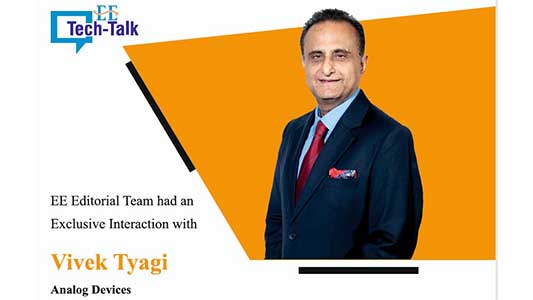
Electronics Era speaks with Mr. Vivek Tyagi, Managing Director of Sales and Site Head, ADI India, to explore the evolving landscape of digital healthcare in India and the role of semiconductor and sensing technologies in transforming healthcare delivery. The conversation examines how wearable technologies are enabling remote patient monitoring, preventive healthcare, and continuous health tracking, while highlighting real-world applications and the impact of wearable health monitoring, including Sensio’s experience. The discussion also explores the opportunities and challenges in scaling connected healthcare solutions across India, and how advanced sensing and semiconductor innovations can contribute to more accessible, efficient, and patient-centric healthcare.

EE: How do you assess the growth of digital healthcare in India today, and what are the key technology and market opportunities that could accelerate the next phase of healthcare transformation?
Vivek Tyagi: Digital healthcare in India is moving from a model centred largely on treatment and episodic hospital visits towards prevention, monitoring at home and more continuous management of chronic conditions. This is particularly relevant in India given the scale of the population and the growing incidence of lifestyle-related conditions such as hypertension and diabetes.
The opportunity is to make continuous monitoring more accessible and clinically useful. This involves sensing, low-power electronics, connectivity, embedded processing to capture physiological data over longer periods. Wearables such as rings, bands and chest patches can support this, while smartphones and cloud platforms can connect that data to patients and healthcare professionals.
There is also an opportunity to build an ecosystem involving semiconductor companies, device manufacturers, healthcare providers, technology companies and research institutions, with solutions developed for India’s requirements.
EE: Wearable devices are increasingly enabling continuous health monitoring. How is this shift from episodic, reactive healthcare to preventive and personalised care changing the way healthcare is delivered?
Vivek Tyagi: The fundamental point is that physiology is continuous, while healthcare decisions have traditionally been based on snapshots. An annual check-up or an occasional hospital reading can show what is happening at a particular point in time, while continuous monitoring can provide a longer-term view of how an individual’s health is changing.
Continuous vital-sign data can support monitoring before and after hospitalisation and can also allow healthcare professionals to follow patients remotely rather than relying entirely on hospital-based measurements.
With data collected over weeks, months or years, it is also possible to establish an individual’s baseline rather than looking only at a single reading or population-level norms.
EE: What roles do semiconductors, sensors, analogue technologies, and signal-processing solutions play in making modern healthcare devices smaller, more accurate, power-efficient, and reliable?
Vivek Tyagi: They are fundamental because healthcare devices need to capture physiological signals, convert them into digital information, filter out noise, process them and communicate the resulting data, all within a small and power-constrained device.
For wearables, sensor placement, optics, movement and the physical design of the device can all affect signal quality. Even a small change in the distance between an optical assembly and the skin can affect a PPG signal. Motion can introduce artefacts, while recovering a weak signal can consume additional power.
Integration can help manufacturers address these requirements. Integrated analogue front ends with optics can support compact wearable designs, while integrated sensors and power-management functions may help simplify the design. Algorithms can also determine when measurements are required, allowing devices to spend more time in low-power modes, depending on the implementation.
EE: Beyond fitness tracking, wearables are now being used for parameters such as heart rate, ECG, SpO₂, temperature, and other vital signs. Which healthcare applications do you believe have the greatest potential for widespread adoption in India?
Vivek Tyagi: Applications include cardiovascular health, blood-pressure monitoring, respiratory health, sleep and metabolic health, including continuous glucose monitoring.
Remote patient monitoring is another application. A combination of smart rings, bands and chest patches can bring together heart rate, blood oxygen, temperature and respiratory rate and make that information available to doctors and paramedical teams remotely, including after a hospital procedure.
EE: Healthcare wearables need to balance clinical-grade accuracy, affordability, power consumption, comfort, and ease of use. How can semiconductor innovation help manufacturers achieve this balance?
Vivek Tyagi: Achieving this balance requires optimisation across the sensor, optics, electronics, algorithms, power architecture and physical form factor. Semiconductor integration can bring more functionality into fewer components. For example, integrated analogue front ends with optics can simplify the design of a compact wearable, while greater integration can help reduce component count and the bill of materials, depending on the implementation.
Power efficiency is also important. Different vital signs do not necessarily need to be measured at the same frequency. Measurement schedules can be adapted to the patient’s needs and the use case, while algorithms can allow devices to remain in sleep or deeper power-saving modes until a measurement is required.
Affordability is also linked to scale. Mainstream CMOS processes, higher levels of integration and higher manufacturing volumes can help reduce semiconductor and device-level costs.
EE: How do you see AI, advanced sensing, edge processing, and semiconductor technologies coming together to transform wearable healthcare — from simply collecting data to generating actionable health insights?
Vivek Tyagi: The wearables can capture physiological signals and perform some processing locally. A smartphone can then bring together information from multiple signals and devices, while cloud platforms can support the storage can analysis of longitudinal data over months or years.
Semiconductors provide the sensing, signal conversion, processing, connectivity and power efficiency required to capture and process data within a small wearable.
For example, temperature can be combined with other signals and compared with an individual’s normal levels to identify changes over time. Some processing can happen directly on the device, particularly when connectivity is unavailable.
EE: What infrastructure — including smartphones, cloud platforms, connectivity, edge computing, and healthcare platforms — is required to create a truly connected healthcare ecosystem in India?
Vivek Tyagi: The ecosystem needs to work as a connected chain, from the sensor through to the healthcare professional. At the device level, wearables need accurate sensing, local processing, low-power connectivity and efficient battery management. The data can then move over Bluetooth to a smartphone application, which can act as an aggregation point.
Cloud platforms or databases can support longer-term storage and analysis, while edge processing allows some decisions or inferences to happen locally when connectivity is limited.
For wearable-generated data to become part of routine healthcare, it also needs to be trusted, appropriately validated and capable of fitting into healthcare workflows and systems. Devices intended for clinical use would also be subject to applicable validation, certification and regulatory requirements.
EE: What are the biggest barriers to scaling connected healthcare solutions across India — cost, connectivity, interoperability, regulatory requirements, data privacy, clinical validation, or consumer adoption?
Vivek Tyagi: Affordability and awareness remain important challenges, particularly if connected healthcare is to move beyond premium devices. The economics have to work at scale, which makes semiconductor integration, efficient power consumption and manufacturing volume important.
Clinical trust is another factor. For wearables to move from consumer health into applications intended for clinical settings, accuracy needs to be benchmarked against appropriate reference standards, with, applicable validation and certification requirements addressed, and doctors need confidence in the data.
There is also the broader healthcare ecosystem, including regulation, affordability and the readiness of healthcare systems. Data needs to be handled responsibly, in accordance to privacy and data requirements, supported by appropriate security safeguards, transparency and valid consent practices.
Scaling connected healthcare therefore requires the technology, clinical validation, regulatory framework, economics and healthcare infrastructure to develop together.