


For OEMs and product development teams, the pressure is mounting across the product lifecycle. Procurement and R&D leaders are constantly balancing the need to accelerate time-to-market, meet defined quality requirements, and respond to growing localisation demands. Traditionally, manufacturing a complex electronic product meant managing a fragmented web of specialized vendors—one supplier for initial design, another for component sourcing, a third for board assembly, a fourth for mechanical enclosures, and yet another for final validation.
However, when these manufacturing processes remain siloed across independent organizations, every hand-off introduces another point of coordination, delay, and risk. The administrative and technical overhead of coordinating separate vendor interfaces frequently erodes the benefits of outsourcing. As hardware systems increase in complexity, the core question facing procurement and engineering leadership is fundamentally changing. The objective is no longer simply asking, “Which supplier can perform this specific manufacturing process?” but rather, “Which partner can connect enough of the product journey to reduce the number of interfaces the OEM must manage?”
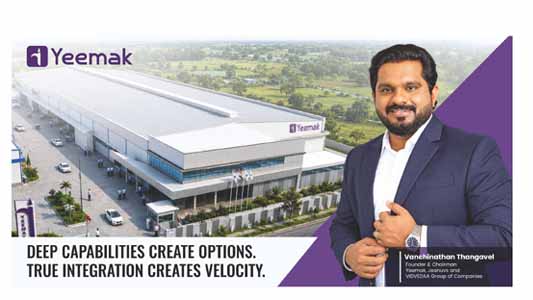
This is the manufacturing model around which Yeemak has built its capabilities. Operating as an integrated OEM and ODM partner, Yeemak links engineering support, electronics assembly, and physical mechanical manufacturing within a unified ecosystem. Its broader engineering ecosystem, including its relationship with Jeanuvs Private Limited, adds specialised expertise in research, development, and high-speed electronics system design. Operating across purpose-built facilities in India, its capabilities extend from circuit design and PCB fabrication through surface-mount technology (SMT), through-hole assembly, custom cable harnessing, testing, and complete box build.
Connecting Capability to Manufacturing Value
For a sourcing or engineering professional evaluating suppliers at a major trade event, a list of equipment is only as valuable as the specific manufacturing problems it solves. Evaluating a manufacturing partner requires looking past machine specifications and examining how an organization’s capabilities address real-world production bottlenecks across design, assembly, and physical integration.
Engineering and NPI
Bridging the gap between design intent and mass production represents one of the most consequential phases in the hardware lifecycle. When a product moves from prototype quantities into repeatable production, unresolved decisions regarding component selection, board layout, tooling, and assembly sequences can derail scaling efforts. Yeemak addresses this by embedding upfront Design for Manufacturing (DFM) and New Product Introduction (NPI) support early in the hardware lifecycle. This approach aims to resolve manufacturability issues before physical production, reducing the likelihood of costly tooling revisions or shop-floor disruption during scale-up.
Electronics Manufacturing

For electronics production, repeatability, yield, and process control become central to manufacturing performance. Yeemak provides Printed Circuit Board Assembly (PCBA), encompassing high-speed SMT and automated through-hole processes. The company also supports custom cable and wire harnessing for power, signal, and data applications, extending its manufacturing scope beyond board-level assembly to support diverse industrial, automotive, medical, and consumer electronics applications.
Mechanical and Electronics Integration
A printed circuit board does not function in isolation; it must integrate into a physical enclosure while satisfying defined thermal, structural, and environmental tolerances. For an engineering team managing separate electronics and mechanical vendors, bringing these disciplines into the same manufacturing framework can remove a major source of late-stage redesign. By integrating board-level assembly directly with in-house mechanical production—encompassing precision plastic injection molding, sheet metal fabrication, and structural welding—electronic subsystems and mechanical housings are evaluated within the same workflow from the earliest build stages.
Testing and Box Build
Quality control cannot be treated as a final, isolated checkpoint at the end of an assembly line; it must be embedded directly into the manufacturing sequence. To give procurement and quality teams greater visibility into product performance, Yeemak integrates multi-stage inspection technologies, including Automated Optical Inspection (AOI), Solder Paste Inspection (SPI), X-ray validation, in-circuit testing (ICT), and functional testing (FCT). These inspection and validation processes are complemented by Environmental Stress Screening (ESS), while Yeemak’s manufacturing operations are certified under frameworks including ISO 9001:2015, ISO 14001:2015, ISO 45001:2018, ISO 27001:2022, IATF 16949.
From Downstream Integration to Upstream Control
The logic of connected capabilities is straightforward: integration is not a factory-count argument; it is a coordination argument. In a fragmented supply chain, every boundary between independent suppliers creates another interface requiring coordination, oversight and accountability. When these interfaces are brought into a single manufacturing framework, the implications extend across several OEM functions. For procurement teams, integration reduces the number of suppliers that need to be qualified, audited, and monitored. For engineering teams, it creates a closer feedback loop between design, manufacturability, and physical production, helping changes move through the development cycle with fewer cross-vendor dependencies.
Production teams benefit from greater synchronisation between board assembly, mechanical fabrication, and harness build, reducing the risk of one missing subassembly holding up final integration. Quality teams gain clearer visibility into root causes when issues cross process boundaries, with fewer hand-offs between separate suppliers. For programme managers, the model creates a more direct line of accountability when production schedules, component availability, or product specifications change. Ultimately, integration creates value when connected capabilities improve communication, production visibility, and schedule control across the build.
Recognizing that downstream manufacturing efficiency depends heavily on supply continuity, Yeemak is extending this integration strategy further upstream. At its expanding manufacturing hub in Thoothukudi, the company is developing a technologically advanced multilayer PCB manufacturing setup. This initiative is supported by technology from a Korea-based partner through an already-signed joint venture. The project represents a deliberate expansion of Yeemak’s manufacturing depth—from downstream electronics assembly toward the fabrication of the boards and critical inputs that underpin the hardware supply chain. Alongside multilayer PCB manufacturing, the facility encompasses planned upstream capacity for key PCB materials, including copper foil and copper-clad laminates (CCL). The strategic objective is to give OEMs greater visibility into critical manufacturing inputs, strengthen localisation efforts, and potentially reduce exposure to global supply-chain disruption.
It is this expanded manufacturing proposition that Yeemak will bring to Productronica India 2026. Scheduled for September 16–18 at the Bangalore International Exhibition Centre (BIEC) in Bengaluru, the co-located electronica India and Productronica India platform brings suppliers, equipment manufacturers, material vendors and technology providers across the electronics value chain into one decision-making environment. For companies evaluating potential manufacturing partners at the exhibition, equipment and process capability are only part of the assessment. The broader question is whether those capabilities can be connected across the product journey—from electronics manufacturing and mechanical integration through testing, box build, and eventual production scale-up in India.
The Buyer-Seller Forum is particularly relevant to this model of supplier evaluation, bringing together decision-makers across Purchase, Sourcing, R&D, Quality, Materials, and Plant functions for focused supplier discussions. For Yeemak, the opportunity is to move those conversations beyond individual processes toward the broader question of manufacturing fit: how engineering, electronics, mechanical production, testing, and scale can work together within a single programme.
For Yeemak, Productronica is therefore more than a showcase of individual capabilities; it is an opportunity to demonstrate how those capabilities can be brought together around complex manufacturing programmes. The combination of downstream and upstream capabilities positions Yeemak to support OEM and ODM programmes spanning NPI, electronics manufacturing, mechanical integration, box build, and production scale-up. This broader manufacturing model is particularly relevant to companies localising manufacturing in India, diversifying their supplier base, or evaluating India as part of a broader global manufacturing and supply-chain strategy. Beyond customer programmes, the expanded manufacturing base also creates scope for technology partnerships, joint development, and potential joint ventures where complementary capabilities can be combined.
By bringing engineering, electronics manufacturing, mechanical integration, product validation, and upstream PCB capabilities into a connected operating model, Yeemak is addressing a problem that increasingly sits at the centre of supplier selection: how to reduce manufacturing complexity without losing technical control. Productronica India 2026 provides the setting for that proposition to be explored through direct conversations with companies evaluating manufacturing partnerships, localisation options and supply-chain strategies in India.