


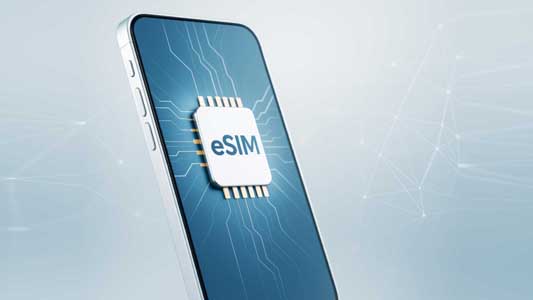
The potential for the humble eSIM to support India’s energy transition and our COP30 ambitions to deliver a next-generation grid benefiting citizens and commerce.

Country Director for India
& VP Engineering
Kigen
India’s energy system is accelerating on all fronts: clean mobility, growing cooling demand, electrified industry, and rapidly rising rooftop and utility scale renewables. Grids must absorb variable generation while serving rapidly growing demand—reliably, securely, and with AI-ready data. In this context, utilities that treat connectivity as a core system capability—not a bolt-on—will lead with resilience, data quality and operational insight.
New industrial eSIM brings dynamic network switching—hyper automation for critical data
With the new IoT eSIM standard (SGP.32)—shaped collaboratively with Kigen—eSIM becomes a confidence layer for grid operations. Each device can hold multiple connectivity profiles on one embedded UICC. A certified eSIM IoT Manager (eIM) enforces plain-language business policies (latency, loss, signal quality) and automatically switches connectivity when conditions change.
This is hyper automation where it matters most: dynamic network switching that keeps AMI 2.0 collectors, distribution automation (DA) controllers, C&I meter gateways and substation systems online through monsoons, maintenance windows and demand spikes—without truck rolls—so the data that touches citizens’ daily lives and commerce keeps flowing.
Factory-ready, India-ready: IFPP for scale, sovereignty and vendor neutrality
Standards-aligned In-Factory Profile Provisioning (IFPP; SGP.41/42) means meters, gateways and controllers ship network-ready and stay governable for years. This aligns with India’s twin imperatives:
• Grow domestic manufacturing of smart-grid hardware and telecom/IoT components while avoiding technical lock-in.
• Adopt technology- and operator-neutral designs: a single eSIM-ready hardware SKU can host different operator profiles over time and support legacy
G/3G (where still used) alongside LTE-M/NB-IoT/4G/5G.
For Indian OEMs—meters, RTUs, EV chargers, IoT gateways—integrate eSIM once and serve multiple DISCOMs and operators across states and export markets. Standardising on eSIM-ready modules helps Indian OEMs scale products across states and export markets, while giving utilities flexibility on network partners.
Positive developments that provide proof—and de-risk investment
Across large programmes abroad, we see evidence that the model works and de-risks capex. Collaborations with LCRA (publicly owned utility, USA) and Evergy (investor-owned utility, USA), plus metering ecosystems led by Itron and Iskraemeco, show how policy-driven eSIM turns connectivity from a risk into a lever—maintaining service continuity while modernisation scales. Early results are sound, scalable and transformational. More deployments and breakthroughs are ahead; the timing could not be better, and we are delivering what we said, despite the curveballs.
Resilience is a right: operational reliability for India’s grids

If adaptation and resilience are rights, then critical grid assets must stay connected. For Indian utilities, the primary, drivers are operational : improving billing efficiency, reducing losses, achieving SLA uptime, strengthening MDAS integration, and ensuring reliable, tamper-resistant data. While extreme weather events occur, the core value of resilient connectivity is to maintain continuous data flow and reduce field operations overhead. You cannot coordinate flexible loads, BESS fleets, EV charging or distributed solar without secure two-way communications at the edge.
eSIM-enabled devices can hold profiles from multiple MNOs and automatically fail over to the network that remains available. In disaster conditions, when one operator’s tower is down or congested, AMI meters, reclosers and substation IEDs can still send data and receive control commands.
The practical insight: specify eSIM with automatic failover as a resilience standard in all new smart-grid procurements. eSIM connectivity is moving from “nice-to-have” to hard adaptation infrastructure, aligning with India’s COP30 narrative.
What Government, DISCOMs and telecom leaders should do next
Make eSIM a design decision, not an afterthought, in AMI 2.0, DER and DA—considering the full ecosystem beyond metering.
- Insist on SGP.32-certified eIM for lifecycle control, cyber posture and auditable operations; adopt IFPP so devices attach securely from day one.
- Co-create offers with MNOs/MVNOs: onboard operator profiles for sub-1 GHz and mid-band, integrate private LTE/5G where required, and include managed satellite as a last-resort path.
- Measure what matters: time-to-attach, time-to-switch, dual-reach %, OTA success %, critical-traffic delivery. These KPIs turn resilience into something you can prove.
- Address real pain points : AT&C loss zones, meter tampering, SIM misuse, connectivity blackspots, state-wise MNO fragmentation, and long procurement cycles.
Confidence at a national scale
Choose partners that understand and bring a proven knowledge of the latest standards – proven in nationwide roll-outs and with some of the largest regional utilities in the USA, and is natively integrated with leading metering manufacturers and intelligent edge routers. Across electricity, water, and gas, our teams at Kigen have learnt how critical key moments in deployments are to deliver policy-based resilience at fleet scale, enabling network flexibility across public MNO, MVNO and private LTE/5G. Within the EU, national utilities are also innovatively embracing eSIMs with multi-million and multi-vendor moves—embracing network-flexible deployments across remote islands.
India’s energy future demands confidence in the data that drives it. Building security for industrial, robustly tested eSIMs can lay the foundation for confidence, enabling us to engineer and evolve the grid India deserves for our future.
Further reading: 5 ways eSIMs accelerate grid modernisation for C&I utilities — https://kigen.com/solutions/esim-utilities/