



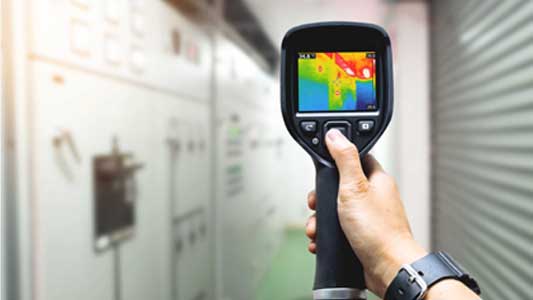
In the evolving world of Test & Measurement (T&M), thermal imaging has emerged as a crucial technology, providing engineers, technicians, and inspectors with the ability to “see” heat. By capturing infrared radiation emitted by objects and translating it into visible thermal images, thermal imagers are enabling smarter, safer, and more efficient diagnostics across industries.
As the demand for accuracy, speed, and data-driven insights grows, thermal imaging technology is undergoing rapid innovation. This article explores the cutting-edge trends shaping the future of infrared imaging in the T&M domain.
AI-Powered Image Processing
Artificial Intelligence (AI) is significantly enhancing the capabilities of thermal imagers. Modern systems are using machine learning algorithms to automatically detect anomalies, classify heat signatures, and reduce false positives.
• Example: AI can now detect abnormal heat patterns in electrical panels or PCBs without the need for manual interpretation.
• Impact: Faster diagnostics, less human error, and improved predictive maintenance.
Higher Resolution and Sensitivity
Recent innovations have led to higher pixel density and enhanced thermal sensitivity, allowing users to detect even the slightest temperature variations.
• Example: New-generation thermal imagers offer resolutions beyond 640×480 pixels with sensitivity <40 mK.
• Benefit: Critical for identifying early-stage faults in components or spotting minute insulation defects in building inspections.
Integration with IoT and Cloud
Thermal imagers are becoming smarter and more connected. Integration with IoT platforms and cloud-based analytics tools enables real-time data sharing, remote monitoring, and long-term trend analysis.
• Use Case: A technician can perform inspections in the field, while the analysis is done simultaneously by a remote team via cloud access.
• Advantage: Efficient collaboration and faster decision-making in maintenance and quality control.
Compact and Handheld Designs
Thermal imagers are becoming more compact, portable, and user-friendly. Smartphone-based thermal cameras and handheld devices are now widely used, especially in fieldwork and site inspections.
• Trend: USB and wireless thermal modules that plug directly into mobile devices.
• Impact: Lower cost, increased accessibility, and ease of use even for non-specialists.
Multispectral and Fusion Imaging
Advanced thermal cameras now combine visible light and infrared imaging (fusion technology) to provide clearer and more context-rich visuals.
• Feature: Overlaying visible images on top of thermal data for better spatial awareness.
• Application: Ideal for complex environments like circuit boards, mechanical assemblies, or crowded industrial spaces.
Expanded Applications in Emerging Sectors
Beyond traditional uses in electrical, HVAC, and mechanical inspection, thermal imaging is finding new applications:

• EVs & Battery Testing: Monitoring temperature distribution in battery packs.
• Semiconductors: Identifying hotspots on microchips.
• Aerospace & Defense: Thermal diagnostics of mission-critical components.
• Healthcare: Early fever detection and non-contact screening.
Software Advancements and Reporting Tools
Modern thermal imagers come bundled with sophisticated analysis software that enables:
• Automated report generation
• 3D thermal mapping
• Time-lapse thermal trend analysis
• Integration with CAD/BIM tools for facility diagnostics
These software tools make it easier for professionals to analyze, document, and share findings effectively.
Conclusion
From AI and IoT integration to enhanced sensitivity and portable designs, thermal imagers are no longer just diagnostic tools—they are intelligent, connected instruments at the forefront of innovation in the T&M space.
As industries push towards smarter maintenance, energy efficiency, and data-driven operations, infrared imaging will continue to play a pivotal role. Staying updated with these emerging trends is crucial for professionals who want to stay ahead in the fast-evolving landscape of test and measurement technology.