

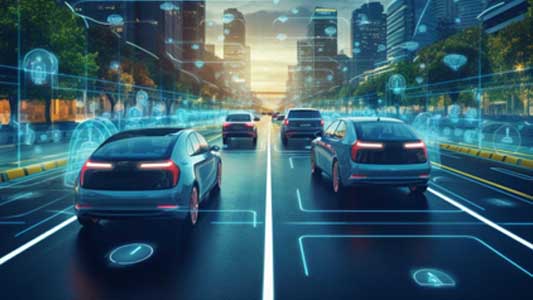
The automotive industry is experiencing one of the most profound transformations in its history, moving from hardware-centric engineering to a software-defined paradigm. This evolution is being driven by the convergence of High-Performance Computing (HPC), Next-generation electrical and electronic (E/E) architectures, and the Internet of Things (IoT). Vehicles are no longer isolated mechanical products; they are rapidly becoming intelligent, connected platforms capable of integrating seamlessly into a vast and complex digital ecosystem. In this new reality, a car is not just a mode of transportation; it is a computational node on wheels, continuously learning, adapting, and interacting with its environment.

The defining enabler of this transformation is connectivity. IoT facilitates constant, bidirectional communication between vehicles, infrastructure, and the cloud. Through this connectivity, vehicles can support an array of advanced capabilities such as autonomous driving, real-time traffic adaptation, advanced driver assistance systems (ADAS), predictive diagnostics, and over-the-air (OTA) software updates. These capabilities mean that a vehicle’s functionality is no longer locked at the point of sale. Instead, it can be continuously enhanced, optimized, and monetized over its entire lifecycle. For manufacturers, this creates opportunities for recurring revenue models based on software features, performance upgrades, and data-driven services, while for users, it means a car that evolves with their needs and technological progress.
Central to this transformation is the unprecedented role of data. Modern connected vehicles generate vast quantities of high-frequency, high-volume data streams from sensors, control units, and user interactions. When processed with advanced analytics, this data enables predictive maintenance, allowing potential component failures to be identified before they occur, thus reducing unplanned downtime. Energy usage can be monitored and optimized, performance can be dynamically adjusted to driving conditions, and personalized experiences can be delivered to each driver based on preferences, habits, and environmental factors. The shift from reactive to predictive operations marks a major leap in reliability, customer satisfaction, and lifecycle cost efficiency.
The integration of IoT into the automotive ecosystem is also a critical factor in the electrification of mobility. As electric vehicles (EVs) become more prevalent, intelligent charging solutions powered by IoT can optimize when and how vehicles draw power from the grid. This can reduce strain during peak hours, make use of surplus renewable energy when available, and even allow bidirectional charging where vehicles feed energy back into the grid. Such capabilities require robust E/E architectures that manage energy systems, software-defined functionalities, and real-time communications with equal efficiency and resilience. This ensures that electrification is not only technically feasible but also sustainable, reliable, and economically viable.
Security, in this connected environment, is an absolute imperative. The expansion of digital interfaces increases the attack surface of the vehicle ecosystem. Threats can originate from multiple layers of embedded control systems, vehicle-to-infrastructure communications, cloud platforms, and even third-party application integrations. Addressing these risks demands end-to-end cybersecurity frameworks that are deeply embedded in both hardware and software design. Secure boot processes, encrypted communications, intrusion detection systems, and real-time threat monitoring must be standard. Beyond protecting consumer safety, robust cybersecurity is essential for maintaining brand trust, complying with evolving regulations, and safeguarding the long-term viability of connected mobility platforms.
The transition to software-defined vehicles is not a simple incremental upgrade; it represents a fundamental redefinition of the vehicle lifecycle. Every stage from concept and design to manufacturing, deployment, daily operation, and end-of-life recycling will be influenced by real-time data, continuous software updates, and integrated AI-driven intelligence. Design cycles will increasingly leverage digital twins, enabling virtual validation before physical prototypes are built. Manufacturing processes will rely on connected supply chains with real-time adaptability. During the operational phase, vehicles will receive not only performance and safety updates but also entirely new feature sets, extending relevance and value far beyond traditional product lifespans. Even in decommissioning, IoT data will inform material recovery, recycling strategies, and component reuse.
Success in this new era will hinge on the ability to build open, interoperable platforms that can evolve with shifting standards and market demands. Rigid, closed architectures will quickly become obsolete. Manufacturers, suppliers, and technology providers must embrace collaborative ecosystems where APIs, communication protocols, and data models are standardized, enabling seamless integration across diverse systems and services. Data will not merely be an operational byproduct; it will be a strategic asset that informs design, drives innovation, and shapes competitive advantage.
In this new mobility paradigm, IoT is not an optional enhancement layered onto existing systems. It is the foundation that enables the fusion of connectivity, autonomy, electrification, and continuous improvement. The traditional boundaries between vehicle, driver, manufacturer, and service provider will dissolve, replaced by a dynamic, data-driven network of interactions. Vehicles will be as much defined by their software and data capabilities as by their physical design and performance characteristics. For the automotive industry, this is more than technological evolution; it is the creation of an entirely new ecosystem where value is derived from intelligence, adaptability, and connectivity.