


Introduction
Quantum computing and quantum sensing technologies are rapidly emerging as transformative fields that promise breakthroughs in cryptography, materials discovery, optimization, and artificial intelligence. Among the different hardware platforms under development, superconducting circuits based on Josephson junctions have become one of the most mature and scalable approaches to building quantum processors. Companies such as IBM, Google, and Rigetti have already demonstrated multi-qubit processors using this architecture.
At the heart of these systems lies the Josephson junction, a nanoscale device consisting of two superconductors separated by an extremely thin insulating barrier. Despite its structural simplicity, this device exhibits remarkable quantum phenomena, including macroscopic quantum tunneling and phase-coherent current flow. These properties enable the creation of nonlinear superconducting circuits that can function as quantum bits (qubits)—the fundamental building blocks of quantum computing.
Superconducting quantum circuits are essentially engineered electrical systems that behave like artificial atoms. Through careful design of capacitance, inductance, and Josephson junction parameters, researchers can create circuits with discrete quantum energy levels that can be manipulated using microwave signals.
This article explores the physics of Josephson junctions, their role in superconducting circuits, different qubit architectures, fabrication technologies, and emerging applications in quantum systems.
The Physics of Josephson Junctions
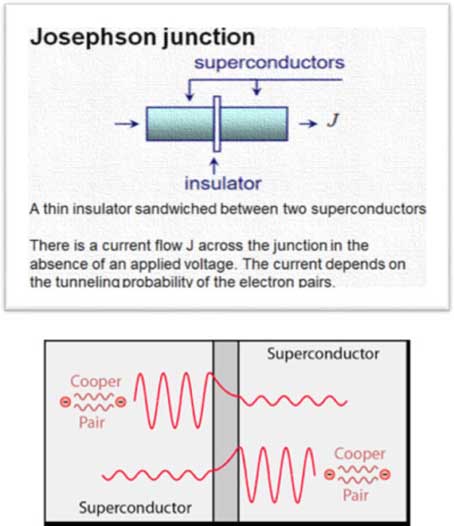
Physicist Brian D. Josephson first predicted the Josephson junction in 1962. The device consists of two superconducting electrodes separated by a thin insulating barrier, typically only a few nanometers thick. In such a structure, paired electrons known as Cooper pairs can tunnel through the barrier without resistance—a phenomenon called the Josephson Effect.
Two fundamental effects characterize Josephson junction operation:
1. DC Josephson Effect
When no voltage applied across the junction, a supercurrent can flow through the insulating barrier due to quantum tunneling. The current is determined by the phase difference between the superconducting wave functions on either side of the junction.
2. AC Josephson Effect
When a voltage is applied across the junction, the phase difference evolves in time, producing an alternating supercurrent whose frequency is directly proportional to the applied voltage. This relationship is extremely precise and forms the basis for quantum voltage standards.
These phenomena arise from the macroscopic quantum coherence of superconductors. In a superconducting state, electrons pair up and behave collectively as a single quantum wave function spanning the entire circuit.
Because of their phase-sensitive behavior and non-dissipative current flow, Josephson junctions are unique circuit elements that cannot be replicated using conventional semiconductor devices.
Nonlinear Quantum Circuits
In classical electronics, inductors and capacitors form linear oscillators. However, quantum computing requires systems with enharmonic energy levels, allowing the selective addressing of only two states to represent a qubit.
Josephson junctions provide this capability
The junction behaves like a nonlinear inductive element, known as Josephson inductance. When combined with circuit capacitance, it forms a nonlinear LC oscillator with discrete energy levels. The non-uniform spacing between these energy levels enables the two lowest states to act as the logical quantum states |0⟩ and |1⟩.
Without this nonlinearity, a simple harmonic oscillator would have evenly spaced energy levels, making it impossible to isolate only two states for quantum computation.
Thus, the Josephson junction is the essential element that allows superconducting circuits to function as controllable quantum systems.
Superconducting Qubit Architectures
Over the past two decades, several Josephson-junction-based qubit designs had been developed each architecture manipulates a different physical variable—charge, flux, or phase.
Charge Qubits (Cooper Pair Box)
One of the earliest superconducting qubit designs was the Cooper pair box, where the number of Cooper pairs on a small superconducting island determines the quantum state. The island is connected to a reservoir through a Josephson junction and controlled via gate voltage.
Although charge qubits demonstrated fundamental quantum behavior, they were highly sensitive to charge noise, which limited coherence times.
Flux Qubits
Flux qubits operate by controlling the direction of circulating current in a superconducting loop containing one or more Josephson junctions. The two current directions correspond to the qubit states.
Flux qubits offer strong coupling to magnetic fields and are suitable for studying quantum magnetism and analog quantum simulation.
Phase Qubits
Phase qubits rely on the quantum phase difference across a Josephson junction. Microwave pulses excite the circuit from its ground state to higher energy states, enabling quantum gate operations.
Although phase qubits were widely studied in early experiments, they have largely been replaced by improved designs with better coherence.
Transmon Qubits
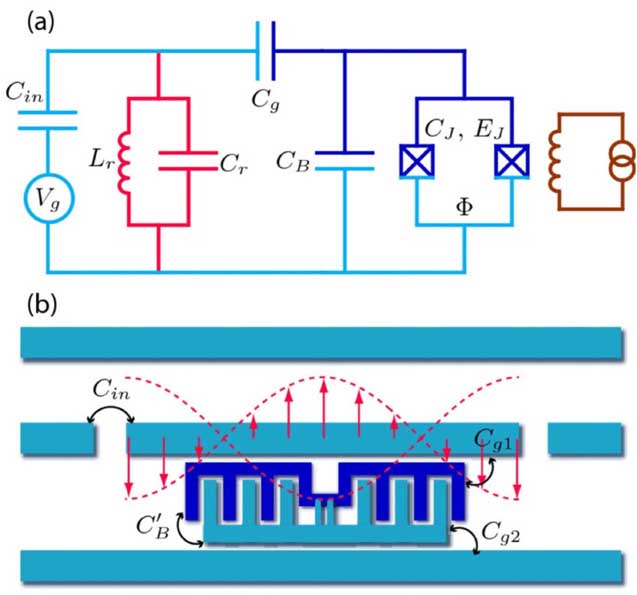
The transmon qubit is currently the most widely used superconducting qubit architecture. It modifies the charge qubit by adding a large shunt capacitor, which significantly reduces sensitivity to charge noise while preserving the necessary nonlinearity.
Transmon qubits typically achieve coherence times approximately ten to hundreds of microseconds and are widely used in commercial quantum processors.
Superconducting Quantum Circuits as Artificial Atoms
One of the most remarkable aspects of Josephson-junction-based circuits is that they behave like artificial atoms.
Unlike natural atoms, whose properties are fixed by nature, superconducting circuits can be engineered with specific parameters such as:
- Resonant frequency
- Coupling strength
- Anharmonicity
- Energy level spacing
These parameters are determined by circuit elements like capacitance and inductance, enabling designers to tailor quantum systems for specific tasks.
Microwave resonators are often integrated with these circuits to create circuit quantum electrodynamics (cQED) systems, where qubits interact with photons in superconducting cavities. This architecture allows high-fidelity qubit control, readout, and entanglement.
Superconducting Quantum Interference Devices (SQUIDs)
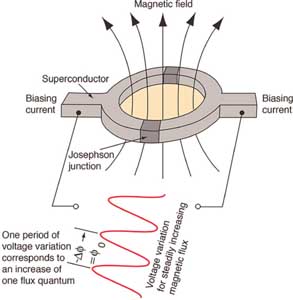
Another important application of Josephson junctions is the Superconducting Quantum Interference Device (SQUID).
A SQUID consists of a superconducting loop containing two Josephson junctions. The device is extremely sensitive to magnetic flux and can detect fields as small as a few femtotesla.
SQUIDs are widely used in:
- Biomagnetic sensing (e.g., MEG brain imaging)
- Geophysical surveys
- Precision magnetometry
- Quantum circuit readout
The device operates by exploiting quantum interference between currents flowing through the two junctions, which modulates the voltage response according to the applied magnetic flux.
Fabrication Technologies
Josephson junctions are typically fabricated using thin-film deposition and lithography techniques similar to those used in semiconductor manufacturing.
The most common material system is:
Aluminum–Aluminum Oxide–Aluminum (Al/AlOx/Al)
Key fabrication steps include:

1. Thin film deposition of superconducting layers
2. Oxidation to create a nanometer-scale insulating barrier
3. Electron-beam lithography to define junction geometry
4. Shadow evaporation or multilayer deposition techniques
Precise control of junction size and barrier thickness is critical because these parameters determine the critical current and Josephson energy.
Scaling up quantum processors requires manufacturing thousands or millions of identical junctions with minimal variation. Advanced fabrication studies have shown that junction resistance variation can be reduced to only a few percent across large wafers, enabling large-scale superconducting circuits.
Recent research is also exploring superconducting semiconductor materials, which could allow wafer-scale integration of millions of Josephson junctions using conventional chip fabrication techniques.
Cryogenic Operation
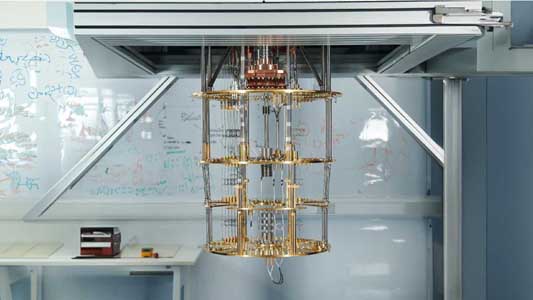
Superconducting quantum circuits must operate at extremely low temperatures—typically 10–20 millikelvin—to maintain superconductivity and minimize thermal noise.
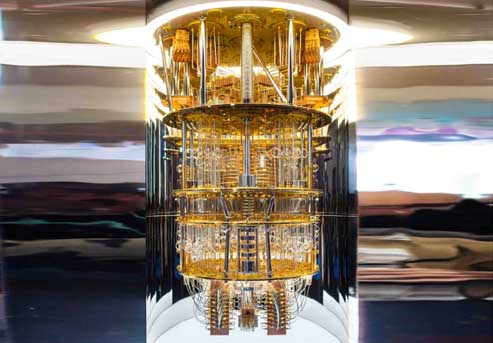
These temperatures are achieved using dilution refrigerators, which provide a cryogenic environment where quantum coherence can be preserved.
The cryogenic infrastructure also includes:
- Low-noise microwave electronics
- Cryogenic amplifiers
- Magnetic shielding
- Thermal filtering
Maintaining such ultra-low temperatures is one of the major engineering challenges in scaling quantum-computing systems.
Quantum Control and Readout
Superconducting qubits are controlled using microwave pulses delivered through on-chip transmission lines.
Typical quantum operations include:
- Single-qubit gates using resonant microwave pulses
- Two-qubit gates via tunable coupling or resonator-mediated interactions
- Qubit readout using dispersive measurement techniques in microwave cavities
High-fidelity gates exceeding 99% have been demonstrated in superconducting quantum processors, enabling the implementation of quantum error correction protocols.
These techniques form the basis for scalable quantum computing architectures.
Applications in Quantum Technologies
Josephson-junction-based superconducting circuits have applications beyond quantum computing.
Quantum Computing
Superconducting qubits are among the leading platforms for building large-scale quantum processors due to their compatibility with microfabrication and integration technologies.
Quantum Sensing
Devices such as SQUIDs and superconducting resonators provide ultra-sensitive detectors for magnetic fields, radiation, and single photons.
Quantum Metrology
The Josephson Effect establishes a precise relationship between voltage and frequency, enabling quantum voltage standards used in national metrology institutes.
Cryogenic Classical Computing
Josephson junctions are also used in Rapid Single Flux Quantum (RSFQ) digital logic circuits, which operate with extremely low power consumption and high switching speeds.
Challenges in Superconducting Quantum Systems
Architecture of a superconducting quantum processor showing transmon qubits coupled through microwave resonators and controlled via cryogenic microwave electronics.
Despite impressive progress, several technical challenges remain.
Decoherence
Quantum states are fragile and can be disrupted by environmental noise, leading to DE coherence. Sources of DE coherence include:
- Dielectric losses
- Magnetic flux noise
- Quasiparticle excitations
- Material defects
Improving materials and fabrication techniques is essential for extending qubit coherence times.
Scalability
Large-scale quantum computers may require millions of physical qubits to implement fault-tolerant quantum algorithms. Integrating such large numbers of superconducting circuits while maintaining coherence remains a major engineering challenge.
Cryogenic Complexity
Operating quantum processors at millikelvin temperatures requires sophisticated cryogenic systems and limits the integration of classical control electronics.
Research into cryogenic CMOS and photonic interconnects aims to reduce this bottleneck.
Conclusion
Josephson junctions and superconducting circuits have emerged as a cornerstone technology in modern quantum systems. By exploiting the macroscopic quantum coherence of superconductors and the nonlinear properties of Josephson junctions, engineers have created controllable quantum circuits capable of functioning as qubits, sensors, and precision measurement devices.
The ability to fabricate these devices using lithographic techniques compatible with semiconductor manufacturing has accelerated their adoption in quantum computing platforms. As fabrication methods improve and coherence times increase, superconducting quantum circuits are expected to play a central role in the development of scalable quantum processors.
While significant challenges remain—particularly in scalability, cryogenic infrastructure, and error correction—the rapid pace of research and innovation suggests that Josephson-junction-based quantum hardware will continue to advance toward practical, large-scale quantum systems.
For the electronics industry, this technology represents not only a new frontier in computing but also a bridge between classical microelectronics and the quantum era, where circuits no longer merely process information—they embody the quantum laws of nature themselves.